 "The celluloid strip is not made in the writer's studio"

to be continued...
http://johnkstuff.blogspot.com/2007/04/real-dialogue-versus-cartoon-writer.html

 "The celluloid strip is not made in the writer's studio"

 Posing and animation. These are the most obvious tools of a cartoon director. He tells much of the story through the drawings and animation. The director draws a lot of the key poses himself and then casts the scenes according to which animator he feels is best suited to a particular scene or sequence. He also gives the animator a good idea of what he wants.
 Variety: The animator in this scene varies the amount of exaggeration for each action. The run is less exaggerated than the take that happens just before it.
 Camera Pan: Foghorn runs in the opposite direction from where he was in the previous scene.
 The camera pans with him and pans in another location-the barn.
 Timing/pacing: The action pauses and changes pace. After a fast run (4x per step) Foghorn stops in front of a ladder long enough for the ladder to register with us. He looks around frantically.
 The inbetweens are extreme smears and Foghorn's poses are far apart as he looks left and right.


 Cartoon Effects: To reinforce the speed and frenetic escape, Foghorn's feathers trail of in the opposite direction of his climb. This movement in the opposite direction helps propel the action with more force. This is the kind of thing that used to come natural to even conservative directors an animators, but would probably seem radical today. "Too cartoony" would be the note you'd get from the bland police that rule animation.
 Cutting, changing P.O.V: This is a strange choice. For some reason, McKimson decided to give away the punch line. He reveals to us that the dog is waiting for Foghorn with a watermelon. This seems to defy normal gag construction but I never really thought about it until I broke the sequence down to look at it. It's only on for 30 x and within the sequence somehow fits the rhythm. Rhythm is a lot more important to the emotional effect of a film sequence than strict narative logic. You can't write rhythm in words or even on a storyboard. It's the director's job.
 Camera angle mixed with frenetic animation: This dramatic angle combined with the way the animation flows just fits together perfectly. It is more dramatic than the straight N/S E/W angles before it and makes the sequence of cuts build steadily to a climax.
 Pacing/contrast: Stop action, slow pace, conclude with calm dialogue.
 After the fast paced series of scenes and Foghorn is defeated, McKimson eases us out of the scene with a line of dialogue. "Some days it don't pay to get out of bed." The line isn't funny on its own. It's just there to give us a breather and let us laugh at the end of the sequence.
 This is one of my all-time favorite cartoons. It has almost every good trait you associate with Chuck Jones:


 You don't hear much about Chuck's layout man Robert Gribbroek and I don't know why. I think he's brilliant. He not only has a modernistic style, but his drawings are solid and perfectly composed. Stylish, yet not in your face.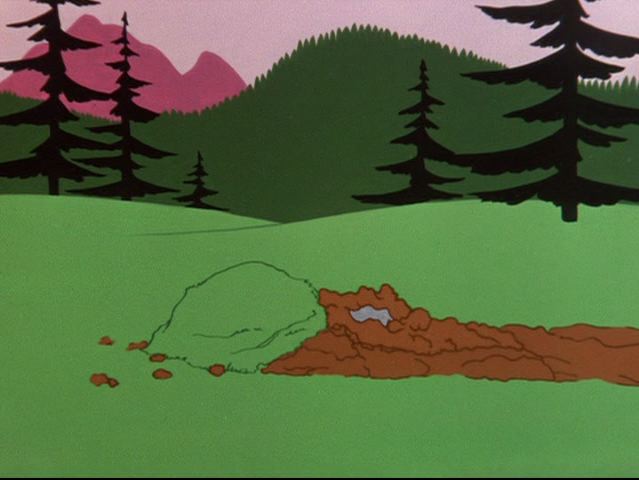
 Bugs is actually active in this cartoon. He doesn't merely ride the direction to an automatic win. Chuck sets him up here and shows he's vulnerable, not completely magic.
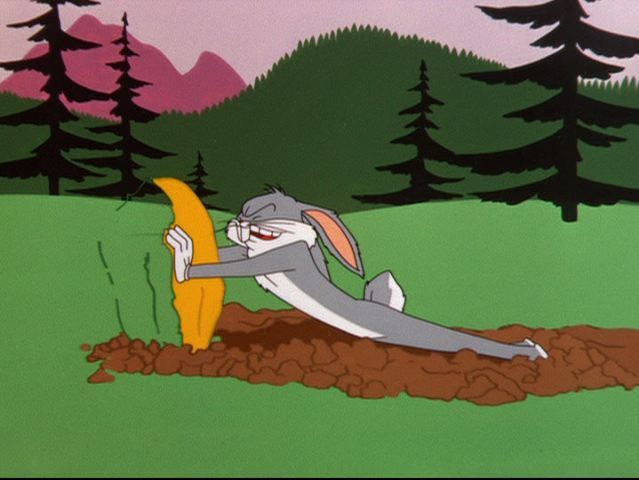
 Here's one of Chuck's patented joined-eye takes.


 This story is very carefully set-up. Like Tex Avery, Jones spends a couple minutes preparing you for what the cartoon is going to be about. He does it in an entertaining way too, not with verbal exposition, but with characterization and suspense.
 Structurally this story is very much like a Tex Avery cartoon. Where it differs is in the types of gags that come after the carefully prepared setup. In an Avery cartoon, once you know what the cartoon is about, the gags are mostly physical and they get bigger, crazier and more preposterous throughout the cartoon. The characters in turn react to the crazy gags. In Barbary Coast Bunny, after the setup, the gags come from 2 main sources - the personalities of the characters, and the ridiculous events that follow Bugs' natural luck. The gags aren't as physically extreme as in a Tex cartoon, but they are ridiculous in very clever ways.
 I love Nasty Canasta's lips. Chuck really put his animators to the test with this design. It's fun to watch all the funny ways they made Nasty's mouth animate during dialogue.
 Nice suspense here.
 Goddamn is that a beautiful drawing! I've heard critics and historians poo-poo the "Preston Blair" constructed drawing approach of 40s cartoons, but without it you wouldn't be able to make such a great specific and stylish drawing like this. All the general principles are here, but they are wrapped around very specific forms and then candy-coated with varied curves and angles.
 The cartoon has a lot of typical Jones pose to pose scenes where just the head moves around slightly to keep the chaacter alive, but there are some scenes where the animation is really clever and adds to the gags. I'll make clips of those.
 Don't be fooled by all the lumps and wrinkles in Nasty's design. They are all small and tightly wrapped around his line of action and his major forms.
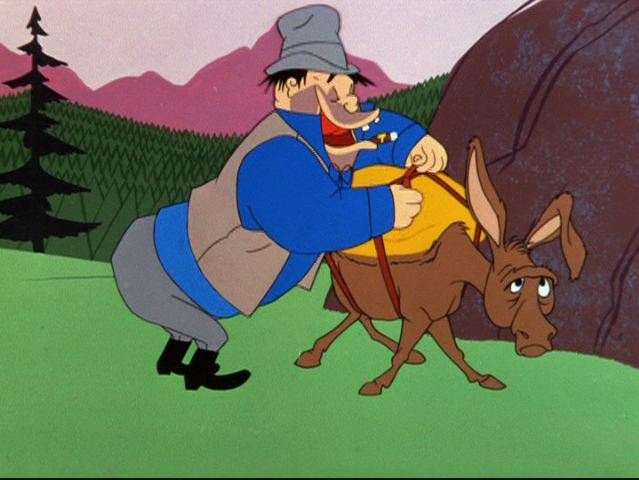 The details also react to gravity. They don't just stick out evenly in all directions.


 Personally, you can have your Toot Whistle Plunk and Booms and your Pigs is Pigs and Gerald McBoing Boings. This cartoon has tons of style and cleverness, yet it's all subject to the total entertainment of the film and it cares about the audience.


 Of course you know, every Jones Bugs Bunny cartoon has to motivate him to revenge.
 Starring Gerald McBoing Boing.
"Magoo's Caine Mutiny" [MR. MAGOO] 3/8/56
"Magoo Goes West" [MR. MAGOO] 4/19/56
"Calling Dr. Magoo" [MR. MAGOO] 5/24/56
"The Jaywalker" 5/31/56
"Magoo Beats the Heat" [MR. MAGOO] 6/21/56
"Magoo's Puddle Jumper" [MR. MAGOO] 7/26/56
"Trailblazer Magoo" [MR. MAGOO] 9/13/56
"Magoo's Problem Child" [MR. MAGOO] 10/18/56
"Meet Mother Magoo" [MR. MAGOO] 12/27/56


