
Showing posts with label rubber hose. Show all posts

Friday, December 07, 2007

Don't Take Betty's Boop

Here's another great Betty Boop cartoon from 1932.
Again, I don't know who the animator is, so if you do please tell us!
This was made before the Hays Office clamped down on Hollywood and cartoons were still allowed to be randy.
It was a cartoon staple in the early 30s to have a near-rape at the end of each cartoon. In most cartoons, the hero would show up and save the girl from the big bad man, but sometimes in the Betty Boops, it would actually happen and she would then like him after! Amazing times.

http://www.cartoonthrills.org/blog/boopoopdooop/rublegsmall.mov

I really love the way this animator draws and moves Betty.
Look how cute her little feet are and how voluptuous her legs are.

The movement is very careful and completely un Disney. Disney in the 30s developed a style of motion that in effect hid the motion. They animated in a very rubbery style that squashed and stretched so much that the actions usually shot past the poses. It looks great, but it avoids showing you the action. You can't see how you are getting from one pose to the next without freeze framing it. This is what most feature animation does today. There is a place for it, but I think there is also a place for this kind of beautiful fluid action that you can appreciate without having to slow down the action.


Gorgeous drawings!
I love the arms and hands. Her hands are like horsehoe crabs. Don't you want your stubbly face to be softly stroked by primitive crustaceans?


http://www.cartoonthrills.org/blog/boopoopdooop/donttakesmall.mov


In this next scene, all of a sudden her anatomy turns into Jack Kirby's style. Is it a different animator? Or is the same animator just experimenting as he goes? Trying things spontaneously as he thinks of them.
It's really cool that the anatomy keeps breaking down into rubber hose in between certain actions.

From rubbery to solid flesh.
She runs out in total rubber hose action. Was this on purpose, or is it the animator giving more work to the assistant to finish?

Either way, it's a great idea to animate back and forth between different approaches. It keeps things surprising and alive.


http://www.cartoonthrills.org/blog/boopoopdooop/sing2small.mov


Someday I should do a post about the differences in taste of ass appreciation between Disney and the other studios.


I just love this style of animation. Weird, sexy, cartoony, silly, innocent and dirty all at the same time.

This is an art form all its own that can't be matched by any other.

Wednesday, August 15, 2007

Grim Natwick - Drawings and Ideas are part of what animation is


Marc Deckter put up a really good post about Grim Natwick.

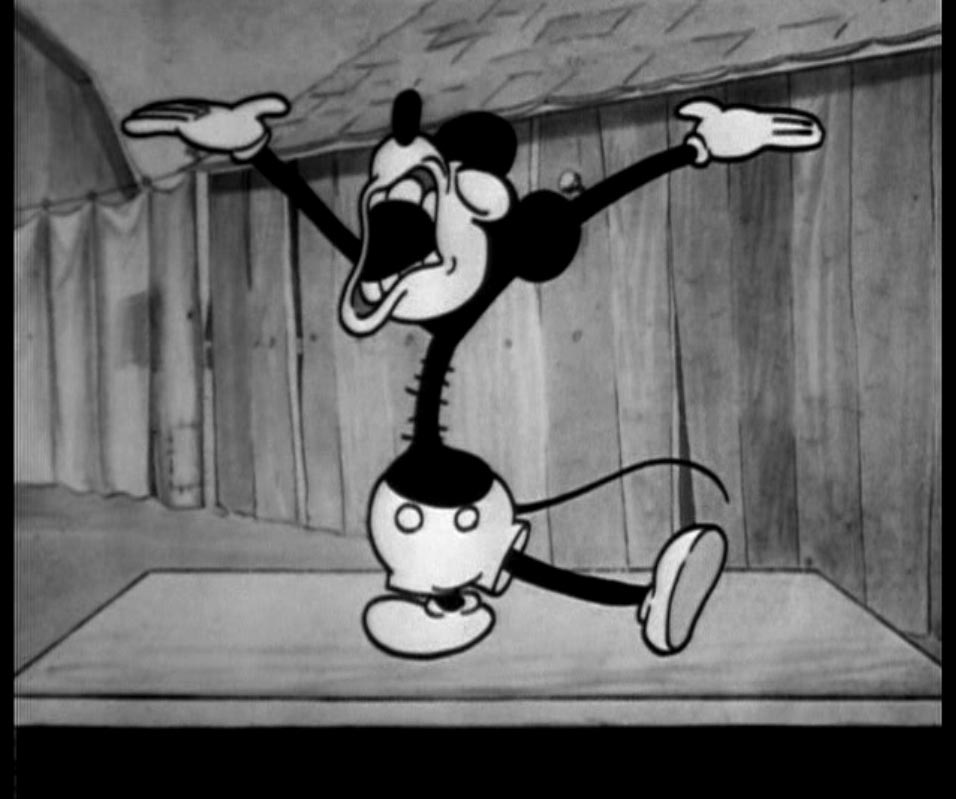
DUCK WALK: GRIM NATWICK'S DANCING WAITER

This is animation from 1930-before there were any "rules" about how to animate. They didn't know much about squash and stretch, overlapping action, maintaining volumes, smeared inbetweens, cushions, secondary actions, etc...It isn't super smooth like Disney became a few years later.

But it has something that much "polished" animation that uses all the principles sometimes neglects.

Imagination

Fun

Drawings and motions that are fun and funny.

In the early days, animators thought in terms of entertainment first. How funny can I make my walks and dances and dialogue?

Grim did his best stuff before he was swayed by the mass hypnosis that Disney cast over the whole industry in the late 30s.

Once animation got "smoother" and had weight and all these other abstract properties, many animators started losing track of what cartoons were all about in the first place.

I personally believe in knowing all the fundamental principles of animation, but I don't think that is enough to make entertainment.

Smooth movement isn't entertaining by itself. It's impressive, but not as impressive to me as fun drawings and actions and ideas moving. The principles of animation should be in service of the drawings and entertainment, it shouldn't be an end in itself.


Here is a clip from Cats Don't Dance. The movement is great for sure, but what is being animated is just standard drawings that we've seen a million times before.

It's a polished version of Tiny Toons designs and poses with some Don Bluth thrown in.


Don't get me wrong, I think these animators are hugely talented and would love to be able to work with a great crew like this and have a similar budget to make a fully animated movie.

I just lament that the business uses such strong talent to do the same stuff over and over again. -and to make each animator basically design, draw and move things the same way.


Here's Betty and Bimbo in an unprincipled highly imaginative and entertaining cartoon:


Thursday, August 09, 2007

Bounce Cycles By Commenters

Well, a few people who visit this blog are really smart!

They are actually copying classic cartoons because they want to learn the best way to animate.

If they keep at it, they will surpass many folks who just kind of wing it and try to teach themselves.

***BTW, count your drawings. There should be 24 drawings in the whole cycle, and each one shot for 1 frame-at 24 frames per second...

Here they are:


Treasure


Groo

http://www.youtube.com/watch?v=woFiSFeTzLY


Mad Taylor

http://madsbasement.blogspot.com/


Anne-Arky

I think Anne just made one up...


Chet

OK, Chet. I watched it. It's good but you shot it on "2's". You need to shoot it on "1's". Just one frame for each drawing. Then it will move faster-it should be 2 beats per second. 12 drawings per beat....makes sense?

Bosco Swing by ~Thunderrobot on deviantART


Guilherme

http://2dflashart.blogspot.com/2007/08/john-k-bosko-exercises.html

I can't get Guilherme's to play either, but maybe you can

Matt Greenwood

http://mgreenwood.blogspot.com/2007/08/bosko-animation-study.html


Matt's action is good, but the volumes keep changing.

Kate Yarberry

http://myspacetv.com/index.cfm?fuseaction=vids.individual&videoid=15097788


Now if all these dedicated folks keep studying the old stuff, they might get to the point where they can animate as well as this:


Milt Gross (thanks to William) - note how everything moves o musical beats!

http://www.dailymotion.com/video/xl28k_jitterbug-follies-1939-milt-gross


So where are the rest of you wanna-be animators?

Sunday, August 05, 2007

Animation Course Level 1, Lesson 1 - The Beat - Kali Does Bosko


Did you ever wonder how animators got this good in such a short time? This is 1942. only a few years later than rubber hose animation. Who wouldn't love to be able to do this?

Coal Black, Bicycle


Great animators started simple
40s animators were so great because they learned to animate like this below. They started with really simple character designs and animated to musical beats.
Bosko Dance

Early sound cartoons moved to musical beats. Here Bosko is bouncing up and down on a 12X beat.

Every 12 x, he squashes down. The lowest position - with his knees bent- happening on the beats. That means he bounces twice every second. A second is 24 film frames.
This is a 24x cycle. He is waving his arms left and right. Each wave is 12x to go with the beat.


I'm convinced that the quickest way to learn the basics of animation is to start by animating fundamental animation techniques using rubber hose designs. I mean Hell, it worked for all the greatest animators in our history. It could work for you too and you the advantage because you have their stuff to study. They didn't have any reference. They were making it up from scratch through trial and error.

But they were very logical and methodical about it too.

1) Animate Simple Characters - why?

If you are teaching yourself to animate and you start with hard to draw characters, you are obviously going to slow your learning curve.

The more details your characters have the longer it takes to draw them, and the harder it is to control the details in motion.

Tall characters with long legs are much harder to animate than short characters with small proportions.

You want to learn basic motion when you are starting out, so keep your characters very simple (and rounded) and you will learn much faster and better.

2) Animate to beats

Animating to a regular beat teaches you:

Rhythmic timing: it feels better- imagine a song with no beat, it wouldn't be much fun. It would meander.

General timing - you get used to what different amounts of frames feel like - what 12x feels like as opposed to 8x.

Classic animators and directors were like drummers. They automatically thought of their scenes as rhythms and that helped make their timing so crisp.

Kali's First Bosko StudyIf you wanna learn animation fundamentals, you can copy these animated cycles and shoot them, like Kali is doing.
As you copy them, analyze what you are doing, so that you can apply general techniques to other scenes. Count how many frames it takes to do each action.
Note the wave action that the arms are doing. This concept can be used in infinite variety.
Note in these bounces, that there are less drawings going down into the accent, and more coming up. That is what gives the beats a noticeable accent. If the timing was even, it would just seem to float up and down. It would be mushy.


Kali animating:


Compare the Bosko animation to the McKimson animation from Coal Black. The fundamentals are the same.This is animated on an 8x beat-the music is faster than the Bosko scene. The accents are stronger too.
Every second beat is accented stronger. 8,8,8,8 etc.
Her right foot moves down faster than her left foot (the one closest to us). That foot moves at a more evenly spaced timing as it circles the pedals.

This scene is way more layered than the Bosko animation, but it's based on the exact same concepts. Learn your fundamentals and soon you will be able to apply them to more complex scenes.

RUBBER HOSE TAUGHT THE BEST FUNDAMENTALS:

Learn to animate to beats using simple cycles and simple circular characters. This is a good first step towards understanding motion and rhythms.

Scenes like this are the foundations of the American style of animation. Snow White, Bugs Bunny, Popeye, Gerald McBoingBoing... all these different styles are built upon the same foundations.

There are 3 cycles in the Bosko clip we put up. Copy them all and stick with this free course and you will see yourself advance past your more stubborn peers in no time.

If you post your tests on your sites, I'll link to them in another post.

Once I have 20 people who have copied this Bosko animation, I will post lesson 2. Rubber Hose Walks.

What basic concepts you learned from this lesson:

Beats

Bouncing

Accents

Wave actions

Cycles

Thursday, July 19, 2007

Individuality VS Standardization

There used to be more than 3 cartoon styles.


Here's where ours started...


When we say "design" in cartoons, nowadays we automatically think of the 50s - or maybe some people think Disney.

I'd like to challenge both those notions . I think the Golden Age of Cartoon design didn't happen in animation. Certainly not in the fifties.

It happened in comic strips somewhere around the 20s and 30s.

Why do I think that?

Because:

1) There was a huge variety of styles.

An age of design would mean lots of designs, not a single school of design.

2) There was more individuality in the styles- certain artists were masters of their own styles.

They didn't belong to a school of style like "The UPA style" or "The Cal Arts Style".

It was expected of popular cartoonists to each have their own unique takes on the world.

Of course, the most successful cartoonists had their imitators, but who remembers them?

Originality was expected in comic strips.

3) Comics reflected humanity.

Comics were about things humans think about and do or dream of. All sorts of humans. Animation characters and stories act and play like, not human feelings, but artificial animation feelings. We animators get our view of life from previous animated cartoons instead of from the world.


Polly and Her Pals, for instance is absolutely great design, but it's still about humans that act and feel like humans we ourselves consort with.

ANIMATION IS A HOUSE STYLE
- all derived from one original style

Otto Messmer is probably the founder of "animation style". Everything being done even today can be traced back to him.
His design sense was partially aesthetic and partially motivated by practicality. He was a cartoonist who became an animator and then later became a strip cartoonist.

His designs are simple on purpose. Animation takes longer to produce than comics - for the simple reason that you have to do many more drawings in order to make things move.

But simple doesn't have to mean even or bland. It just means fewer details and easy-to-move proportions.

Messmer's drawing method is simple but the result is stylish and full of quirks. A variety of curves against straights, lots of uneven twists and turns. No simple math.

In the 20s and 30s, cartoonists were learning to animate by trial and error, so it made perfect sense to use characters that you could draw fast. This logic produced the fastest evolution in animation history.

From Steamboat Willie to Snow White in 9 years. Amazing, right?

But it came with a price....

THE LOSS OF INDIVIDUALITY and HUMANITY

Conformity and model sheets

Someone in the 30s decided that it would be a good idea to have every artist draw the characters the exact same way in the cartoon. This produced an averaging of the artists' styles and the "Rubber Hose style" came into being - a generalized version of Otto Messmer. (And Bill Nolan probably)

Otto's crowds have more varied characters than Disney.
The rubber hose style evolved slightly into the pear and sphere style in the late 30s and this was a bit more sophisticated but still based on the principles of "animation drawing" and still generic. The motion got smoother and more layered but this nagging idea of conformity held back individual creativity.

It didn't have to be that way and it didn't start out that way. At the New York studios in the early 30s, the animators pretty much drew each scene the way they felt it. The overall style was "rubber hose"- Messmer inspired but you could really tell the difference between different animators scene by scene.

Grim Natwick had a unique style that looked a lot more like comic illustration than animated cartoons and when it moves it really stands out as something special.

It's also very human. It's not a mere imitation of someone else's abstract principles. He's drawing life as he sees it and then creating impossibilities using the magic part of animation.

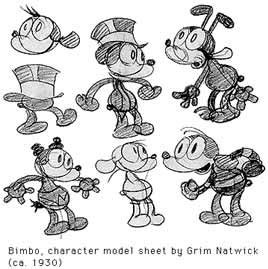
This Bimbo model sheets shows a bit of conformity to Disney starting to take effect.

Here is Disney's take on Otto Messmer's style. All the edges have been smoothed out. Every shape is mathematical and even now. Every character is the same design. Circles and ovals. Only one kind of bend and curve. Expressions are dead and mechanical.

Compare to the source.All the other animation studios stopped being human and started to imitate Disney. Part of what they imitated was this conformity and evenness and averaging of each individual's style into one all encompassing "animation style".

This style as a whole has gone through some changes-from rubber hose to Preston Blair to UPA but the changes were slow and changes that happened as a group to the whole animation community-even against the wills of many studios and artists.


This small animation group later lost the idea of quality and good principles and degenerated into some sub groups -

Saturday Morning Cartoons,

Disney Imitators (Cal-Arts) and

Anime.


BAD THINKING HABITS OF THE ANIMATION WORLD

From the 30s on we have been stuck with the corrupt and creatively crippling ideas of


"On-Model"

"Animation Style"

'Only Disney Style Is Quality"

"Animation should be believable" (meaning bland, without magic)

10 years of combining good animation with individuality

There was a second flowering of creativity in animation when Bob Clampett and Tex Avery reintroduced the notion of individuality in not only their stories and direction, but in the animation itself. They took the good things that evolved in 30s animation and put back the humanity that was being lost.

Clampett encouraged his artists each to draw in their own way and bring their own creative ideas to the design, personality and movement of the cartoons. Avery started doing that in the mid 40s and for a decade or so we had some very individualistic cartoons that didn't follow the "rules" and "style" of animated cartoons.

Collaborative or Herd?

Unlike the constant variety of individual styles in old time comic strips, in general throughout animation history, animation has made its small changes step by step as a group.

A mass of animators no longer influenced by other artists or by the outside world, but only by slightly varied versions of itself.

Pixar imitates Bluth and Burton, who imitate 60s Disney, who imitated 50s Disney who imitated 40s Disney and all the way back to Otto Messmer.

Dreamworks imitates Dic who imitated Filmation who imitated Hanna Barbera who imitated Disney and Warner Bros who imitated Otto Messmer, who probably himself had a wide variety of influences when he he started out.

Anime is extremely inbred.

Modern anime imitates Osamu Tezuka who imitated Disney who imitated Otto Messmer.


ANIMATORS THINK DIFFERENTLY THAN CARTOONISTS

Animation has always had a huge philosophical difference than comic strips. At least comic strips before 1960 or so. Comics didn't have a preconceived house-style. Every artist developed his own style out of being influenced by an assortment of other artists and by life.

We need this in animation. It's always been our blind spot. We are so used to animation-thought that we get angry when our dogma is challenged.

Animation brings a whole new level of creative possibilities with it, but we have to shed our terribly stifling habit of imitating decadent versions of ourselves.

We should collaborate rather than move like herds.

Put all our styles together (those of us that have them) and add them up for a greater total experience instead of shaving off all our unique human quirks to become an average multitude of sameness.

A SUM OF GOOD IDEAS IS BETTER THAN AN AVERAGE OF THEM.

We need an end to model sheet slavery, to animation schools that encourage decadence and to by-rote habits of thought.

Let's share good drawing principles but hang on to our own individual details and takes on life. And look around us.


Here's a time period when cartoonists did just that. What skill and variety it produced!

Wednesday, July 18, 2007

Otto Messmer Cartoon Genius

There were some animators before Otto Messmer, but I can't think of one person who had more influence on the rest of animation history.

Messmer is the founding father of the American style of animation - which in turn influenced the rest of the world.

He created the basic shapes and spongy substance that animated cartoon characters are made of.

Cartoon characters to this day don't have skeletons stuffed with guts and stringy muscles hanging off them. They are instead, made of tight skin wrapped around shell like membranes filled with soft sponge.

I'm willing to bet Messmer also created and developed much of our cartoon film language.

The Disney animators spent years trying to excise the abstract physics and cartoon logic that Messmer innovated, but they hung on to the sponginess and construction ideas even as they tried to make their cartoons more "realistic".

Snow White is not made from observation of a real girl. It's an evolved design made up of Messmer type animation shapes and forms -with all the quirks and fun taken out. Taking out the fun and the style is what many animators call "realism".

Messmer's style is the ultimate in simple and pure appealing cartooniness.
Look how much more stylish this is than the general rubber hose style of cartoons that imitated him.

Steve has put up a bunch of pages of Messmer's classic 30s Felix comic strip.

COMICS: OTTO MESSMER'S FELIX THE CAT 1932

Take a look at some other great strips from early days of our history.

DIGITAL FUNNIES


Buy a compilation of the Felix strips:


For more history, John Canemaker wrote a gripping book detailing the turgid story of Felix, Messmer, Sullivan and the rest:


Sunday, January 21, 2007

I Found Old Cartoons To Buy! The Farmer Alfalfa Show! Jim Tyre! Carlo Vinci! B and W Eros!


Holy crap! I found a great site where you can get tons of old cartoons that they don't run on TV anymore!

WORLD'S BEST COMICS!

http://wbcomicshop.com/shop/searchBase.asp?stS=&selectcategory=234

It's almost impossible to find B&W cartoons anywhere. They don't run them on TV because the execs tell me that kids don't like B&W. I know this to be a lie, because I have little cousins and whenever I visit them I bring armloads of old cartoons-Betty Boop, Popeye, Terrytoons and stuff, and the kids sit in front of the TV in awe! They laugh, rock back and forth cluthing their little toes and then after the cartoons are finished they act them all out then watch them all again! And again and again!

There was a kind of humor in the old cartoons that you can't find in modern cartoons and even in the great 1940s color cartoons.

Terrytoons from the 1930s have these lost styles of animation that later disappeared as animation techniques became more standardized and influenced by Disney.

Carlo Vinci was way ahead of his time. In the late 20s he had already figured out squash and stretch, he could animate dancing, he animated really sensual little furries. Each animator was figuring out how animation works in his own way. There were no rules and the gags are cartoony and crazy.

Farmer Alfalfa cartoons are completely wacky and unpredictable and a lot of pure cartoony fun.

50s TV Cartoons Had Cool Packaging!
Hey, in the 50s TV was a lot smarter than today. They had a great idea for showing old cartoons.
I remember when I was a consultant for the Cartoon Network, a few years ago, they used to have these 3 hour blocks where they would throw together unrelated old cartoons from different eras and studios and give the block a retarded name like "Down Wit' Droopy D". This was a dead giveaway that these were "old" or "used" cartoons. Kids would know this and the feel cheated, because kids think that new means better.

In the 50s, they would take old cartoons and make half hour shows out of them. They would animate a new fun title sequence and write a rousing theme song-like the Bugs Bunny Show's "This Is It". Then in between the classic cartoons, they would get real animators to animate "bumper" scenes of the characters talking to the audience which made the kids think the characters were real. It made the cartoons feel special and new. This was the inspiration for the bumpers in the Ren and Stimpy Show.

The studios that now own all these old cartoons tore off all these great title sequences and threw out the bumpers, so most of these shows are lost.

THE FARMER ALFALFA SHOW!

Here is a great discovery. The Farmer Alfalfa Show from the 1950s.

The shows are intact as actually aired on TV 50 years ago! With:

Rare classic Terrytoons-even black and white ones!

New Titles animated in the 1950s by Carlo Vinci and the old Terrytoons animators- but -here's the really cool part- animated in the 1930s style! So...it's like they had to remember how they animated 25 years earlier-so it has a bit of 50s UPA influenced style (what they were doing at the time), mixed with the typical Terrytoons style - mixed with the rubber hose style! It's a really funny combination!

Jim Tyer Bumpers!
Between the cartoons are these weird non sequitor bumpers animated by the craziest animator of all time!

The Original Commercials!
As in all old TV shows the programs were directly sponsored, and the characters from the cartoons in Farmer Alfafa do these long elaborate commercials for Tootsie Rolls. Animated by the real Terrytoons animators! So cool
I just ordered a whole bunch of the Farmer Alfalfa Show
http://wbcomicshop.com/shop/searchBase.asp?stS=alfalfa&selectcategory=0&1=Go&kfg=fromsearch
Now I'm gonna dig through the rest of the cartoons at World's Best Comics and dig for more animated treasure...

Thursday, April 27, 2006

Rubber Hose c - Fleischer VS Disney


These cartoons were made within a year of each other.
One of them is more fun, crazy and imaginative.


http://www.animationarchive.org/2005/11/filmography-swing-you-sinners.html
you decide!


Hey! If you wanna hear all about the early days of cartoons from Friz Freleng, and Hanna and Barbera, go to this interview I did with them in 1992. You won't believe what these guys have to say about everything past and present! If you think I'm crabby...


http://www.animationarchive.org/2006/04/biography-john-k-interviews-bill-joe.html#comments

Steve Worth
has done an amazing job of illustrating and editing the interviews. If you love classic cartoons, you don't wanna miss this!
PLEASE! Everybody post a comment and let Steve know what a great job he's doing with the animation archive. There's already more info there than in all the animation books ever written-and he's only got started!


Wednesday, April 26, 2006

2 Types of cartoonists-Origin of styles 2 -Rubber Hose animation part B


SPECIFIC VERSUS GENERIC RUBBER HOSE CARTOONS

A very specific rubber hose character created by Grim Natwick-the best of the era.

I used to not like rubber hose cartoons because I thought they were primitive, and in some technical senses they are, compared to what the same animators did in the 1940s.

They didn't have color, lines of action, construction, everyone tended to move the same, not much characterization...etc.

This was true for most of the studios in the early 30s, but one studio more than made up for all these early limitations-The Fleischers'.
<