Showing posts with label story. Show all posts

Monday, July 28, 2008

some storyboard and layout images from our commercials

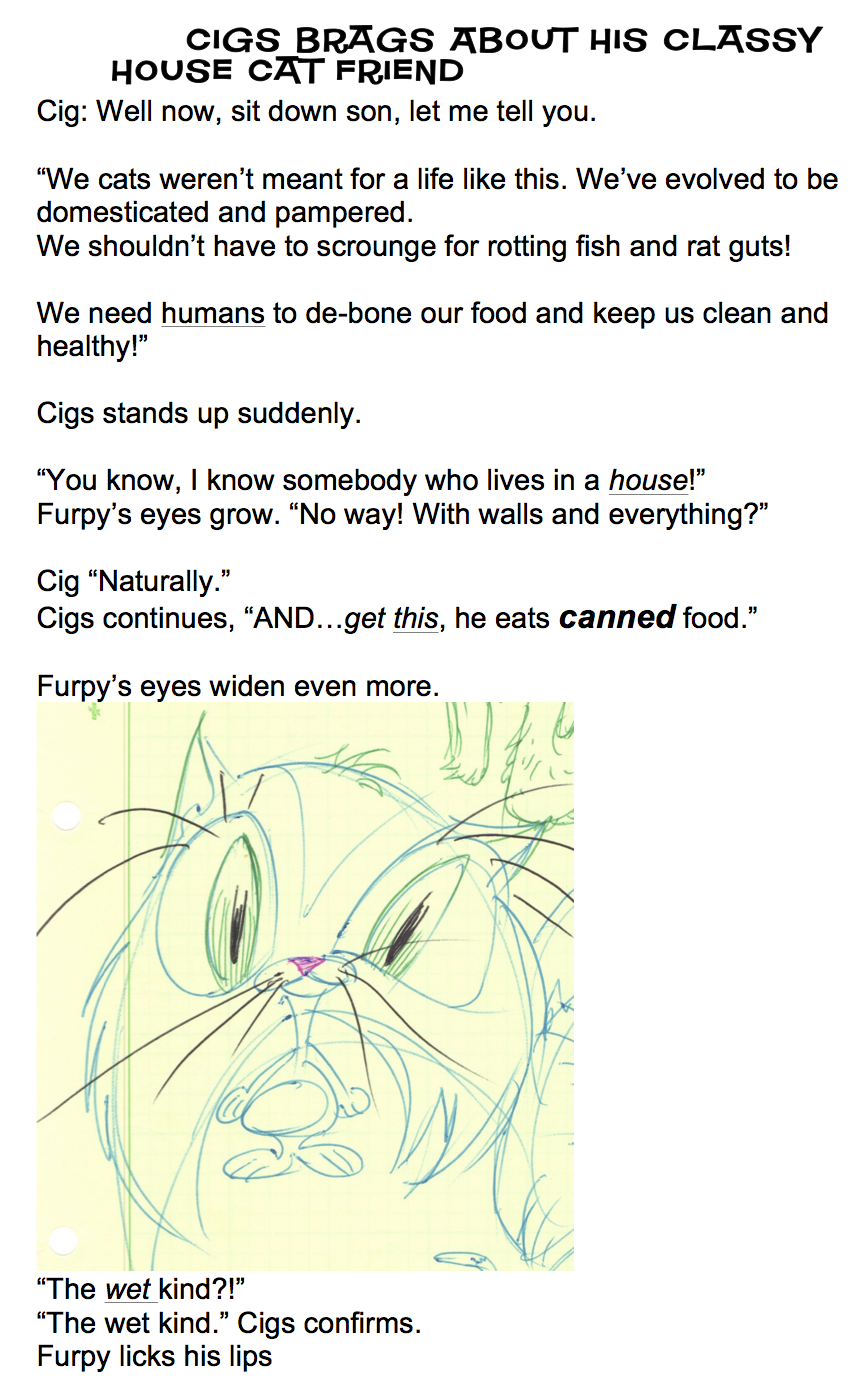
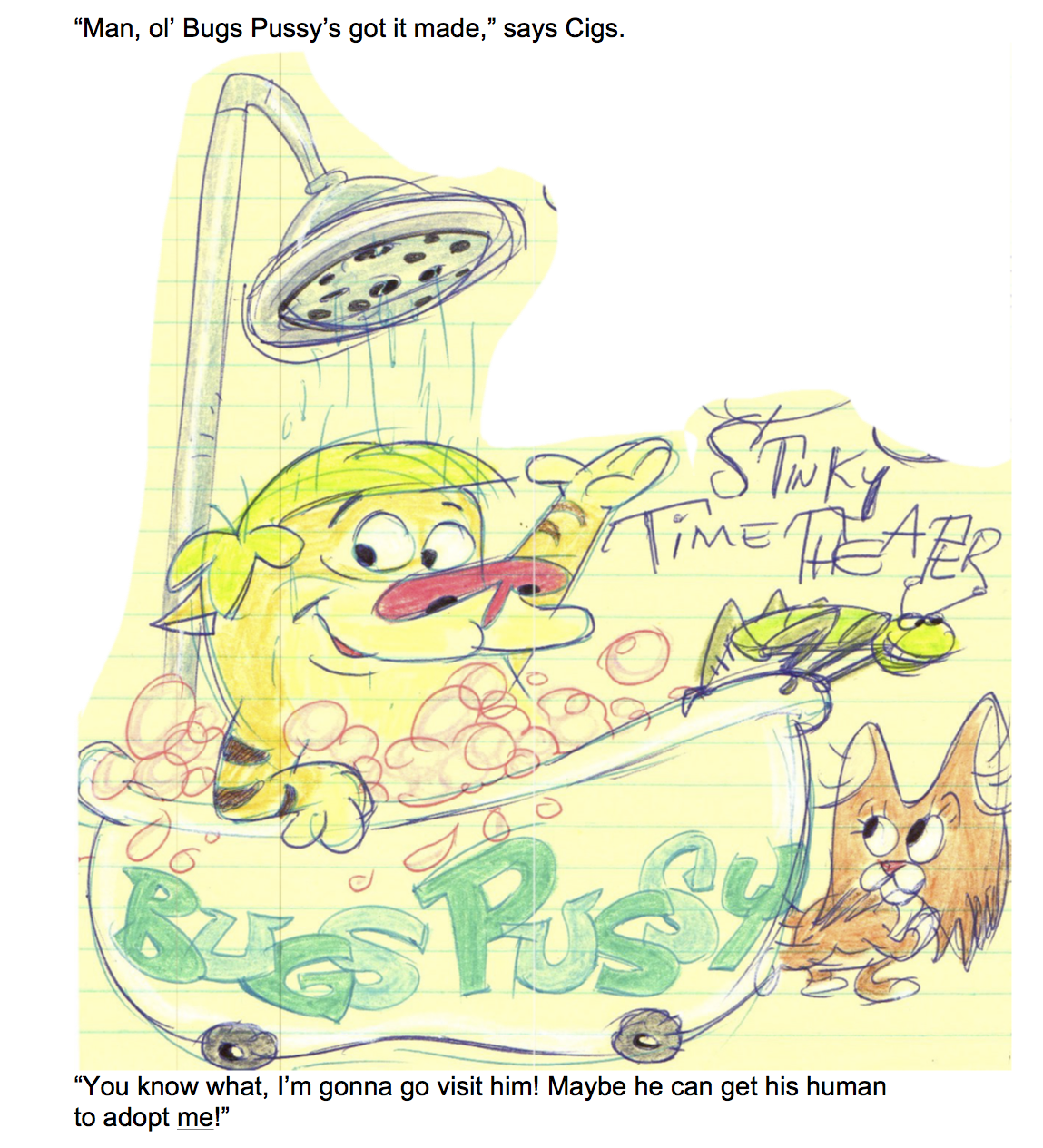
You can see how rough our boards are. Their purpose is mainly to tell the story, not be finished cleaned up layouts.
I draw my boards at EAT on Magnolia during breakfast, while I don't have to think about anything else and no one bothers me. I scribble them out as fast as I can, just trying to get the gags, continuity and story to flow.I use crappy cheap lined writing pads and BIC medium ballpoint pens, so I don't worry about wasting good paper. I want to draw fast, not worry about construction too much and not worry about clean lines at all.

This below is a pencil storyboard sketch on fancy paper and is less lively than my crappier scribbly ball point pen sketches on wood pulp.


Here's a couple of Jim's setup idea sketches...
Jim has his own theories and techniques and they make his style unique and fun.
More of my continuity scribbles...(not in continuity though)


If you don't have to draw perfectly clean and on-model while you do storyboards, then you can access the part of your brain that thinks about STORY, rather than clean up.

A lot of studios today have a department that's called "storyboard" but they don't use storyboards in the same way that they were originally intended. They use them instead as mini-layouts, that are supposed to be blown up larger and used as keys for the Asian animators.

"Storyboarders" don't usually get to do story anymore which is a shame and an irony. Writing with pictures is a blast and brings so much more to your stories, than merely trying to describe everything with words.

It's also hard to draw good detailed layout drawings small, so the end result of storyboarding from scripts, is both bad storytelling and bad layouts. The poor storyboarders don't get to have much fun in this system. I'm sure somewhere there are a couple exceptions.

A lot of lucky accidents happen while doing rough storyboards, and the trick is to preserve them in the layouts. When taking the idea sketches and blowing them up to animation size, tightening them up and flipping them from pose to pose, there is a great tendency to tone everything down and lose the humor and spontaneity.

In fact, every step of the animation process has a dangerous tendency to lose some of the life of the previous step. I have been working on a science to combat that for my whole 30 years in the business.

Finding good layout people who can draw with life is a blessing from above!


A side note:

Many times in a cartoon, I have tried to get funny layout drawings inspired by the storyboard to flip right and lost the humor in the process. In those cases, I would just use the funny poses, even if they didn't animate right. Lucky for me and the rest of the industry, Bob Jaques and Kelly Armstrong developed techniques to smooth the connection between 2 not very well connected poses. This technique (in simplified form) amazingly has become the standard for most Flash animation today. Carbunkle's animation used a wide assortment of techniques and they customized many scenes, but a couple of their tricks (without the custom tailored thought) became the standard style for whole studios down to today.

That's why you see so much "snapping" from pose to pose today, where you antic and go past the next pose and settle back into it. (You are in effect, avoiding the inbetweens) It's one good technique that's useful in some cases, but it gives me a headache when I see whole features use it to connect every single pose. No variety in timing or emotion. Every emotion using the same timing trick - or handful of tricks.

If you watch an old 40s Warner Bros. cartoon, you will find all kinds of custom timing and posing that is designed to fit the story and emotions. They didn't use a handful of tricks. They really thought about every scene and its context. Of course we can't afford to do that with today's TV and internet budgets, but they could easily afford it in today's animated features, if people in charge had the will to do it.

Wednesday, April 30, 2008

Lloyd Turner Interview - Storyboard Artist/Writer at Looney Tunes

http://www.michaelbarrier.com/Interviews/Turner/interview_lloyd_turner.htm

If you were interested in yesterday's post about how stories are written at cartoon studios, there is a really fun behind-the-scenes- interview with one of the storyboard artists/writers at WB in the 1940s at Mike Barrier's site.
http://klangley.blogspot.com/2008/03/art-davis-bye-bye-bluebeard.html

Lloyd Turner was in Art Davis' crew and later worked for Bob Clampett on Time For Beany.
The image “http://www.tvacres.com/images/timeforbeany.jpg” cannot be displayed, because it contains errors.

http://www.tvsquad.com/2007/01/13/full-episode-of-time-for-beany-video/


He went on to Rocky and Bullwinkle and other Jay Ward cartoons.

He also wrote many live action sitcoms, including The Jeffersons, All In The Family and Mork and Mindy - unless there were 2 writers named Lloyd Turner!

Anyway, read the interview and you'll get a real feel of how they go about writing cartoons, with all the dirt and studio politics involved!

Tuesday, April 29, 2008

The Language Of Cartoons

As we all know, cartoons ideas and stories are written with drawings, accompanied by words for dialogue.
The drawings don't need to be finished, totally on-model drawings of the characters. The cartoon story writer has to be more concerned with the story- continuity, acting, staging, gags clarity.
If the story man has to worry about doing cleaned up perfectly on-model characters and finished background drawings, then his mind is not free to think about story.

The storyman wants to show the continuity through the characters. The characters need to appear spontaneous and alive and motivated from within. A really good story man can draw fast and confidently, which automatically gives the continuity a spontaneous - this is really happening now - quality to the work.

That's why storyboards are generally simple and don't have a lot of extraneous detail. When you see a storyboard that is very clean and does have a lot of intricate detail, you can assume that the artist was not thinking about the story. He might have been thinking about impressing an executive, or preparing the drawings so that an overseas studio can just xerox them up to use for layouts, which is a very wrong use for storyboards. It generally adds up to general stiffness, lack of spontaneity, formula staging and storytelling.


The story artist still needs to use some of the same tools that other cartoonists use-clear silhouettes, line of action, opposing poses. All these tools make the acting and story clear and easy to read. They give direction and purpose to the ideas.

He needs to understand the characters and the dynamics between them, so that he doesn't draw each character acting and posing the same way.


Here are some Dan Gordon storyboards for the first Flintstone cartoon. Lots of life and spontaneity.


Here's a Flintstone board by someone else with no life and formula staging. This started the trend towards cartoons where the cartooning doesn't matter. The characters just become surrogates that exist only to mouth the generic words of the people we've come to call writers - who are really just "writers - for -hire", a totally different animal than an actual writer. The irony is that it was probably cartoonists themselves that started this horrific trend, and made it easy for non-cartoonists to take over our business.
There are a series of semi-historical articles at the animation archive that tell how storyboards and the general writing procedures evolved at animation studios. Pretty interesting and very logical.

http://www.animationarchive.org/2008/04/story-writing-cartoons-pt-1-gag-session.html


http://www.animationarchive.org/2008/04/story-writing-cartoons-pt-2-continuity.html

http://www.animationarchive.org/2008/04/story-writing-cartoons-pt-3-structure_25.html

Wednesday, February 27, 2008

Tex Avery's Rational Story Structures

Here's a very good copy. Thanks to Steve and Asifa!

http://www.animationarchive.org/pics/badluckblackie.mov

Here's a youtube low rez version.


here it is with a better picture, but in French.


Tex Avery's storytelling tradition goes back to American folklore -"Tall Tales" like Paul Bunyan.

He likes ideas that are based on impossible premises. Once you accept the impossible premise, he keeps building it to more preposterous heights.

This takes a lot of imagination to make funny, but it also takes a very rational approach to storytelling. Tex Avery at MGM became a master of story structure.


Bad Luck Blackie structure

Premise

The premise is that if a black cat crosses your path it brings you trouble.
A Bulldog is mean to a kitten. A black cat witnesses the bullying.
He tells the kitten “If you’re ever in trouble, just whistle and I’ll cross the bulldog’s path and something will come crashing down on his head.”

Is the premise funny?

Not if you just told it to someone.
Tex wants you to understand this premise, so he can get to the middle of the cartoon, which has a series of funny accidents happening to the bulldog, each time he bullies the kitten.


Setup

Structurally, the beginning of the story has to introduce the premises upon which the story is based on. Tex needs to have us understand what the cartoon is going to be about.

In some Avery cartoons, Tex gets the setup over with as fast as possible using exposition, so that you can get to the story part, like in his hilarious “Deputy Droopy”.

In Bad Luck Blackie, he instead chooses to make the setup really funny by not merely stating the story premise, but by giving us feelings about the characters.

Characterization

In less talented hands, a mean bulldog torturing a kitten would be very downbeat and depressing. Some of the gags are downright shocking and cruel! Like the kitten getting his tongue caught in a mousetrap.

Amazingly, this whole section is really funny. You feel sympathy for the kitten, but at the same time, the bulldog’s design and acting and his sheer glee makes you like him as well.

Introduce Twist

Once we’ve seen the setup and we feel sorry for the poor kitten, Tex introduces a way to save the kitten and thwart the Bulldog’s bullying.

A black cat tells the kitten to just whistle whenever he’s in trouble, and Blackie will walk by the bulldog and cause something to fall on his head.

Blackie himself is not just a black cat; he is a character too, a street smart city kid, like one of the Bowery boys.

Build The middle

The gags in the middle are mostly bigger and bigger and crazier things falling on the Bulldog’s head, but the setup, middle and payoff for each gag is funny too.
Most of the humor comes, not from the object that lands on the Bulldog’s head, but from his personality. His joy at torturing the cat, his change in attitude as he starts to realize the consequences of his actions, and his self pride, when he thinks he has figured out how to outwit the whistle gag.

So Tex leads us to believe that the gags are a straight build up of things crashing on the head gags (and those are all funny) but he tosses in some twists and thwarts our expectations here and there, just as we think we have it all figured out.

This is not only imaginative, it is extremely clever and took a sharp brain and serious structural planning to pull off.

Tex is in total control of our brains and our expectations.

Crazy Topper Ending

Once Tex has basically milked what you think is the most you could from this premise, he tops it all off with a fast climax as the bulldog runs away with huge impossible things falling from the sky. By this time, as Joe Adamson keenly observed in his Tex Avery, King Of Cartoons book, the premise is no longer needed for us to accept things falling on the bulldog’s head.
Blackie no longer needs to cross his path. We just have to hear the whistle and we totally accept the logic.


The Best Cartoonists Make Us Believe Preposterous Things

Tex took us on a ride that we should never have accepted if we stopped to think logically about it. Thank God he didn't have to get notes from today's executives!

He did it with utter control of his talent, skills, logical brain and our psychology.

Tex Avery is a genius in my books. Most cartoons day are plagued with time-eating explanations for things that don't need to be explained logically. The more that modern cartoons try to explain the ridiculous things that happen in cartoons, the more we are aware of how unbelievable they are. And these explanations are generally boring to boot.

Cartoons can completely convince us of impossible, illogical things...if they are highly structured and logical in their illogical premises. And the more fun they are, the less time we will have to stop and say "Why, that's impossible!"


Tuesday, January 29, 2008

Michael Sporn and John Canemaker Storyboard Reference

Michael Sporn and John Canemaker have been sharing a lot of great storyboards from classic animated films (and some more modern). If you want to see how powerful cartoon stories are told, check out all these wonderful posts!


Note that the drawings don't always have to be tight or even too on model. The important thing a storyboard artist should concentrate on is creating and telling the story. Continuity, staging, pacing and entertainment. There are other departments to refine visually what the story artists write.


Most old cartoons were timed to musical tempos. Cartoons were meant to appeal to the senses. They aim to look good, sound good and move pleasantly.


Disney had a luxurious production system. His storymen would draw rough boards first just to get the ideas and rough continuity down, then they would draw tighter boards with rendering and even color - sometimes just to impress Walt and help sell their ideas.
Then they would time them and shoot them on test reels to see if the continuity was working. They left it open at every stage to lots of changes and revisions according to how well the stories worked visually and rhythmically.


They sculpted their stories with groups of people, constantly tweaking and changing and revising. Of course all this was very expensive at Disney's since it was always open to changes. The other studios streamlined the process.


Even the folks who rebelled against Disney stylistically still used the basic logical cartoon production system.


For lots more details on great story art from your favorite cartoons, click the link at the top and go through many pages of classic storyboards.

Tuesday, January 15, 2008

Too Funny For Words 2 - more wisdom from Frank and Ollie

Hey I got a nice note from famous animator Ken Duncan:

Hey John,

I’ve been enjoying reading your blog. All your notes about story, and storyboarding are right on. The animation “business” has been overrun by those who don’t understand visual storytelling/entertainment….

How the hell can I get you to come by the studio for lunch, or a drink? Should I send a car to pick you up?…..

It’d be interesting to discuss some way of doing some cartoony animation, having fun with the medium. ...

Take it easy,

Ken D.


Now here are some more pearls from the greats!


Audiences identify with getting their butts stuck to flypaper


Walt and his staff were convinced that the way to write cartoons was through drawings and pitches (performing) and collaboration. They obviously didn't believe in having a guy who didn't draw sit away in a room somewhere and on his own craft a story from beginning to end - then hand it over to the artists like some verbose tinpot dictatorial despot. Instead, they drew and performed their stories and sculpted them into entertainment together.

Did typewriters exist in the classic period of cartoons? Sure. Did they use them to write up notes from story meetings? Or dialogue scripts? Outlines and treatments? Of course. We all do that. Even artists use words on occasion.

Did a non artist ever write a script from beginning to end? Possibly, but no classic cartoon directors or storyman goes out of his way to admit it. Just the opposite; they stress over and over again that cartoon stories differ from live action and must be written with drawings, not scripts. Maybe an exception or two may show up one day after some serious archaeological digs and cross-checking. After all, there are 2 egg-laying mammals out of 4600 or so. But you'd have to be dishonest or crazy to suggest that mammals are egg-layers based on 2 exceptions out of thousands of mammal species.


Performance tells better stories than words
Live performances are more instructive than sitting in a room and writing
I learned myself by experience that when I tried to write dialogue on a typewriter, it had a tendency to sound stilted and writerly, as opposed to natural and spontaneous, like the way people actually talk. So, while I might make some structural notes on the computer to decide the meaning of what a character is going to say, I then get up and walk around the room acting out the scene and saying the dialogue as I feel a real character would say it. That gets a much more natural and funny read, so I then sit down and copy what I performed.

When I pitch it to other people, I refine the dialogue and gags further as I see the reactions of my live audiences. All this story procedure happened naturally by trial and error, and it turned out to be the same procedure used at the classic cartoon studios. Because it works well.

Drawings and live performances are the most natural and efficient tools of a cartoon "writer". You don't write a performance. You can act or draw one, though.


What a cartoon-"scriptwriter" from the 1940s might look like

Frank and Ollie On Natural Cartoon Story Procedures - part 1

Too Funny for Words: Disney's Greatest Sight Gags

Frank and Ollie wrote a book to explain the importance of visual story telling in cartoons, and detailed Disney writing procedures and their philosophy of cartoon storytelling.
I'm not a big fan of Disney stories, but I'm in complete agreement with the methods they used to write them. These methods evolved naturally. If you put a bunch of cartoonists together and tell them to start making cartoons, they will by their very nature, start drawing up gags and pitching them to each other.

I've worked in every imaginable cartoon system. I worked from scripts written by non-cartoonists. I've written scripts and collaborated with other cartoonists on scripts. This worked much better than working from non-artist scripts, but was still clunky. On Mighty Mouse we went from artist-collaborated scripts to drawing tiny storyboards - pre-printed a few panels per page.


When I finally got to do everything my way on Ren and Stimpy, we eventually started drawing storyboards on larger individual panels because we could easily change the order of scenes and insert new ideas and continuity and basically sculpt the stories into shape with the input of other good story artists and the reactions from pitch meetings. This method was the most fruitful and we discovered this directly through experience and trial and error. Just like all the classic cartoon studios did.

We learned by natural progress the most logical and efficient way to make our cartoons.

Certain procedures tend to create themselves for certain fields - naturally, like convergent evolution.

There may be many different styles and creative approaches to classical music, but all composers use the same language to write their very different pieces. They use musical bar sheets and musical notation. It makes sense. It would not make sense to try to write music in prose descriptions. Only a non-musician could find any sense in this. You might like Beethoven better than Tchaikovsky, but you wouldn't argue about the medium they used to write their music.

That's the same way storyboards and ex sheets arose in animation. They evolved through utility. They made sense and gave the artists much more creative control and creative choices for our medium.

Many animators and studios and directors create different types of cartoons and humor and stories, but they are pretty much all in agreement in the working tools that give us the most creative control over our cartoons.

Frank and Ollie are very analytic and clearly explain not only their working methods and principles of entertainment, but also their philosophy of entertainment in cartoons. They did it with their 12 principles of animation in The Illusion of Life, and they did it for story in "Too Funny For Words".


Stories start with a handful of drawings.
Entertainment more important than continuity.
It's better to have many people pitch ideas in story meetings than to have one person write alone. Stories grew and were molded and changed along the way by a group with a leader, rather than to have one person alone make all the creative decisions by himself in a non-visual language and then hand them over to the guys who'd actually have to make it work.
"Animals are better cartoon characters than people, because we aren't good enough to animate people convincingly."

This holds true to this very day. The animated humans in cartoon features are always awkward, cardboard and stiff, mere shadows of their live-action counterparts. The closer you try to mimic reality, the harsher we are critically when we view it. Why aim for an inferior imitation of another medium when we can create something no one else can match?


"Walt was never interested in structure"


It would be hard to find animators today who don't long to go back to the creative system that produced the films that inspired them to draw in the first place.


Lots more insight from Frank and Ollie into the Disney story philosophy and procedures to come...

Friday, January 11, 2008

Peet and Disney's Unique Story Process

From everything I've read by anybody who worked on Disney stories and animation, it seems that Disney had a really unique way to write the stories for their cartoons. They didn't write it first and then animate it. They had a "story department" that constantly changed and revised everything.

It seems to be an ongoing process, like the story isn't finished until the animation is finished.

Here, Bill Peet talks a bit about it.

I also have a book called "Too Funny For Words" by Frank and Ollie where they say the same thing. I'll post some of that soon.

Marc Davis and The Illusion Of Life


Province: Marc Davis has personally described you to me as the best story man in the business.

Peet: Well, that’s OK, but I wish he would tell someone else. All the publicity went to those people. The biggest problem for me was that I was so creative, and other people would grab hold of my stuff. When Illusion of Life came out, I called Ollie [Johnston] and gave him hell.

I told him it seems strange to me that he never mentioned that there’s a storyman and a creative end to this thing. The public probably thinks the animators sits down and starts doing it from scratch. I did storyboards, thousands of them, and character design; I would direct the voice recordings.

The Personalities of Dalmations Were developed With Drawings

Then guys like Marc Davis, Ken Anderson and Woolie Reitherman would take credit for my Cruella deVille and all of the personalities. Those personalities were delineated in drawings, and believe me—I can draw them as well or better than any of them. Marc Davis told Charles Solomon, the animation writer for the Los Angeles Times, that he created Cruella deVille from scratch and had his picture taken with the girl who did the voice.

Peet Wrote The Screenplay for Dalmations

I wrote the screenplay and every bit of dialogue. I found the woman who did the voice and I wrote all her dialogue. I don’t have any of my Dalmatian drawings because I left the studio in a hurry, but after I was gone they took credit for everything. They might be down in their morgue, but those people made damned sure there was nothing left of mine because it would prove what I am saying. I had it all cut and dried for them. These are the types of things that drive you nuts.

How Do You Pinpoint Who “Created” What?
Storyboard Man Works The Story and Personalities Out For The Animators


Province: But in an assembly-line product like animation, where literally hundreds of hands touch it, how can you be exactly sure who did what?

Peet: There has to be a brain. The humor rarely comes from the animation. It has to be on the boards. Illusion of Life doesn’t even suggest any thought behind it. For a feature to hold together as a drama and have a continuity with personalities, it has to be very carefully worked out. Then you get the soundtrack recorded, right down to the gnat’s eyelash.

How Long To Do A Feature – The Animation Overlapped The Story!

Province: How long would it usually you to work through a typical feature?

Peet: Usually around two years. The animation would overlap because they would pick up scenes as I moved them down. In other words, the first three scenes of Sword in the Stone would be underway in animation while I was working on the next fifteen minutes of the film. Then that piece would go down to the animators until finally I was down to the last sequence and they would still be animating the first half of the film.

________________________

Eddie wrote a great post concerning the controversy that isn't a controversy:

http://uncleeddiestheorycorner.blogspot.com/2008/01/were-scripts-ever-used-in-animations.html

Thursday, January 10, 2008

More Peet

Walt Liked The Live Action Process and Wanted Respect

Province: You feel his interest in animation waned after Disneyland opened?
Peet: He always held up Disneyland and, later, Mary Poppins as being great. It was something tangible that he could see; the cameras filming, the sets being built and the special effects. Everything happening right then and there. Animation took too long. Walt would have to wait forever to see the results, and then you don’t dare watch it because if there’s a mistake there’s nothing you can do about it because you’ve spent the money. You can’t just cut out pieces because it costs so much. Live action, you just shoot again tomorrow and you can tell the actors what to do. Walt could control live action, too. He always wanted to compete with the big shots and make a Gone With the Wind or something.

Mary Poppins – a Movie About People You can’t Identify With

Province: Mary Poppins was definitely Disneyfied because she certainly isn’t a warm character in the original book.

Peet: It’s about a wealthy British family that no one can identify with, let alone a nanny. I thought Mary Poppins was an icky, sweet nothing.

Province: I understand that Mrs. Travers, the author, did not part with the rights easily.
Peet: She came to the studio and was tougher than hell. She tried to oversee it and insisted that she be involved in some advisory role. They wouldn’t let her do it because she would have raised hell every day. She was a witch of a woman and a real pain in the ass.

The Nine Old Loyalists

Province: What kind of relationship did you have with the “Nine Old Men”?

Peet: That name has always bugged me because it gives people the idea that there were only nine animators and that they did everything.

There sure weren’t nine old storymen because it’s the most precarious job in the business. When I left the studio, I was the only one left from the story department from Pinocchio. Yet the Nine Old Men were there the entire time and they could do no wrong.

Story men are replaceable, Animators Are Not

They knew Walt wasn’t going to fire them because of some piece of animation that didn’t work. But a storyman was only as good as his last story. Walt always figured he could get a storyman, but he respected the animators and didn’t want to mess with them. He figured they were the special talents. They had been there the longest, but that didn’t mean they were great. There were two or three that were pretty mediocre, but they carried the load on the features. The storymen aren’t given any credit or seen as being important in any of the Disney books. They never gave me any credit for any of my work on The Jungle Book.

Bill Peet says what he thinks

I was just reading this really interesting interview with Bill Peet at Hogan's Alley.Peet is generally considered to be one of Walt's top story people. A writer who draws his stories.
In the interview, he is very candid and says things that if anyone said today, they would be lynched. His gruff statements remind me a lot of Friz, who I've worked for and had many funny encounters with.
Here are some highlights:

Dried Up Newspaper Cartoonists, Walt's Favorites in the 30s

Province: Obviously not receiving screen credit bothered you a great deal.

Peet: Yes, it was a crusher. There was a committee of the older men which was kept secret. These were mostly old dried-up newspaper cartoonists and people Walt felt had experience even though they couldn’t draw as well as the younger men. This was who decided who got screen credit. They hated the younger men who had talent because they were a threat to their jobs. They gave credit to themselves and their friends. We dared not complain since in the long run it would always be Walt Disney’s [name] and that long list of names [below his] like a page in the phone book. The drawing quality had to be improved when we went into features, and that’s when the younger talent began to do more. Walt began to realize that these people were real artists and not just dried-up old newspaper cartoonists.


Peet Redrew Timothy

Province: Fred Moore is often described as the boy genius of the studio.

Peet: There’s nobody that good. He was a great Mickey Mouse artist. He had the juices and was very creative. He created the dwarfs for Snow White, and he had a real loose, natural style and was a natural for animation. He gave a new flexibility to the whole art of animation. I think he was too young when he hit his peak, for one thing. He was only twenty-four. Freddy drank himself out of sight and got a little bit cocky and thought he was too good for the whole thing. He would hardly do any drawing, and his assistants would cover up for him. He thought you could draw and drink and you can’t do that. I worked on the mouse [in Dumbo] a lot for Freddy. It was his last big animation assignment. Ironically it was the drunken mouse scene. The champagne bottle falls into the tub of water, and the bubble comes up and then the mouse falls into the tub. Freddy just couldn’t draw a mouse that didn’t look like Mickey. It was so ingrained in him after drawing just thousands of them. The nose was too round, so I went over Freddy’s things including the storyboards. Freddy did a fine animation job on it, but I refined his drawings so they looked like Timothy.

Peet fixed Tytla’s Elephant Drawings

Province: Two of the best, Bill Tytla and Fred Moore, worked on Dumbo.

Peet: People were always amazed at Bill Tytla, that he could draw the giant devil for “Night On Bald Mountain,” and the giant in “Brave Little Tailor;” these ponderous, muscled characters, and then do this little elephant. After he got his first scene on Dumbo, he passed me in the hall and said, “Y’know, Bill, I can’t draw these goddamned little elephants. If I send Nick [his assistant] up with the scene, would you see if you could work it out?” Nick brought up this stack of drawings, Bill’s scene where the elephants first appear was just a mess. So I went over every one of them, probably a couple of hundred drawings, every damned frame in the picture, and redrew the whole scene. They shot the pencil test and showed it to Walt. He was ecstatic! Nick came up and told me, “Walt loved that thing, and I want to shake your hand!” Well, Bill never bothered to thank me, Walt either.


Disney’s Humor was suspect, but he could organize people

Province: Would you say Walt Disney had forgotten where he came from? After all, his own artistic ability was modest.

Peet: He couldn’t do any of the things he was famous for. His humor was suspect. I would call it sarcasm at best. He also couldn’t write or draw. I ran into a barber many years ago who had a Donald Duck drawing on the wall of his shop down in Hollywood. He said it was an original drawing by Walt Disney. It was from around ’36 or ’37. I thought it was funny because Walt could never have done that. He would sign the stuff, but he was always scared to death that somebody was going to ask him to do a drawing. He was a catalyst. He could take a room full of people and organize them into doing it. He could spot talent and pick this guy as good for that and someone else would be good for this.


Walt Hired Screenwriters and Playwrights and Didn’t Use Their Work

He was always hiring these big-time screenwriters and playwrights. These people had no conceptions in visual terms at all, all dialogue. So they really couldn’t handle the stuff. He paid them a hell of a lot of money to fail. When it came down to it, we had to do it. He was very excited about Disneyland and working on that. Then to have to come back to the studio and work on the same old stuff he had been doing for years.


More to come....

Tuesday, January 08, 2008

Great Quotes From Uncle Walt - cartoons are written by artists on storyboards

The following paragraphs were written by Walt Disney for "Wisdom" magazine in 1959."The early cartoon-makers were hampered in an orderly preparation of stories because of the nature of their medium. The written script used for live-action filming couldn't convey the swift action and fantastic effects that could be achieved in cartoons. A need for a better mode of presenting cartoon stories was felt.

When the Walt Disney Studio was bursting forth with creativity in the early thirties, the first storyboard was born. Today it is standard procedure in the cartoon industry.

The storyboard is ideally suited to cartoon making. It tells the story graphically, exactly as the camera's eye will see it, and is also flexible.
Changes in the storyboard can be made by merely unpinning sketches and substituting others or even changing the sequence of the boards. The boards show pace, movement, excitement.

Sixty boards generally comprise a board. No attempt is made at art. The sketches are made boldly, so they can be read across a room.

Usually they are done with black pencil or charcoal since color can give a board a jumbled appearance. However, color is occasionally used to suggest a mood or illustrate a costume.


With its many sketches underlined with strips of paper containing the dialogue or musical lyrics, the boards take on the appearance of a comic strip.


Three storyboards can usually tell a short subject. (by "storyboard", he means a 4 by 8 bulletin board filled with individual story panels, not the individual panels themselves)

A feature requires 25 or more.

When the story is complete, the boards are photographed and photostatic blow-ups are distributed to all the artists working on the production." - Walt Disney

to be continued...

Here's an interesting interview with one of Disney's top story-men - Bill Peet. According to him, Walt would periodically hire big time screenwriters, but they never worked out and it was a waste of money.

http://www.cagle.com/hogan/interviews/peet/home.asp


Warner Bros. cartoons are the best written and funniest cartoons in history. They also have the most developed personalities. The storyboard artists drew very rough and not on model, because these writers were more concerned with telling the story than doing finished art as they drew the storyboards. It was up to the animators and assistants to do the finished slick art.

from Baseball Bugs by Friz Freleng

How many of you storyboard artists out there go insane when you read scripts written by non-artists that just don't work? Post some horror stories in the comments.

Thursday, December 27, 2007

Clampett Structure - Clever and Entertaining Setups Tale Of Two Kitties


Clampett and Film/Story Structure
Clampett has a reputation of being wild and anarchic (thanks mostly to Chuck Jones telling everyone that) but in reality, his films are extremely well structured and tightly controlled.

All storytellers have to find ways to balance storytelling devices with entertainment. You have to tell your audience what your story is about at some point and this requires a setup. Setups can be boring or expositional as the writer or director explains to the audience through words what they are supposed to expect from the story.

Exposition to Setup the Story
Tex Avery usually spends a minute or 2 having a character explain what the story is about before the actual entertainment starts, "Whatever you do, don't make a noise, not one little sound!" and then we know that there will be a succession of gags around someone trying not to make a noise.

Entertaining Setups

Clampett's setups are very clever..."clever" is a word you usually associate with Chuck Jones, but Clampett's clever is different. Jones wants you to notice that what he just did is clever and he will point to the clever bit in some way (a character will glance at the audience and pause, to let you know to appreciate it)

Clampett doesn't care if you know what he did was clever. Cleverness is just one of many storytelling tools he uses to entertain you with. He's so confident in his power to entertain that he just throws tons of ideas at the screen and doesn't worry if you miss some or just feel them.

TALE OF TWO KITTIES
This cartoon is a masterpiece of entertainment, acting, story and film structure, crazy ideas and cartooniness. And cleverness.

It's structure is multi-leveled.

This post covers the setups. Clampett has to setup the story and character relationships but doesn't want to rely merely on exposition. He does it in 20 seconds, and you don't even see the characters for most of that time.

http://www.cartoonthrills.org/blog/Clampett/42TaleOf2Kitties/1Tale2Kittiesopensml.mov

The very first thing we hear is "Hey Babbit!" but we don't see the character. The audience already knows this will be an animated incarnation of Abbot and Costello, but Clampett teases us by not showing them. Instead he shows a fence and we hear the violence happening behind it as we see loose boards slamming and garbage flying up in the air as Babbitt smacks Catstello around.

(BTW, a modern audience doesn't know who Abbot and Costello are and this cartoon structure still works. )

This is a really clever and indirect way to establish the characters and it builds suspense and curiosity in the audience. We are hooked right away and can't wait to see what's coming."

Set Up Audience Curiosity and Characters
"Hey Babbit! Cut it out! I don't wanna do it!
By the way, this layout of the fence is great. It has a flowing S curve that gives the pan a much more dynamic motion than if the fence was just horizontal and vertical lines.


Setup Story Plot and More About Characters
In the first tight acting scene of the characters we can really see their relationship. Catstello is wimpy and Babbit domineering. It's funny lively acting while they quickly make the story point that they are hungry and Babbit wants Catstello to catch a bird for them.
"You wanna eat, don't you?"
"Well go up and get the bird!"
This funny shot shows how hard it's gonna be for Catstello to get the bird.


http://www.cartoonthrills.org/blog/Clampett/42TaleOf2Kitties/2setupcatssmll.mov

Clampett makes us think at first that Catstello is an animal lover and doesn't want to hurt anyone, when in reality he's just scared.
"But I donn't wanna hoit nobody Babbbit..."
"What's the matter fraidy cat, this is only a tiny little bird!"
"You mean only a teensy weensy itsy bitsy tiny defenseless bird?"

This is all Bob McKimson animation. Full animation that deserves the work that went into it. No tricks. No squishy stretchy snapping away from and into poses. It's all done to let you enjoy the characters as characters, not as animated cliches.

Catstello Finds Courage
As soon as Catstello thinks the bird is too tiny to put up a fight, he gets courage. This could have been done with one quick pose and expression, but Clampett gets McKimson to milk the new found bravery with 3 different stages of fun personality animation.

"Let me at 'im!"
"Gangway, I'll moidelize him!"

He turns into a Gorilla in the middle of the bravery scene and hops around. This is a pure Clampett type of idea. Just for fun, but it makes the point.


"Let me at 'im!"

Then he goes into a boxer bit...
Many of the top animation directors have been assigned certain skills and signatures that define them. Because Jones' style and cleverness is so obvious, he gets the title of being the clever stylish guy.

Friz gets the title of musical guy, because his timing is so mechanically to the beat and it's hard to find any more tangible cartoon skill that everyone else isn't much better at - he gets music and timing by default. Tex is the wild crazy guy.

Clampett is all of the above and much more. A lot of his creative tools are behind the scenes working to make the entertainment experience stronger and richer, so they don't get written about by critics much. Because you have to actually get into deeper analysis of his films to see how they work, they are harder to write about. Especially if you don't make cartoons yourself and aren't aware of all the problems you have to solve firsthand.

Compare these acting scenes to later cartoons and see if you don't think 40s character acting in cartoons is more fun that the walking talking and held poses of 50s cartoons.

Much more of Tale Of Two Kitties to come.


Tuesday, June 19, 2007