


Yes, I think so.
I'm just going to touch on the subject because there are so many things I could go on about, so let's just start with an overview.
HERE ARE 2 TYPES OF LINEWORK: A PENCIL ROUGH AND A CLEANED UP INK
I think an animation drawing should be tight enough that a cleanup artist or inker can preserve what the animator wants. The animator should not hand in vague scribbles and then expect an assistant to figure out where the drawing is. Both these artists have some responsibility to use lines to convey distinct drawings that have a commitment to an idea.
GREAT LINE WORK CAN ENHANCE GREAT DRAWINGS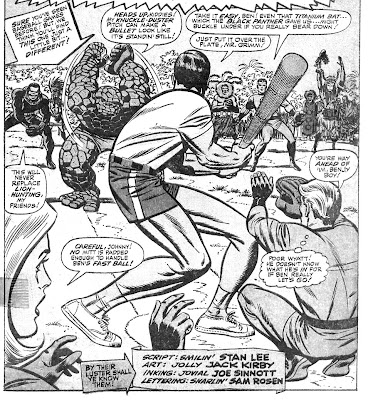
Jack Kirby is considered the king of comics and for good reason. Many of his classic comics have unfortunately suffered from sloppy inking. Joe Sinnott (who inked these 2 pictures) really worked to bring out the best in Jack's work. He made his characters look solid, organic and made them stand out against the backgrounds.

A lot of other inkers tended to flatten out Jack's work and make the images harder to read. To me, the work then looked too stylized, less alive. Some people like that better, though.
 LINES DON'T EXIST BY THEMSELVES
A line isn't important for its own sake. There are some artists who think having a big bold clean line is practically the art itself, and the drawing it describes is unimportant - as in many modern fake-UPA style cartoons.
If you have an uninteresting or ugly drawing underneath, no amount of thick clean lines can hide it-at least not from me.
On the other hand, great drawings can also be ruined by poor line work. Each animator, layout artist and cleanup artist should all understand and feel how to do warm descriptive lines that draw attention to the good qualities in the drawing they are bordering.
LINES CAN HURT DRAWINGS AS EASILY AS THEY CAN HELP THEMThen there are styles that purposely use wiggly
 I'm not even sure if this is for real. Maybe it's someone's idea of satire.
or scratchy lines-maybe to make you know you are looking at drawings, maybe to be ugly on purpose, I don't know.
Many artists, as they get older lose their line quality. I know I can't draw as "clean" as I could in my 20s. That's why I rely on younger inkers and clean up people-but I train them to know where to put their clean lines without "losing the life" of the original roughs.

In the 60s, Disney introduced the xerox process. This was a way eliminate the cost of doing all the beautiful hand-inking they used to do on their cartoons. They sold the concept to the animation community as a way of preserving the spontaneity of the artists' drawings -maintain the liveliness.

To me it looks terrible. When I see scratchy lines boiling and shimmering at 24x per second, I can't help but be aware I'm looking at individual drawings, rather than animated characters.

Plus, the xerox line itself loses a lot from the pencil drawings. It's a cold, harsh itchy look.
By the 1980s, sensitive artistic line work was a thing of the past.

COMPARE POPEYE IN THE 30S TO POPEYE AND EVERYTHING ELSE IN THE 80S


I had to fight the whole industry to bring back thick and thin organic lines to cartoons. You would never believe how hard everyone resisted. I was a dirty radical to want the lines around cartoons to look good. Not only did I want thick and thin to come back, and organic lines, I even wanted to have some
color lines -
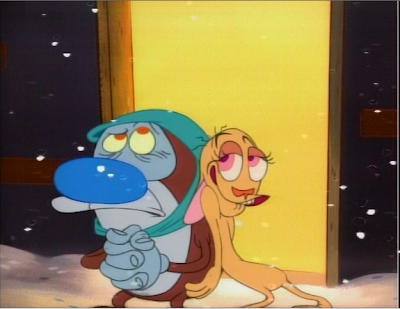

and everyone thought I was insane! But that's a whole other story.
LINES ARE YOUR DRAWINGS' SERVANTSIf you have a grasp of your drawing principles, then your lines can do a lot to bring out the elements of your drawings.
Like Pete Emslie
 http://cartooncave.blogspot.com/2007/09/angry-girlfriend.html
His lines are very appealing - but not merely appealing for their own sake. They make sense. They are there to help describe the drawing underneath. They are slightly loose and rough, but a cleanup artist would have no trouble knowing where to put the final lines, and how much weight to give them.
His lines are artistic, but they are subservient to the drawings they are describing.
They aren't just one skinny even line that travels around the outline.

Preston Blair also has beautiful flowing lines.

They are drawn quick, but perfectly describe the forms underneath. These aren't quite clean enough for a final cel, but the inker knows exactly where everything goes from the clean up.

Many animators work very rough. That's fine, but I think it's their duty to go back and tighten up the drawings to the point where an assistant or inker knows where all the details go, and how the forms actually work solidly. As I've said before, smooth motion is only part of good animation. The drawings you define with your lines, the specific expressions and details are also part of the equation, and I can't see why an animator would want to give up that layer of fun and control.

I think some Disney features in the last 20 years have suffered from cleanups that don't reflect the animators drawings very well. I've seen many scenes with underlying loose animation, but stiff Filmation-style cleanups that undermine the motion.

It seems like somewhere between the animator and the clean up department, something is not connecting.


From a rough but defined sketch like the Sody one above, a good inker (like Brian Romero) can work his magic and give you a smooth, alive, organic being.

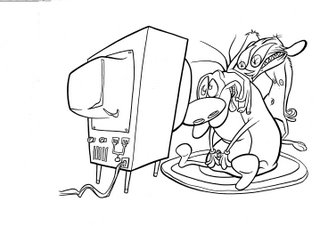 HIERARCHY OF LINES DESCRIBE HIERARCHY OF FORMS
Lines, like forms obey a hierarchy of importance. Some parts of your drawing are more important than others and need thicker lines.

Details are less important, get thinner lines, but still have to flow in the same directions as the larger forms.
It's not quite that simple and not completely a science. There are some general rules to help out, but then part of it is instinct.
SHANE GLINES
Shane Glines used to ink a lot of my stuff and he knew exactly how to enhance what the drawing itself was trying to say.

You admired his lines, but you saw a character first, not a bunch of disconnected details.

***Note to Mitch-

when you copy the old cartoons, try to get a feel for the pencil lines animators used to use. Your lines can help give your drawings more form.
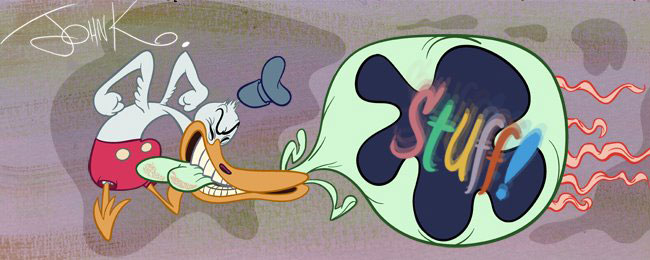

 What is it about insanity that so delights our every pore and follicle?


 This is considered offensive today. Insane or what?
 "Psychodrama" about 12 years ago and that was the first time I heard that label, but I liked it when I heard it. (I'm not sure whether it was a criticism or a compliment!)

 One complaint I get from many executives is that my cartoons are too unrealistic. They don't know how wrong they are.
 Beware My Lovely
 Beast With 5 Fingers
 MAD LOVE
 KISS OF DEATH
 DETECTIVE STORY
 THE ENEMY WITHIN
 STRAIGHT JACKET
 NIGHT OF THE HUNTER
 -----------------------------


