
Friday, March 30, 2007

Writing For Cartoons 7 - Continuity, Personality

Continuity

Each idea has to be linked to the next idea. Each line of dialogue has to follow from the previous and into the next smoothly. Each scene should connect to the next.

There can't be gaps, where the audience wonders "how did we get from here to there?"

The outline should have the basic structure. It should link each scene.

The detailed continuity should be up to the person doing the storyboard.

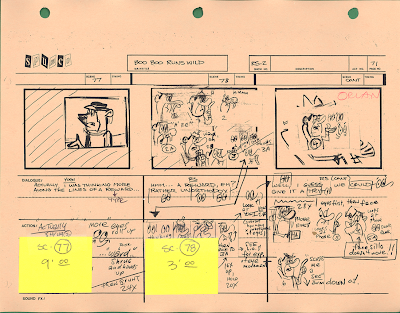
This storyboard was done by Vincent Waller. Those little sketches were done by me, either in the layout poses first and then doodled onto the board to time from, or I doodled them first and then addedd them in the layouts. I don't remember...
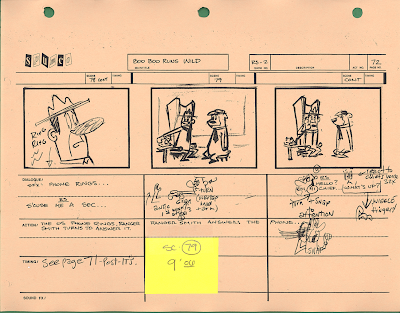
Either way, pose artists animators, directors and assitant animators each fill in more continuity.
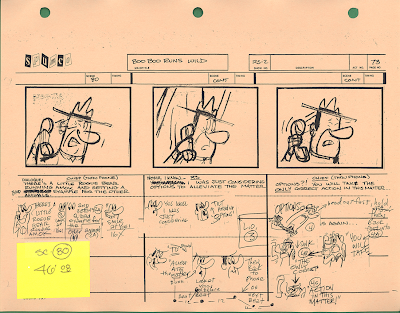
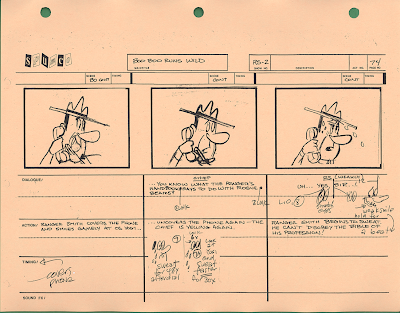
The storyboard artist/writer links the dialogue, the action and the acting. Between each major expression, there are smaller expressions that connect them.

The outline is where you contruct your story. The storyboard is where you write it and connect the dots.


Understand Personality

This is not essential, because many cartoons are not about personality. Tex Avery never used layered characters in his MGM cartoons, but still made some of the best cartoons in history.

Disney's characters are one-dimensional (if they are lucky!) but that didn't stop him from being pretty successful.

But you should know enough to not have your characters all of a sudden do or say something that is totally out of character-unless the story supplies a believable reason for it.

Your characters' actions and their dialogue should come out of their character.

Ren doesn't do things the way Stimpy does. Bugs talks and acts different than Elmer, etc.

I had a really good board artist doing a scene for "In The Army". Ren and Stimpy were doing KP duty, peeling potatoes, and in the board Stimpy was cross with Ren. He was chewing out Ren for getting them in trouble with the sergeant over and over again. It was beautiufully drawn, but out of character, so I asked the artist to rework the scenes so that Ren is the mean one and Stimpy thinks that KP duty is a reward. Stimpy almost always thinks that Ren's mischief is a good thing. You have to push him pretty far to upset him.

Needing to understand character seems obvious, but I have yet to meet another cartoon writer who can keep their characters consistently in character. I usually have to do that part myself, but I could sure use some help if someone exists out there! There are a lot of great and funny artists, but less that can create inspired characters and certainly none of the writers can. That's the whole history of the business. Warner Bros. seems to have been the big exception.


Character Treatment

I actually frown on writing up character treatments- a description of your characters' personality traits.

They (TV execs) make you do that when you start a project or pitch one. They make you write a "story bible" and as part of it you have to describe who your characters are and worse, what their catch phrases are.

The bad thing about this is that if you force yourself to try to figure out everything there is to know about your characters before you start making your cartoons, you end up restricting yourself to what you thought you knew about them early on. The execs make you stick to it and your characters are forever limited to being cardboard cutouts.

What you find from actually making cartoons is that you think of many more and better ideas along the way and your characters evolve as they find themselves in new adventures.
Ren and Stimpy, George Liquor, The Ripping Friends and old cartoons all evolved along the way. They would maintain some of their core traits, but they would get more shaded as more stories got produced.

Catch Phrases
If catch phrases happened, they happened by accident. They weren't "created" upfront, like they are now. How many times did you cringe as a kid when you heard "Welcome to the 90s!" or such other writer creations? (Hey share some of the most obnoxious catch phrases from your childhood cartoons here in the comments!)

When I had Ren say "You bloated sac of protoplasm!" and similar things, people would yell them at me at appearances. I would see them on t shirts. People make me say "No sir, I don't like it" all the time. None of the lines in R and S were ever meant to be catch phrases, but they would just catch on, and Nickelodeon would lean on me to use them again. I resisted as much as possible, figuring that funny dialogue in the next cartoons would also catch on naturally.

Characters should issue from your loins
If you are truly a good character creator, you understand your characters from inside. You feel what's right for them, but you allow them to breathe and grow naturally as you make cartoons. They aren't a list of arbitrary traits and catch phrases. They exist and you are just relating their adventures to the audience.

Many of the artists who work with me add shadings-although if they add something that I feel doesn't fit, I suggest something else. Voice actors would also bring new shadings to the characters when we rehearsed the stories, and their inflections would give me ideas for new stories and new ways to develop the characters' traits further.

If you watch the Ren and Stimpy shows, you can see the characters evolve not only in design, but in their personalities too. I would purposely write whole stories just exploring their personality traits-like Stimpy's Invention or Ren Seeks Help.

OK, enough crap...to get to the point, I did write up a character treatment for Ren and Stimpy-not for myself, but for the Nickelodeon executives and for the artists and story crew on the show. Here it is, if you are interested.


I have one for the George Liquor characters too if you ever want me to post it. Let me know.


Scene Planning For TV - Setups for storyboard and layout 3

Once a layout/pose artist has drawn all his setups with all his character poses complete, and he has done a rough indication of a background, he gives to the BG designer to draw a more finished BG.

Hanna Barbera used the simplest possible staging in their first cartoons because of the severe budget restrictions. This drives Eddie crazy.

I used their staging in this manual just to give people the basic idea of how to reuse shots in other scenes.
Here is a sequence of storyboard from Ripping Friends which had a wider variety of shots.

If you look through these boards you can see shots that have been reused from earlier scenes. There are reuses and "works out of" poses and expressions too.

I still planned the show to reuse shots, but the layout artists were redrawing the same angles from scratch every time, because of the strange production system being used at the service studios in Canada. (This happens at overseas studios too-they hand out the same setups to different artists who don't know that someone else already drew a setup and BG that they themselves could use to save time, so they redraw everything 20 times) This cost extra time and money, and way too many backgrounds to paint when we couldn't even afford real background painters. The production managers tried to tell us they could paint in photoshop and we would never be able to tell the difference between fuzzy photoshop paintings and real paint. Now the Ripping Friends live in the Land Of Fuzz.


So I made this manual to help the production managers save time and money and make it easier on the artists. Unfortunately, the manuals sat on a shelf hidden away from the artists who could have used them to save some sweat.

Maybe they will help someone out there in the ether.
These gutsy manly storyboard drawings were done by Jim Smith. http://www.jimsmithcartoons.com/index2.html
The extra doodles and notes under Jim's drawings are my additional breakdowns of expressions for acting. All this stuff was way toned down in the layouts, and so I then had to make another manual explaining how to not tone down expressions and poses. Those production managers had impressive looking shelves, piled high with Spumco manuals that
were never opened!

BTW, this section is all exposition. In the story, it's meant to make fun of shows like Superfriends where there are too many characters in a scene and they all just talk and explain what's going on to each other. Those scenes are always hard to board, because you have to come up with interesting angles for static mouth flapping characters. Jim solved it by putting them in funny heavy poses and making funny compositions.

We were always trying to figure out how to make fun of seriousness. Serious superheroes to me are automatically funny, but not so to the audience, so we tried to emphasize how silly serious superheroes are.


more to come....

Thursday, March 29, 2007

Bill Tytla - Terrytoons - cartoony animation

Here's a Terrytoon inspired by Chuck Jones' "Dover Boys". This fun animation is by the great and versatile Bill Tytla.


I actually like this even better than some of his more famous Disney animation. It's less overworked and not meant to be competing with live action. The poses are very cartoony.


CLICK HERE TO WATCH CLIP!

More on Tytla:
http://www.animationarchive.org/2007/02/filmography-tytla-and-terry-jekyll-and.html

http://www.animationarchive.org/2006/12/biography-bill-tytla-part-one.html

Roger Ramjet - "Woodsman" - clip 3 -grunting bear

I loved this bear when I was a kid. He's real funny looking. His voice killed me and my friends. We used to go around school talking in grunts like the Ramjet bear. You shoulda heard us moan and groan when the teacher would hand out the homework assignments!

We learned to actually communicate with grunts and expressions and knew what each other wanted. We would go to the corner store and order potato chips, cigarettes and comic books just by gesturing and grunting. One time Nick the Leb chased us out of his groceteria screaming his own foreigner obscenities at us and waving his broom. We didn't understand the words, but we knew exactly what he meant!

I still do it. Where is this all leading?? To the next writing lesson: How to write grunt language - with conviction and heart.


CLICK HERE FOR ROGER RAMJET CLIP!


Here's another clip:
CLICK HERE TO SEE A ROGER RAMJET CLIP!


Tuesday, March 27, 2007

How To Do A Shorts Program Using Logic and Experience

Fred Seibert and his team of crack executives peer in on the latest short being focus tested


Looney Tunes The Most Successful Shorts in History
When Fred Seibert hired me to consult for him as he took control at Hanna Barbera 12 years ago or so, he asked me why old cartoons were so great and new ones sucked. He wanted to make new ones that didn't suck. So I gave him a history lesson.

I used Looney Tunes as my main example because they did everything right and succeeded because of it.


Looney Tunes created more popular characters than any other studio in history. Their cartoons have lasted 60 years.

Their key Directors are all famous and looked up to decades later.

How did they do all this? They had a logical studio production system that developed and encouraged talent:

Short Cartoons
First, like every other studio, they made short cartoons and constantly created new characters to see what characters clicked with the audience.
They didn't put all their eggs in one basket, like when a Saturday Morning Studio green lights a whole series at once and then when it fails, a lot of money is lost in one shot.

Director System
The producer-Leon Schlesinger was a very smart business man. He was risking his own money-unlike today's executives who don't care how much they spend.

Leon knew that his success depended on the talent. He was always on the lookout for the stars within the studio.

He would promote his experienced animators to director then let him sink or swim. If the director made cartoons that made the audience laugh, they got to keep their jobs.

Directors and Units Got To Practice Their Craft
If the director made yawners, then they didn't keep their jobs for long. But Leon wouldn't fire you if your first cartoon was a flop. He gave you enough time to learn how to direct and get used to your crew. Chuck Jones actually made 4 years of yawners with Leon threatening to fire him the whole time unless he started to make funny cartoons. The other directors kept telling Leon that Chuck was a real talent and Leon believed them. Eventually Chuck became the most famous director at WB. Leon trusted his talent. He didn't have sub executives telling him what cartoons worked or who was good.

Directors had their own units
The director had his own team of animators, story people, BG painters. These people would get used to each other's styles and working methods and with each cartoon, they would naturally get better-especially under a strong director.

Sometimes certain artists would migrate to other directors whose sensibilities were more in tune with their own.

Storyboards
I explained that there were no scripts in old cartoons, that the artists drew the stories on storyboards. Fred said "Of course! That explains why we can't find any Flintstones scripts at the studio!"

You Had To Work Your Way Up Through The System
You didn't start at the top like many of the young guys the Execs dig out of a cornfield in Idaho today. You had to learn from the ground floor up and as you started to prove yourself you could be up for promotions.

They Got Experience First
Bob Clampett started at Schlesinger's when he was 16-as an inbetweener - not as a director. He then became an animator after a couple years, and the whole time he was learning his craft, he was always pitching story ideas to the directors and to Leon. He begged Leon for years to direct and finally got his chance when he was 23 - 7 years after he started. He turned out to be the star director really fast and created many characters and classic funny films and influenced everyone else in the industry.

Partly because of his awesome talent, but also because he knew how animation worked in every sense, from working with experienced folks for years and working in various departments himself. He paid his dues first.

A good director has to understand how all the parts fit together in a cartoon, because he has to manage them and coordinate them for the most entertaining effect. He also needs the respect of the artists working for him, and an inexperienced director is not going to be respected by experienced artists.

No one today gets the opportunity to learn what it takes to be a director, because the execs split up all the director's duties and don't start people at the bottom anymore.

Dumb.

Everything evolved -characters, styles, artists
Nothing was ever set in stone. People believed in progress then. The characters changed design in a steady flow, the studio style, the personalities constantly grew and progressed. There were no story bibles, no predetermined catch phrases. Everyone expected next year's cartoons to be better than this year's. You can tell an early 30s cartoon from a late 30s cartoon because of the steady progress in skill.
http://johnkstuff.blogspot.com/2006/05/when-cartoons-evolved-3-first-bugs.html
Look back at the last 15 years of cartoons at any studio today. Anyone see any progress? It all seems to be slipping backwards to me.

The Audience Decided What Was Successful
This is so logical and obvious, it baffles me why execs can't grasp this today.

The directors knew when they had a hit cartoon and they would get inspired and run off and say "Let's do more of that!" If no one laughed, they would be ashamed, and go back and try to figure out what they did wrong and not repeat it. They didn't go into the audience and ask people what to change, as we do now with "focus testing". Imagine an architect asking a house owner why the house caved in and how to fix it.


OK, so I explained all this to Mr. Seibert and he got real excited and decided on the spot that he was going to institute a shorts program at Hanna Barbera, and I wholeheartedly supported him.

He only remembered part of what I said though. He remembered that shorts are there to discover new talent and new star characters, but the rest he kinda discarded.

I helped him find some potential new director talent and he found some of his own, but in my opinion he jumped the gun.

He started too many units at once. Too many chiefs, not enough Indians.

Then on top of that, he hired a pile of sub-executives out of nowhere, people who didn't know the first thing about cartoons and didn't like cartoons and didn't like cartoonists.

The artists would overhear these lieutenants in the hallways talking about how stupid this whole shorts idea was. It was ridiculous to write cartoons on storyboards and give cartoonists any say in the making of cartoons. "We should go back to using scripts, like we did at Ruby Spears." Yeah, that was successful! How many people can even name a Ruby Spears character today?

Of course when they were in meetings with Fred, they were all gung-ho about what a great experiment this was.

Many of these bottom feeders have now migrated to other studios and hired more of their kind and the creative process has become more complicated and illogical than it ever was.

Fred is the most logical and sincere of the modern execs for sure, but he combined some purely logical elements of cartoon making with modern crazy witch doctor management theories that undermined the cartoonists-even though he didn't mean to. It's just his hippie executive management background.

Even so, just doing something right was enough to revolutionize Hanna Barbera and put the Cartoon Network on the map. They made some pretty successful series based on the shorts created by Dave Feiss, Genndy Tartakovsky and Craig McCracken.

Since then, every studio has started up their own shorts program. Why? Because they want to discover real talent and new characters the logical efficient way?

No. They all have them because it's the thing to do. No self respecting network can have a studio now without having a shorts program. It just isn't done.

Executives don't do things for logical reasons. They do them because everyone else is doing them. Slaves to trends.

The whole reasoning behind shorts programs has now been undermined and they are managed crazily.


It would be so easy to do it right and then beat the crap out of all the other studios, just by setting up a program with pure common sense and lessons from experience and history. The first studio to follow my advice would be the top dog within a couple years. If you know what your goal is, you oughtta take the shortest most direct route to achieving it. So, let's review the goals of a shorts program.


...In the next post of free advice for execs


Writing for Cartoons 6 - Spelling, Grammar, Clarity : The Boy Who Cried Rat Outline


Spelling and Grammar
You are going to have to use some words when you write a cartoon-in outlines and premises -which the audience never sees, and in dialogue - which the audience hears. If you spell badly and can't construct a sentence, then it's pretty certain that you'll have trouble constructing a paragraph, let alone a story. You also won't be able to write effective dialogue if you have trouble with language.

Spelling and grammar use the same kind of thinking that writing stories and doing storyboards does, so if you can't spell or construct clear sentences, you might want to give up on the idea of being a writer. You can still be a good artist. It's a lot harder to be an artist than a writer anyway.

Clarity

You should be able to control your ideas in a way that the audience sees, feels and understands what YOU want them to see, feel and understand. You have to be able to present your ideas simply and clearly. Vagueness is a sign of poor writing.

Don't try to be fancy or show-offy. That tends to muddy up your ideas and baffles the readers, artists and audience. Use the fewest possible words to say what is happening.

Clarity is also important to the artists who have to follow up on what your ideas are. If they have to muddle through vague writing, storyboarding and overly complicated details, they will have trouble understanding what the point is that they have to convey to the audience.

If you are writing an outline, write with short simple sentences that tell clearly what is happening. Do not try to impress the artists with fancy-ass flowery prose and inverted sentence structures. They won't be impressed. They will be frustrated and confused and will not do their jobs well.


NOTE! This is an 11 minute cartoon. The outline is just 4 pages long.

Clarity applies to every aspect of art and entertainment-to the telling of the story, to the posing, the sfx, the music, the acting. The best directors are the ones who state their ideas in the clearest non-ambiguous manner.

Here are some notes a secretary wrote up from a meeting at Spumco. We were studying Tex Avery cartoons. Tex was a master of clarity.


http://video.google.com/videoplay?docid=5458467101259814270&q=tex+avery

Monday, March 26, 2007

Walt Disney Presents - "A Story of Dogs" - the director

WHOOPS! COMMENTS ARE ENABLED AGAIN.

By the 1970s and 80s, the Saturday morning cartoon studios had devolved an extremely creatively inefficient production system.

They produced cartoons on an assembly line basis. Each function of an animated cartoon now had its own department: The "story" department, the storyboard department, the layout department, etc. No one in any department talked to anyone in other departments. They were all kept separate.

Each department had a department head. The head of the story department was a "story editor" or some such nonsense. This head would oversee all the stories in the studio-superhero cartoons, funny animal cartoons, girlie cartoons, whatever generic product was rolling down the conveyer belt. He was an expert in every single style. ...Yeah.

This system has no communication from artist to artist. A storyboard artist has no director to guide him in his presentation of the story. The layout artist doesn't consult with the storyboard artist. The animators ignore the layouts and just xerox the model sheets and write timing charts on the presupplied poses worked out by the model department. In other words, each step in the production is a waste of money, because the next department is just going to do everything the same way they always do it.

All the individual job functions had their functions changed. Storyboards were no longer where you wrote the story. Layout was no longer where you creatively staged the scenes. Animation had become tracing.

In this illogical system, no one has any any creative stake in any cartoon. If anyone happened to sneak an act of creativity into his layout, or animation, or storyboard, the system would automatically erase it. When you saw the final cartoon that you worked on, nothing you put in made it to the screen. Artists in the 80s were a mighty depressed lot.

This horrible system eventually migrated into Feature production, although it was combined with superficial elements of how Disney used to make cartoons and no one would admit they weren't still doing it the classical way. But 80s and 90s Disney movies sure as hell look and sound like the stuff we did for Ruby Spears and Filmation in the 80s, although with harder camera angles and lots of inbetweens.

Anyway, the old system that produced classic cartoons was a sensible system. It had directors in charge. The directors were animators who had worked their way up in the system and knew exactly what went into making an animated cartoon. These directors would in turn work directly with each of the key creative people on their cartoon. Everyone knew how everything was going to fit into the overall creative scheme. People could have a stake in the success of each individual cartoon they created, so they had an incentive to do things well.

That's why old cartoons have feeling, style and are directed. They have creative points of view, while modern cartoons are committee-made, executive garbled mush.


Look how sensible this old fashioned production system is.
No scripts in sight. The director (Gerry Geronimi) works with drawings.

The layout artist (Tom Codrick) who staged the scenes visually is in on the meeting with the animator and director.


Woolie Reitherman is the animator.
Geronimi explains the scene generally to the animator.


Then the animator (the performer) sketches up his suggestions for how the action might work.
Everyone can look at the pictures and see exactly what the suggestions are. There is no need to describe the actions in words when you have artists making the story.


* an interesting side note: Tramp is a typical cute but generic Disney design, but the other dogs are starting to look like 70s Saturday Morning character design - an ill omen of what will eventually happen to animation in the coming dark ages.


At my studios, we restored a version of this old fashioned production system -adapted for TV schedules, and for a while Nickelodeon and Cartoon Network "borrowed" it. But years later as more and more executives are added to the process, the system is gradually reverting back to the nonsense production system of the 70s and 80s. And maybe even worse, because there are more execs now than ever and decision making is so slow, feeble, arduous and insanely expensive. It's the process of eliminating creativity and fun from cartoons, while burning money.


CLICK HERE TO SEE MOVIE CLIP!

Sunday, March 25, 2007

Roger Ramjet - touching himself, close-ups & funny fight

Roger touching himself animation:


extreme close-up cutting:


funny gorilla:


funny fight:

Look at these great drawings! Anyone know who did 'em?


Saturday, March 24, 2007

Scene Planning For TV - Setups for storyboard and layout 2


to be continued

If you take some time before you start straight ahead drawing your scene out you can plan what you are going to do and save setups.

The less new setups you have to draw, the more time you can spend on the entertainment-the drawings themselves.

Who cares about fancy camera angles and lots of cuts if what's happening in the scene isn't fun to look at?

Note how all the principles I have been talking about are now starting to be used together in actual functional practice.

The scenes have specific acting poses, continuity, gags, LOA,...many things I have been talking about for a year are being used together in these layouts.

All these concepts are not merely artistic abstractions to be used for their own sake. They are your artistic tools with the ultimate purpose of entertaining the audience.

Animation is an art of performance. It is not a written art. Although it uses writing as one of the tools, it is only one of many tools and a tool that is in service of the performance. The performance-the drawing entertainment is the number one reason to watch cartoons-or for that matter any visual medium.

Animation is a specific type of performance art that contains elements of the others, but it also can do things that no other art can do and if it doesn't, what good is it?

NEXT WEEK! A NEW SERIES:

FREE TIPS FOR EXECUTIVES: HOW TO DO A SHORTS PROGRAM RIGHT

Friday, March 23, 2007

Writing for Cartoons 5a: animation: Keep it simple and short! Misconceptions of animation "writers"

Here are a couple of major misconceptions that animation scriptwriters have:

1) Animation scripts should be longer than live action scripts
This is from someone's webpage where she is trying to sell you a book on how to write cartoons.

"How to Write Animation Scripts

In writing animation scripts, there are two pages written for one minute of viewing time. This is done because you have to call the camera directions, angles, and scenes. In contrast, when writing cinematic scripts, you write one page of script for each minute.

That's why many cinematic scripts with live action run 90 pages in length for 90 minutes of viewing. With animation scripts, a 12 minute script runs about 24 pages in length." Yikes!!!


http://www.newswriting.net/animation.htm


It's actually the complete opposite. Animation writing should be short, because you have artists to fill out the visual details. Animation scripts are always too long and storyboard artists have to draw hundreds of extra scenes just to have them all cut out by the studio when they figure out that the show is too long.

Sometimes the whole show gets animated before the producers figure out they have wasted a hundred thousand dollars animating 10 minutes that doesn't fit into the half hour. This happens all the time and it seems no one will tell the writers to write shorter scripts. (I've done it myself and learned my lesson now!)


Every script page equals about 2 minutes of screen time, the way animation writers write.


2) You can write tons of complicated actions and details into cartoons because it's easy for someone else to draw it


Complicated backgounds and scenery:

"WIDE ON PAPA YELLOW NAPE, AND PICKLES

as they enter a brightly lighted room. There is a huge swimming pool surrounded by classical Roman and Greek statues. The pool

is rimmed by turquoise, blue and white mosaic tile. There are

tall, gothic windows. The white marble statues circle the large, kidney-shaped pool. The walls are tiled in the blue, white and turquoise fleur-de-lis mosaic tile. The pool has an open skylight

roof--an atrium where the sun's rays shine down into the pool

to show hazy beams of light."


Millions of characters to animate:

" PAPA YELLOW NAPE

That statue's pointing to the light

ahead.

The two scramble in the direction the statue is pointing.

They stumble upon a huge aviary filled with the eaglets

and other very rare birds, including blue macaws, green parrots, red cardinals, etc. The aviary is perched on a ledge high on the

stalagmites and under the stalagtites. Brainy climbs up on the

ledge and unlocks the birdcage door.

PICKLES

Okay eaglets and other birds.

You're free now, and big enough to fly away home.

All the BIRDS make an exit from the huge cage, except for the

eaglets. They look up sadly and vulnerable at PICKLES."

"

PICKLES takes the bracelet from Fledgling's outstretched wing and punches a white button on the bracelet. It lights up and pulsates for a moment. Then in an explosion of light, all the

statues are restored to life. The statues run free in all directions, cheering and shouting.

WIDER ON STATUES

as all statues with the exception of TWO scatter to the light at the end of the cave.

STATUES

(scattering wildly)

We're free at last,

after all these years."


Here's a real dandy scene to animate:


"Suddenly a travelling mound of black CROWS and toucans approach from the east. From the west a mountain of HAWKS approach the battle from the west, each aimed at a head-on collision with HAWK's flying dinosaur bird. These two humongous clouds of BIRDS both speed into shot at the same time with GARGAMEL caught in the middle as the two giant flocks of birds are headed for collision.

PICKLES

Look! Up in the sky.

It's every bird in the land.

PICKLES points to the tornado of birds, now turned into a cycloning whirlwind of two different flocks. Then that becomes four flocks, eight flocks. The entire sky fills with flocks of all different types of BIRDS."

This person needs to be locked in a room with a pencil for 3 years until she finishes animating this one scene.


Wait, she's not finished!!

"CLOSER ON THICK FLOCK OF GREEN PARROTS FORMING A MAGIC CARPET

WITH THEIR UNDULATING, FLAPPING FEATHERS

Just before they hit the tops of the trees a thick flock of TOUCANS suddenly rise from the Parrotberry Treetops and berry bushes and rise up to the occasion forming a thick crazyquilt of colored, feather carpet that allows PICKLES and PAPA YELLOW NAPE to float on this magical carpet of TOUCAN'S wings. The TOUCANS carry Parrotberries in their beaks as they head for home.

WIDER ON PICKLES and FLEDGLING

as they ride the carpet of toucans slowly floating to land in front of their own home."


The responsible way to write for animation is to keep the average amount of characters down to 2 per scene. Especially in TV animation. More characters per scene equals less time to animate each character. This results in cheaper faster crappier animation and no personality animation at all.

Of course in order to write a cartoon about 2 characters, you'd have to understand how to write for personality, and I've yet to meet a non artist who could write believable, entertaining characters.

Hey, all you storyboard artists and animators, feel free to add your horror stories in the comments!

Thursday, March 22, 2007

Terrytoons- "Champion of Justice" Silhouettes

If you remember awhile back in one of the animation lessons, http://johnkstuff.blogspot.com/2006/05/animation-school-lesson-5-line-of.html
I talked about the importance of silhouettes in making your poses read clearly.

Here are some great scenes from an old Terrytoon.

"Champion of Justice" (1944), Terrytoon Cartoons


If you combine silhouettes with line of action, you can control your poses so that they tell the story well. Every pose should have a direction. Where you aim the body can tell you what the character is doing and what he is feeling. People tend to lean toward or away from things and where the lean helps give meaning to each moment.

Many cartoons today have no line of action or silhoettes. The characters just stand straight up and down. I see this even in a lot of full animation and in a lot of animation students' cartoon drawings.

In this animation, you can see the real value of clear staging using line of action and clear silhouettes. The limbs are kept in the clear.


CLICK HERE TO SEE CLIP! (3.29 mb)


Here we have no line of action and barely silhouettes:


Here's fake line of action:
Samurai Jack has a line of action.
The other characters have arched bodies which would make you think you are looking at a line of action, but the arches don't have direction. They don't aim or point anywhere. You need your characters to aim somewhere to have a line of action.

Here are some jumbled undirected poses from expensive modern cartoons to compare approaches.

http://www.disney-dreams.net/gallery.php
I know the animators are totally capable of clear classic principles. I assume that it's the management that thinks if something looks classic, then it's too "cartoony" so they bend the artists towards what they think is more like what imagine live action is.
If you are thinking that those don't have line of action or silhouettes on purpose because they are "realistic" then take a gander at this Frazetta painting:


I think old school clear staging whether in cartoons or illustrations is more effective than modern stiff awkward stuff.


It's hard to stage a fat guy, but this drawing shows a lot of skill and thought. The line of action is clear even though the silhouette is not.


If you wanna see tons of old classic cartoons that you can't see anywhere else, you gotta visit Asifa's amazing animation archive. If you are in LA, be sure to drop in and experience cartoon heaven!

http://www.animationarchive.org/2007/03/meta-visit-archive.html#comments

http://www.animationarchive.org/
Or better yet, be a volunteer and help them archive all this great stuff.

Wednesday, March 21, 2007

Writing for Cartoons 5 - Humor, Structure: Nurse Stimpy Outline

Humor
You should be funny if you are going to write cartoons. I have yet to meet a cartoon writer (who isn't also an artist) who cracks up all the other folks at the studio every day with his funny stories and acting.

Once I have an idea for a cartoon, let's say...Ren gets sick and Stimpy decides to nurse him back to health and his caregiving is worse than the illness. There's the premise to the cartoon. I have a purpose and a goal for the cartoon entertainment to achieve.

Then I have a "gag session" with the funniest artists in the studio-my "writers". I tell them the premise and everyone starts tossing out gags. I'll take any gags as long as they fit the purpose of the premise.

Someone will take notes and then we produce a list of the gags from the session in no particular order.

Of course just having a bunch of gags in no particular order doesn't make a story. The gags then need to be organized in a logical building sequence.

No matter how funny you are, you need to have an understanding of structure to most effectively present your ideas. Stucture is not that hard to learn, but it is essential and it gives you control over your ideas and story elements.

Structure
Even if you are naturally funny and have ideas and a point of view, you still need to learn some skills.

All art needs structure.

Structure helps you put your ideas in an effective order.

It gives you a hierarchy: Your story needs a main purpose, and all the gags and bits in the story should fit basically into the story. Your details should hang neatly on the major points and help emphasize them.

You don't want to get lost in tangents that confuse the audience.

You don't want to have your best ideas and jokes in the first 2 minutes and then have the rest of the cartoon be an anticlimax. (This happened in my cartoon "Black Hole". It had funny ideas and gags, but the structure was faulty and didn't live up to its setup.)

With the aid of logical structure you can have your cartoon build and move inexorably forward and keep your audience on the edge of their seats.

The stucture in a cartoon is worked out in an "outline."

An outline is a list of the story elements and main events of the story - IN ORDER. It doesn't need to have every detail worked out and it shouldn't. You want to leave room to add gags, acting, personality and visual ideas for the storyboard stage.

The best form for an outline again is a list. Simple sentences that just tell the next guy what happens, so he can start boarding it.
It should be easy to read, like this.

The way cartoon scriptwriters write is torture to read. It is very hard to muddle though the bad prose and thick dialogue and awkward descriptions of action that non-visual people "write". Scripts are intended to impress and dumbfound executives. An outline is a working tool and is much easier to work from.

http://uncleeddiestheorycorner.blogspot.com/search?q=script

look how awkward this is to read:
You can see why artists go nuts reading this stuff. You muddle through the page, try to figure out even what the hell is going on and if you do manage to figure it out, it doesn't add up to any humor or entertainment. So what do we need this process for? It's just a huge waste of money that kills the morale of the talent and makes us not care about doing a good job on the cartoons.

compare it to this:
Now when we write this stuff, we have already done a lot of sketches, so we don't need to spell out the details. We know the drawings are going to make every line and description funnier. This outline is the working tool for the artists, not the final entertainment product for the public. The public will get the cartoon.


Wow, look at how many revisions they makes us go through!

Monday, March 19, 2007

Roger Ramjet - "Woodsman" - clip 1 opening scene

Look at these hilarious drawings!

CLICK HERE TO WATCH ROGER RAMJET CLIP!


This is great design. It has all the principles of technical good design, but on top of those it's funny looking too. It's like it's making fun of the 60s style.

You might think it's odd that I would get excited over that, but it's pretty rare to see funny drawings in the cartoon business.

Opposing poses-funny body poses, great balance of negative and filled space in the designs.

Funny voices, funny cuts.

This is the opening scene of one of my favorite Ramjet cartoons. The dialogue so far is mere exposition to set up the story, but the animator/director made it funny.


Even this seemingly simple background is funny. It's also great design and super organic, with lots of balance.


HEY BOB KURTZ! WHO DREW THIS ONE?


Writing For Cartoons 4 - Ideas: The Origin Of Cecils


The Premise:
A premise is a quick and short explanation of what your cartoon is generally going to be about.

What is a premise for? It helps clarify the purpose and intent of your cartoon for you. You can also use it to hand to other artists to get them thinking up gags and bits to add. Your premise should be crystal clear so that anyone reading it instantly gets it.

You also use premises to sell the executives on your idea.


Some history:
1987: Bakshi's New Mighty Mouse Adventures Premiers
It causes a big splash.

It is the first cartoon made in at least 25 years that allows the cartoonists to completely create the material.

I hired people to write who had never written cartoons before, but were funny cartoonists: Tom Minton and Jim Reardon.
We also had a comic book writer, who had a lot of trouble writing for cartoons. Non-stop verbal obscure superhero type dialogue.

Tom, Jim and I wrote most of the cartoons: On scripts. We wanted to write on storyboards but that was too radical a concept at the time.

The show came out and had cartoonist humor all over it. And all kinds of "plots" that didn't follow the 12 legal ones all the regular cartoon writers had memorized. No skate boards, no celebrity cameos, no "parodies" of Spielberg movies. We did have a cheesy kid character and we made Pearl Pureheart feisty and liberal, I guess to appease the Network, but we made fun of these contrived elements all the time.

Cartoonists are basically artists with a sense of humor. We make fun of everything and everyone all the time.

The show influenced the whole TV business.

The following year, the Scooby Doo writers at HB copied the superficial elements of it and offered up A Pup Named Scooby Doo. All of a sudden they were doing things that everyone told me you couldn't do in cartoons a couple years before: "Breaking the 4th wall. Takes. Wonky backgrounds. Satire. etc."

in 1988, Bob's wife Sody Clampett (who I love a lot!) told me she wanted to develop Beany and Cecil for Saturday Morning TV. I said "great!" and started writing up story ideas.

She was surprised when I started pitching them. She said "But John, you're an artist. We need a writer. You do the pictures!"

I said, but I wrote the Mighty Mouse stuff and she didn't believe me. "You just directed it, didn't you?"

I said, "Didn't Bob write a lot of his cartoon material?" "Well, yes but that's different. He's Bob!"

I didn't wanna fight with Sody, so I got her to also hire Tom Minton, who himself was a storyboard artist before I hired him as a writer on Mighty Mouse. We agreed not to tell Sody, that he could draw.

She loved all the stories when he pitched them. Whenever I did, she kinda didn't take it seriously. Irony of ironies!

Where do I get my ideas, people ask me. From everywhere. Anything I notice in life that's interesting, I laugh at it.

I always liked nature shows and evolution. I think evolution is funny, Nature is the greatest comedian of all time. Naked Mole Rats, Liver Flukes, Tarsiers, Axolotls and Lemurs all had made appearances in my cartoon pitches that never sold.

I was thinking about what kind of oceanic adventures Beany and Cecil could have and It thought. Hey! Maybe they could go to the Galapagos islands and see variations of themselves, each adapted to the different environmental conditions of each separate island.

Tom and I brainstormed the idea, then I wrote up this premise to pitch Sody. It's a much longer premise than the kind I wrote later for Ren and Stimpy, but I just wanted to get all the ideas down.

I hadn't discovered computers yet! This was prehistory. We did everything the caveman way. By hand.


When I pitched it to Sody, she looked at me like I was some poor dumb crazy artist. She loved me too though, so had Tom talk me down gently.

2 years later I rewrote it (on a storyboard) with Jim Smith and we made "Untamed World" for Ren and Stimpy.

Win a piece of Jim and cartoon history here!
Jim's Guitar


Next:

Humor
Structure

Writing For Cartoons 3 : P.O.V., Ideas, Sincerity

More skills you need to have to be a good cartoon writer:

An original P.O.V.
Even if you can draw and have all the writing skills below, that is not enough to make you a good writer. A real creative writer in any medium, should have a personal point of view. He has to see the world and his medium in a unique way. A way that is worth the audience's time and worth the effort of all the artists who have to make the ideas look good.

This can't be taught. You either are an extremely interesting person, or you're not. You also should be sincere. You shouldn't have to read a book on how to write stories for film so you can use a tired old plot structure, just because that's what they tell you in film school. If you really have something to say, you can learn to say it in a structure that suits your voice, not Jeffrey's.

The animated features today and most TV cartoons are written by comittees of people who try to figure out what entertains an audience. http://www.adultswim.com/shows/metal/
They should instead be written by entertaining people who already know because they entertain people everywhere they go in real life.

That's why we have so much insincere non-entertainment crap like "Character-arcs", bad puns, ripoffs of famous movies in the guise of "parody", contrived pathos, characters who try to find themselves, bland protagonists, one-shaded villains, broadway style tuneless songs that "move the plot forward", in every damn feature. Another amazing lie you see in many animated features is when they make fun of corporations or try to teach the audience ethics-even though the movie is being made by evil corporate executives who have no morals at all - people who stop the actual entertainers from entertaining you so they can pretend to be creative themselves.

Anyone in the world can learn how to "write" this kind of stuff. It's not "story" or writing. It's just stuff. You just have to be related to the right person. A real writer has a sincere and unique outlook (his voice) on the world and has a naturally entertaining way to communicate it so that regular folks can enjoy it.

This insincere style of film making can be traced at least as far back as Irving Thalberg and the earliest film executives at big motion picture companies. These people exercised their creativity, not by getting on stage and dancing or telling a funny story, but by "giving notes" to real live entertainers.

How many folks complain about the Marx Bros. movies that have all that bullshit romance filler in the movies? Romance and story filler about characters THAT NOBODY IN THE AUDIENCE CARES ABOUT. This is pure executive thinking.

Who goes to a Marx Bros. movie to watch Zeppo and his ilk? Every second of the "story" makes you twitch around in your seat.

Today we have huge budget animated features with nothing but Zeppos in them, and no Grouchos. It's all filler and zero pure entertainment or a sincere creator's voice.

Ideas
Most animation writers don't really have any ideas, but they should.

Instead they recycle the same 7 (or is it 12?) tired old "plots" and just change the catch phrases to match whatever characters they are plugging into the same script they have "written" 50 times already.

I actually used to hang out with some animation writers and they all had these formulas they firmly believed in. They were all convinced that every plot had already been written. Then I pitched them a bunch of stories that didn't fit any of those plots, they shook their heads knowingly in disdain until Mighty Mouse and Ren and Stimpy came out. Now these same writers and hordes of new opportunistic charlatans have added those plots to their scripts and recycled them for the last 15 years.

They copy the Simpsons plots now too and proudly admit it to each other!

Well you can certainly get away with calling yourself a writer by recycling ideas that have already been done and memorizing a character's catch phrases, and you can even make a lot of money doing it, but you won't ever be remembered in the same way that novelists, entertainers and cartoon directors are. Everyone knows Edgar Rice Burroughs, Jerry Lewis, Matt Groening, Moe Howard, Mike Judge, Tex Avery and Chuck Jones. Who the hell knows who Jeffrey Scott is?

I can't tell you how to have ideas. I will tell you how I got certain specific ones, but you should find your own. If you have them, your other artist friends probably know it. Don't trust your own opinion.


Much more to come...

Writing for cartoons 2 - Skills You Need: Be a Cartoonist First


This is part 2. Read part 1 first if you haven't: http://johnkstuff.blogspot.com/2007/03/writing-for-cartoons-1.html


Skills you need to have to be a good cartoon writer:


Here's the most important one:
Be a cartoonist

This is so self-evident, it seems crazy that it needs to be explained to anybody, but here goes...


You don't have to be the greatest cartoonist, but you should have some experience animating, or at least inbetweening so you know how cartoons work. That way you won't ask animators to do things that don't work in animation.

http://www.vintageip.com/terms-storyboard.html

You shouldn't write for any medium that you don't understand, because the people who have to actually make the medium will think you're an idiot and will waste their abilities trying make your awkward "ideas" seem smooth by patching them together with bandaids. That's the basic system the studios use today.

Johnny Mercer wasn't as good a singer as Frank Sinatra, but he played instruments, read music and sang. He knew enough about singing to know what could be sung well by better singers. He knew the language he was writing for. He could carry a tune.

Would you trust a songwriter to write tunes if he had no way of playing you the tune-or even singing it to you?

"Trust me, the tune in my head is really good. I just don't have any musical ability to show it to you. Let me describe the tune. There are some really fast low notes, then they speed up and go higher. Then there's a short fat note that wiggles for a couple beats. I think I mean beats... uh...what's a beat again?"

I'm sure that's how this was "written":
http://melaman2.com/cartoons/singles/mp3/tiny-toons.mp3

That's what cartoon writers who don't draw are asking you to believe-that they have good visual ideas but no direct way to express them. That is exactly how their idiotic scripts read to us and we shake our heads in disgust. It's why the scriptwriters are laughed at by artists. I don't know how these "writers" can walk down the same halls as the artists who know they've had their medium stolen from them and know what charlatans they are.

The language of animation is pictures- and simple pictures too, because you have to draw lots and lots of pictures just to make something move. The more complicated the pictures are, the less an animator can do per week and the lousier the motion looks.

http://johnkstuff.blogspot.com/2007/01/great-quotes-from-uncle-walt-cartoons.html

Having experience animating teaches you this fast and cures you of wanting to write crowd scenes and complicated costumes and difficult camera angles.

Animation is also potential magic and you need to be able to draw and animate somewhat so that you can take advantage of what kind of magic animation can actually do well. An experienced animation artist's understanding of what cartoon magic is is much different than a non-visual person's is.

Here's what Jeffrey Scott and most animation "writers" think is the magic part of animation, "In live-action you have to write a lot of real-life stuff, like people's problems and crime. But in animation for kids I can make up wild stories, write sci-fi or fantasy, and dream about worlds and see them appear on screen. This would be too expensive in live-action, but in animation it only takes an artist to draw some pictures and there it is!"

http://www.ninjaturtles.com/cartoon/jscott.htm


In other words, the magic is that you can slough off all the responsibility of having to know what you are doing on an artist. You don't have to do the hard part. You can write a bad live-action style epic with huge elaborate sets and a cast of thousands, and magically some poor artist (or hundreds of them) is stuck with making it happen - at 12 drawings a second.


Here's a news bulletin for all cartoon writers: ANIMATION IS NOT CHEAPER THAN LIVE-ACTION. GET THAT CRAZY IDEA OUT OF YOUR HEAD. WE HAVE TO DRAW A PICTURE FOR EVERY 12TH OF A SECOND, SO MULTIPLY YOUR CROWD SCENES BY 12 AND THEN AGAIN BY HOW MANY SECONDS OF SCREEN TIME THE CARTOON IS ON FOR.

Obviously, drawing a storyboard gives you a much better idea if a scene or cartoon will work than writing it in words. You can just look at the storyboard in continuity and see it.
Even artists who try to write scripts realize this quickly.

I learned by having to draw scenes I first "wrote" in words that some things I thought would work didn't. Then when I sat down and drew the ideas I invented many scenes, character bits and gags that I would never have thought of just by typing the ideas floating in my head and wasting time trying to verbalize them. Somehow, much magic comes out of your pencil without you consciously dreaming it up.

Someone who can't draw will try to argue that he thinks visually, but unfortunately for him, he can never prove his point. In order for a blind writer to prove that he thinks visually, he has to get an artist to prove it by drawing the pictures for him. He can't get his wonderful pictures out of his head without the aid of someone who can draw. If the writer doesn't like the artist's interpretation he has no way of explaining how to do it right.

On the other hand, artists who also have story ability can prove it by just doing it. As they did for the first 4 decades of animation history. In the 90s Spumco proved it again and for a while because of the huge success of bringing back real cartoons even executives went along with it,
http://www.animationarchive.org/2006/09/media-ren-stimpy-big-house-blues-seq.html until they started meddling again, and so much now that the business has reverted to the 80s system of hiring non-creative "writers" who can neither draw nor write, but are happy to steal the money while taking advantage of the ever gullible execs.

http://johnkstuff.blogspot.com/2007/02/walt-disney-vs-ted-on-who-should-write.html


Next:

An original P.O.V.
Ideas

and keep checking back for more things you need to be a good cartoon writer...

Sunday, March 18, 2007

writing for cartoons 1

People ask me all the time about how I come up with my ideas and how I write my cartoons, so I thought I'd do a series of posts about it.

I'm not going to tell you how to make cartoons the typical way. If you like Scooby Doo and Shrek and you want in on easy money and to have all the artists hate you, buy this book:
http://www.amazon.com/How-Write-Animation-Jeffrey-Scott/dp/1585672408
"The biggest difference between animation writing and other forms of TV and film writing is that in animation the writer has to practically direct the show. In live action you can say "the Indians take the town" and the director will spend five days shooting dozens of pieces of action. But animation, if you say "the Indians take the town," you'll see two Indians enter shot, pick up the town, and carry it away. It's very literal. So instead you call out every shot and describe everything you want to see on the final show. The reason for this is because there is no director, as in live action, who is working on the show from its start (script) to finsh. So it's up to the writer to do it."


I imagine if you are a Ren and Stimpy fan, you would rather know how to write for a show that uses the drawings and every other creative element as part of the entertainment and storytelling. Maybe you want to know the process behind Space Madness, Stimpy's Inventions, Ren Seeks Help, Man's Best Friend and the like. I can tell you how we wrote those. Not in one post of course, but I can start now.


"Of all of our inventions for mass communication, pictures still speak the most universally understood language." - Walt Disney


How many times have you heard this cliche: "Well, the animation was great, but everything really all comes down to story." The people you hear it the most from, are invariably the people who don't know anything about story- especially the folks who make animated features. Most features follow the basic structure and trappings of Snow White and have turned it into a blind formula. The original Grimm's fairy tale of Snow White has about 4 pages of story (about 10 minutes worth of screen time). The movie added about 50 minutes of filler. Animals cleaning plates with their buttocks, comedy relief, romance between two lifeless people, pathos. They also added some delightful song sequences. I would call those entertainment, not neccesary for the story but worth putting in a movie because they are fun.

Clampett made the exact same story as Disney's version of Snow White in 8 or 9 minutes and left out all the filler. Most features today are about 90% filler. The songs are no longer fun; they too have become filler.

People toss around the words, "story", "writing", and "plot" as if they are some mysterious concepts that don't need definition, but
are somehow the magical ingredients of entertainment that only "writers" can grasp.

If you like a cartoon, you might say: "I liked that, therefore it was a good story." Sometimes maybe it is, but story is not the main ingredient of entertainment. Sensations are.

I've never heard anyone say, "Boy that was a great dance. I wonder who wrote it." or "Who wrote this ice cream?" These make about as much sense as "That cartoon made me laugh, therefore it was a good story."

Most pleasures are not derived from story. In entertainment, story can be an ingredient, but it isn't entirely necessary and it's only one ingredient of many possible things that are fun to watch and listen to and experience.

I use drawing, acting, animation, sound effects, music, voice acting and every possible type of entertainment tool I have at my disposal to try to amuse the audience. Writing is one part of it, and really for me, the easiest part. Learning to draw takes years and can only be done by people with a gift and a lot of time to learn. Everybody kind of knows how to write.


Today, phony "writers" make the creative decisions in the visual medium of cartoons. That makes them the bosses. That makes as much sense as putting the sound effects editors in charge of the artists.


First, why don't we get some definitions clear. Writing and story are different things. A story is a sequence of related events. Period. A good story is a story that keeps people's attention. Not many stories are so interesting in their raw ingredients, that a mere reading of them adds up to good entertainment. You need a good storyteller to make a story interesting. You can have a bad story told by a good storyteller and it will still keep people's attention. It's much harder to keep people's attention with a good raw story and a weak storyteller.

Strangely, everyone including executives seems to have opinions on writing and story. Vague ones for sure, but they are firm in their vague beliefs and these beliefs change from year to year. I know, I changed a lot of the executive beliefs.

I think maybe the reason everyone and his dog is an expert on writing is because everyone writes. Everyone knows the basic rudiments of writing and practices them every day. This gives great confidence to charlatans and executives. It's a language common to all humans. Art or music is harder to talk about because not everyone practices them. You have to have obvious demonstrable ability that most normal people don't have. It's a lot harder to fake being an artist than being a writer. A singer who sings flat will make almost anyone cringe, probably even an executive. Clumsy writing though passes right under the noses of any executive, so management is easy prey for used car salesmen types who sell them on their brilliant story ability.


It takes extra gall for people who don't draw to tell you what's good or bad about your drawings. Of course, there are people who do it - as you all have witnessed, but it's harder to get taken seriously if you yourself draw stick figures while boldly giving your opinions to real artists.

Here are some terms as defined in the dictionary.

story /'st{phon_capo}:ri/ noun (pl. -ies)
1 ~ (about / of sth/sb) a description of events and people that the writer or speaker has invented in order to entertain people: adventure / detective / love, etc. stories * a story about time travel * Shall I tell you a story? * He read the children a story. * a bedtime story—see also fairy story, ghost story, short story
2 ~ (about / of sth/sb) an account, often spoken, of what happened to sb or of how sth happened: It was many years before the full story was made public. * The police didn’t believe her story. * We must stick to our story about the accident. * I can’t decide until I’ve heard both sides of the story. * It’s a story of courage. * Many years later I returned to Africa but that’s another story (= I am not going to talk about it now).—see also cock and bull story, hard-luck story, life story, shaggy-dog story, sob story, success story, tall story note at report
3 an account of past events or of how sth has developed: He told us the story of his life. * the story of the Beatles * the story of the building of the bridge


plot /pl{phon_capq}t; NAmE pl{phon_capa}:t/ noun, verb
" height="10"> noun
1 [C, U] the series of events which form the story of a novel, play, film/movie, etc.: a conventional plot about love and marriage * The book is well organized in terms of plot.


writ•ing /'ra{I}t{I}{<span class=phon_capn}" class="ipapic" height="10">/ noun
1 [U] the activity of writing, in contrast to reading, speaking, etc.: Our son’s having problems with his reading and writing (= at school) * a writing case (= containing paper, pens, etc.)
2 [U] the activity of writing books, articles, etc., especially as a job: Only later did she discover a talent for writing. * He is leaving the band to concentrate on his writing. * creative writing * feminist / travel, etc. writing—see also songwriting


writer /'ra{I}t{<span class=shwa}" height="12">(r)/ noun
1 a person whose job is writing books, stories, articles, etc.: writers of poetry * a travel / cookery, etc. writer
2 a person who has written a particular thing: the writer of this letter

com•poser /k{<span class=shwa}" height="12">m'p{<span class=shwa}" height="12">{<span class=phon_capu}" class="ipapic" height="10">z{<span class=shwa}" height="12">(r); NAmE 'po{<span class=phon_capu}" class="ipapic" height="10">z/ noun a person who writes music, especially classical music

chore•ography /'k{<span class=phon_capq}" class="ipapic" height="10">ri'{<span class=phon_capq}" class="ipapic" height="10">{<span class=phon_capg}" class="ipapic" height="10">r{<span class=shwa}" height="12">fi; NAmE 'k{<span class=phon_capo}" class="ipapic" height="10">:ri'{<span class=phon_capa}" class="ipapic" height="10">:{<span class=phon_capg}" class="ipapic" height="10">/ noun [U] the art of designing and arranging the steps and movements in dances, especially in ballet; the steps and movements in a particular ballet or show

* chore•ograph•er /'k{<span class=phon_capq}" class="ipapic" height="10">ri'{<span class=phon_capq}" class="ipapic" height="10">{<span class=phon_capg}" class="ipapic" height="10">r{<span class=shwa}" height="12">f{<span class=shwa}" height="12">(r); NAmE 'k{<span class=phon_capo}" class="ipapic" height="10">:ri'{<span class=phon_capa}" class="ipapic" height="10">:{<span class=phon_capg}" class="ipapic" height="10">/ noun

I added the definitions for composer and choreographer to make this point: There should be a similar word for an artist who composes the stories for cartoons. A cartoon writer is more like a person who composes and arranges the visual entertainment with the characters and story. The term is unfortunately "Storyboard ARTIST". 2 words that confuse executives. Because the term contains "artist" the modern executive assumes that the person doing the storyboard is not a writer, when in actuality he should be. You can't separate the writing from the drawing in a cartoon. It's like asking someone to describe a tune in words. Try it.

The kind of cartoons I like (and most of you too)-the classics and the modern truly "creator-driven" type can not be created with scripts. They have to be written with outlines and storyboards.

I will continue posting an outline Monday of what basic skills you need to be a good storyboard-writer-artist on Monday, so keep checking back if you are interested.

Later, I will do more detailed posts about each of the separate skills using examples from classic cartoons and mine to make the concepts clearer.


Friday, March 16, 2007

Good and Bad off-model from Warner's

50 years ago even bad cartoon art was good.This was a golden-age of off-model merchandise.


From 1970 on, off-model looked like this.
Look at the humans that this artist thought he was doing in the Looney Tunes style.


Off-model from the 50s looks better than on-model today.

Here's on-model from the 50s: Chuck Jones style
Here's almost on-model from 1947: Friz style
On-model today:


Old toys:


Modern toys:


Post 1970 WB art:


Pre 1970 art


So long, folks!

Thursday, March 15, 2007

My Lady's Garden - Carlo Vinci - beat up the pervert

Here's a wonderful kiddie picture with a common cartoon theme.

Title:


"My Lady's Garden"(1934), Terrytoons


Alternate Title:


It's amazing how many early cartoons had would-be rapists in them. Spiders are almost always rapists and they don't even want their own kind. They like mere six legged chicks.


Clip 1:


The funny part about all these old cartoons is that the little guy is always able to beat the crap out of the big hairy brute. They never even bother to explain it. Like Puddy the fly was bitten by a radioactive Ultimate Fighter and then gained super strength or something. Nope.

Merely because the little guy is good, that's enough to beat up a huge bastard. Today, the executives would make you explain why the little guy can vanquish the big mean monster. "Kids won't understand it unless it's logical." or some kinda poppycock like that. Maybe because executives are bad and ugly and they have vanquished the good and kindly cartoonists. For now.


Clip 2:


In the 30s you didn't need an excuse to be entertaining. You just did it and no one ever questioned it.


Carlo Vinci must have animated a hundred of these scenes where the beautiful girl's chastity was threatened but ultimately was preserved for another day.


If you are interested in seeing more perverted cartoons, write to world renowned animation archaeologist Jerry Beck at CartoonBrew.
http://www.cartoonresearch.com/garagesale.html

Wednesday, March 14, 2007

The rise and fall of Construction in cartoons Pt 3 - 1950s - Undertures and corners

This is part 1 of the Disney 50s: Undertures
Part 2 will be: stock "cartoony" construction
part 3 will be: UPA influence/ Tom Oreb/Ward Kimball-The Cal Arts New Testament
Part 4 will be: combining UPA with rubber hose-the most successful use (to me) of UPA influence at Disney.


Undertures:

Disney continued making their main characters "undertures", that is - designs that are less cartoony, interesting or individual than live humans. This Prince from Cinderella is the worst of the type, because there is no visible construction in it. The facial features just float inside the inspecific silhouette of his face. This inspecificity of construction makes it very hard to animate. It means the features will have a tendency to float around, because they are not clearly set into specific forms.
Alice is an underture, but her construction is still mildly visible. She is still based on Elmer Fudd/ Preston Blair baby construction.

You can see her cheeks bulge out and her eyes fit into them.

There is no specific individual design to the character. She is pure generic. She is construction alone, with no individual variations on the basic Disney forms.
Wendy is the exact same design (or lack of design) as Alice. She still has a bit of visible construction. She has a definite chin, jaw and cheek. (Today's Disney designs don't. The mouths and eyes just float around independent of the silhouette of the head and jawline)
Aurora is sthe same design as Alice and Wendy, with taller proportions and a slightly more anglular finish. The angles make 3-dimensional sense unlike today's wobbly pointy copies of this style.

She is animated beautifully, with the help of rotoscoping and Marc Davis' fantastic skill, but the most you can say about it is that it is smooth and solid. It's a hell of a lot of trouble to go to for the mere result of not looking clumsy.

No one today could animate humans without the features floating all over the place and the construction shifting and melting as the character tries to turn in 3 dimensions. I don't know why anyone even tries, since the best you can get with "realistic" design is merely: "It didn't look awkward." Unfortunately, today there are no Marc Davis' at studios that spend a lot of money and 20 years training you to do extreme solid animation that isn't clumsy.

Here is an extreme underture animated by the great Milt Kahl. Even Milt himself hated animating this and complained all through the production. He wanted to go back to the old sensible days of animating cartoony characters like Br'er Rabbit.

This is the only male realistic character I have ever seen that is animated smoothly, without melting all over the screen or looking completely awkward. Yet much less capable animators than Kahl in eras that are much less disciplined than mid century America keep attempting it.This looks like Dic took over Disney.

Can someone explain why?? No one likes to animate stuff like this and it only worked the one time-and didn't work at all in the context of the film itself:
Next installment: 50s construction of "cartoony" characters at Disney's. Using the same stock construction for countless characters.

Tuesday, March 13, 2007

Scene Planning For TV - Setups for storyboard and layout 1

All storyboards should have some logic in their planning, whether for full or limited animation, but it is especially important in limited animation.

Hanna Barbera developed an extremely intelligent system in the late 50s that allowed them to animate whole cartoons with one animator-one American animator.

Of course they used the simplest possible system, just 3 shots basically, but we can add more shots than that and still get a lot of good stuff out of it. They only had $3,000 per short back then so what they did with it was pretty amazing. We have a lot more money these days to play with, even taking inflation into consideration. We just waste most of it.

Storyboard theory today, thanks to Dic and some other studios in the 1980s developed storyboard practices that are not only creatively preposterous, but also way too ambitious for how much money they actually had to put into the cartoons. Downshots, crowd scenes, 3/4 animation and other expensive practices that are difficult to pull off in even fully animated features became standard practice in the 1980s. Many producers feel cheated if you use actually practical common sense thinking when planning your cartoons. Executives tend to like storyboards that look like the animation will be very hard to do. They want to imagine they are getting Sleeping Beauty when they look at the storyboards for their low budget kiddie cartoons.

They had crazy rules in TinyToons from what I hear from the artists who worked on it. Everything had to be hard to do, or it wouldn't get accepted. Something simple and entertaining was cheating. So the board artists developed tricks to fool the execs into thinking that their cartoons would call for the most expensive and time consuming techniques. Techniques that do not add up to entertainment or good drawing, acting or story.

The ugly result of this is that all this ambition upfront ensures that the cartoons will have to be animated overseas at lightning speed and the animation coming back will look like hell and disappoint everyone back in the states who worked on the cartoons.

The amount of money that is spent on cartoons today could easily bring back animation to our shores. We'd have to eliminate a lot of wasted money on this end-on market research, development, executives, crappy scriptwriters-believe me there is a ton of wasted money that never makes it to the screen.

And we'd have to plan our cartoons efficiently and logically. Then we'd have to train the artists to follow simpler staging procedures. We wouldn't be making Bambi, but we could make Ren and Stimpy quality this way.

I made a manual for artists that had worked on these crazy cartoons that all started with a downshot, just to try to cure them of irrational practices and concentrate their staging on telling the story in the simplest, funniest and most effective way. You get it for free.


Using simple staging buys you more time and money that you could use to put some animation and maybe even acting in the cartoons.
http://johnkstuff.blogspot.com/2006/04/my-animation-1.html

More to come....

Monday, March 12, 2007

Raketu cartoons on YouTube

Send 'em to your buddies!


RAKETU - SODY POP CARTOON


RAKETU - BOBBY BIGLOAF CARTOON


RAKETU - GEORGE LIQUOR CARTOON


RAKETU - MOBILLY CARTOON

Sunday, March 11, 2007

More Predictions

Here's another old article about what I thought should have happened by now.


Thursday, March 08, 2007

Slow But Sure - Carlo Vinci

Wow, before the censorship code happened in the mid 1930s cartoons were full of erotica!

Terrytoons had some hilarious titles:
Busted Blossoms
In My Lady's Garden

and this baby...


"Slow But Sure" (1934), Terrytoons
This is some very early Carlo Vinci animation. Carlo is one of the most unique animation stylists in history. He moved things like no one else. His specialties were sexy girls and dance animation.


clip 1:


Carlo was way ahead of his time. His animation is much more advanced than his contemporaries. He was doing squash and stretch, overlapping action, follow through and animation techniques before they were officially invented at Disney's.

In these same cartoons, there are animators moving almost stick figure like characters, while Carlo's animation of the same characters is very much alive.

In "Slow But Sure", the hare races the tortoise, but stops midway for some action from a sexy bunny who eagerly complies.


clip 2:

That's some pretty detailed anatomy for a kiddie cartoon!


I'm gonna have pizza with Carlo's granson John Vinci tomorrow, so I'll try to get some good stories about his talented Grandpa for you...


clip 3:

Carlo was a dancer himself and you can certainly tell from his animation that he knew how to shake booty.


CLICK HERE TO WATCH THESE THREE CLIPS ALL TOGETHER!

The scene after this sure looks suspicious, like they did something more thrilling than skating and dancing!

Terrytoons and a lot of lost cartoons are full of funanimation styles that have disappeared, but thanks to Jerry Beck and Mark Kausler and a few other folks, the cartoons are being rediscovered. I hope we can revive some of the techniques that have been lost to time. Wait'll you see some great Bill Tytla animation from Terrytoons. I like it even more than his Disney animation!

If you are interested in getting some of these long lost cartoons, write to world renowned animation archaeologist Jerry Beck at CartoonBrew.

Marc Duckwalk Deckter procured these great images and clips for you, so give him a big thank you!

Wednesday, March 07, 2007

Cal Arts 1 - apology to the students


I'm making a direct apology to all you Cal Arts students. I have used the term "The Cal Arts Style" to point to many familiar modern drawing and animation cliches in order to contrast them against more universal animation drawing principles, and I can understand why students might think I am directly blaming them or attacking them which I am absolutely not!


I'll elaborate on this in the next article, but first I want to post some life drawings I saw at a show at Cal Arts a couple weeks ago.

I have to say, when I was invited to Cal Arts to see this artwork, I wasn't expecting much. But when I arrived with Eddie, I was shocked to see these wonderful drawings!
This seated woman shows that the artist is very observant, can:

see in 3 dimensions,

understands hierarchies of forms (the details follow the perspective of the larger forms) and on top of that

has some individual style. There are some angles imposed upon the figure, but the angles seem to fit in sensible places-unlike many cartoon designs today that just have arbitrary angles for the sake of having angles.


This tortoise shows both form and style. In some areas the form is more evident-in the legs and the bottom of the shell. The top of the shell seems more arbitrary-less sensible, because the plates aren't following the perspective and form of the shell. But I can see that the artist when he is thinking about it, can make it make sense and that takes a good eye and a good brain.This seated girl on a tortoise shows that the artist is capable of applying what he learned from life drawing to an image he created out of his head. This to me is the goal of art school-to learn how things really look, and then to remember the principles that make things look the way they do...so you can then make up images that are convincing and show off your knowledge.


This drawing of a girl's face shows a lot of style and some form. Some of the form-the shoulder, the bottom of the nose, is cheated, but the drawing shows off obvious talent and personality.
Here is a slight caricature that looks like the artist really looked at the model. It doesn't look like a caricature that is trying to be in a certain caricature style. It isn't filtered through another artist's style. The artist didn't ask himself "How would Hirschfeld interpret this person?" Or "How would I draw this in an animation style?"

The drawing is based on pure observation, and when you draw from a model that's what you should do-get all your opinions from the way the model actually looks, instead of interpreting the model through a predetermined style. Every model is its own style.

This drawing shows foreshortening and perspective in the positions of the arms.
I'd love to see that in a cartoon drawing or animated scene.

These drawings are by an extremely observant and talented artist.

There were good "realistic" drawings like this plastered all over the walls at Cal Arts.

So if all this talent exists at the school, it makes me wonder why I never see this kind of talent translated into cartoon drawings or animation and acting, particularly in cartoons that are considered the "Cal Arts Style"-Don Bluth, Disney, Pixar, Cats Don't Dance etc. Or now- the flat style- The Cartoon Network/Nickelodeon TV fake UPA style.

None of these cartoons reflect the observational ability that I see in these life drawings.

Disconnect between life drawings and cartoon drawings
There were a few cartoon style drawings that hung on the walls and if I'd only seen those I would have assumed there was not much talent at Cal Arts. They mostly fit into current trendy non-principled styles, the ones I listed above.

It makes me ask the question; "What's the point of having strong talent and observational skills and then to turn around and not use any of these abilities in the cartoon drawings?"

Many of the cartoon drawings were at the level of typical Cartoon Network kiddie shows so it makes me wonder why the huge disconnect between the draftsmanship in the life drawings and the flat simplistic uninspiring cartoon drawings.
There's a big difference between these 2 drawings. The top drawing anyone can do. The bottom drawings are done by a highly principled draftsman who learned his fundamentals first before deciding to draw in a stylized way.


HOW CAN LIFE DRAWINGS HELP ANIMATION?

I know from 20 years of hiring and training students from Cal Arts and other schools-and kids with no schooling at all - that having good life drawings is absolutely no indication whatsoever of whether you can be a functional cartoonist or animator.

I know every animation school tells the students how important life drawing is, but then they don't teach you how to apply what you could be learning from your life drawings to your cartoon drawings.

I've been fooled before. I've hired artists who had great life drawings in their portfolio, and then found out they couldn't draw a cartoon to save their life. They couldn't make up a drawing out of their head and turn it around and pose it and make up expressions- all functional needs if you are to be an animation artist.

I have spent a ton of my own money retraining artists who already spent a hundred thousand dollars or so for 4 years at school and didn't learn to be functional.

This makes me mad, not at you students, but at the schools for not doing their job. I figure they owe me a lot of money because I have to redo their jobs for them. It's pretty established that I have trained a ton of artists and that after I do, these same artists are then in demand by all the other studios in town, so I hope you will take advantage of some tips I will give you for free now, while you have time at school to learn important principles of animation and drawing.


NEED A CLASS TO TEACH APPLYING WHAT YOU LEARN IN LIFE DRAWING TO YOUR ANIMATION AND CARTOONS

While I agree in theory that life drawing can be helpful to animators, it doesn't automatically follow that spending a lot of time drawing models makes you a good animator.

School should be methodical. It should teach you skills and then how to apply the skills to typical practical problems that you will encounter in the real world.

How many of you have seen artists who are really great at drawing something that is put in front of them, but when they have to make something up out of their heads, they can't do it? They draw primitively when they have to rely on their imagination or memory. It happens all the time.

Then you might know someone who isn't very good at copying things, but can animate and create things that look great, just out of her head.

The point of doing life drawings is to learn things that you can REMEMBER and then apply to your creative drawings-the ones you make up.

There should be a class that is a link between your life drawing class that makes you remember certain things about your life drawing class and then methodically apply what you learned to a cartoon drawing or a scene of animation.

Not anatomy. Anatomical cartoons tend to look awkward and clunky.
Construction
http://johnkstuff.blogspot.com/search/label/construction
Perspective
Solidity of structure but with organic surfaces
http://johnkstuff.blogspot.com/search/label/organic
Individual specific features
http://johnkstuff.blogspot.com/search/label/specific%20design
Human expressions-as opposed to "animation expressions"
http://johnkstuff.blogspot.com/search/label/specific%20acting


If your cartoon drawings are in some specific modern trendy style-like the flat style, then you don't need life drawing. In fact, you don't need to waste a hundred thousand dollars and 4 years of your life drawing in a style that so many amateurs with half your talent learn just by watching the Cartoon Network and copying the shows for free at home. There are a million people who can draw in that style.

You have talent. Don't you wanna show the amateurs and posers up? You can certainly do it, but you'd have to be methodical about getting there and you need to learn the difference between good drawing principles and stylistic cliches. You want to know how to take your observations from life and interpret what you have observed from life into cartoon form.


MAKE YOUR TEACHERS EARN THEIR MONEY
If I was your teacher, I wouldn't even let you design your own characters in animation class. I would make you animate characters that already work-simple, well constructed characters like Elmer Fudd, Donald Duck or Tom and Jerry. Students shouldn't even be trying to design their own characters. You need to learn to animate in 3 dimensions first. If you are struggling to animate an amateurish awkward design, your progress will be hugely handicapped. I would put your tuition to the most efficient use and give you the tools you need to be functional when you get out of school.

You should run and beg your teachers to show you fundamentals and to criticize your work if it's awkward, flat or clumsy. Otherwise you are throwing away a lot of money.

If you just want to be "creative" and an "individual", you don't need to go to school for that. Save your money and be a hippie at home! Schools should teach you decades of experience and fundamental knowledge.


Drawing good cartoon principles is not a style
Some of you probably think I am going to try to convince you to draw in the "Spumco Style" which I promise I'm not. I hate the Spumco Style and I tell young artists who have portfolios with fake Spumco drawings in them to go learn to draw cartoons for real before coming back to me.


Here is a clever page of cartoon drawings that is not typical of Cal Arts, These drawings are cartoons, but they don't fit into a trendy modern cliche style, but more important than that:

These cartoon drawings show a good understanding and observation of fundamental principles:
They show some knowledge of construction (they aren't flat). They show observation of real anatomy-which is not required in animation, but if you are going to do it, you should use your own observations like this artist did, not Don Bluth's imitations of Milt Kahl's observations.

I think this style would be hard to animate because anatomy is complicated and will slow down your learning of how to make things move in 3 dimensions. That's why I recommend using simple rounded characters while you are learning to animate-so you can spend your time learning to move things, rather than spending a ton of time trying to figure out how to draw very complicated forms from difficult angles, and then trying to animate them.

Then you see your animation test and it doesn't work, so you've wasted a lot of time drawing individual drawings that take too long to figure out.

These drawings have a lot of visual appeal too. Quite beautiful. The artist obviously has a good design sense and wants to follow in the footsteps of Mary Blair and Lynne Naylor. But both those artists have well rounded skills and drew in more principled styles before they developed their own signature looks.

If you intend to animate and choose a designy style while you are learning motion, you are going to run into a lot of problems trying to figure out how to get one pose to move convincingly into another pose. You will have to rely on tricks. You sure would have a tough time moving one head position slowly into another head position without having the features float all over the face.

I love design too, but think design is a more advanced goal and your design ability will be greatly enhanced by learning to draw and animate in 3 dimensions. I'll talk more about that in another post.
http://johnkstuff.blogspot.com/search/label/Style

Use school to become a powerhouse animator
I really want to see talented people succeed and so I'm gonna devote some posts to you and try to give you the benefit of my own experience not only drawing myself, but training so many other talented people and encouraging their own unique talents. There is no studio in the business that is more open to artists using their individual styles and ideas in the cartoons than mine, but you need to earn that right by having solid functional skills and having a REAL style, not a trendy one. Every other studio will force you to draw "on-model" and I promise you, you won't enjoy that. You will also be in competition with much less talented artists than yourselves who can draw simple styles "on-model" and they will work for less than you and will suck up to the executives who hate you.

Draw better than the hacks and make good drawing be in demand. Your talent can lift the whole business up and make the hacks scramble to keep up with you! Don't aim low or you and all creative people will pay dearly for it later.

I know you are young and therefore rebellious and suspicious of all experience and authority and I don't blame you. I'm old and STILL suspicious of authority! But I distrust arbitrary authority-like dumbass executives who can't draw a straight line to save their life.

But I'll tell you one thing, I sure as hell begged Clampett, Jones, Avery, Hanna and a lot of the classic animators I knew to teach me every possible little thing they were willing to share with me and I applied many of their hard won techniques to my own cartoons and created my own style and quite a revolution doing it.

You can be much more of an individual if you learn the difference between solid principles and stylistic tricks so I can only hope a few of you take my advice and make yourselves the most powerful and creative artists your gifts will allow you to be.

I wouldn't go to this much trouble if I hadn't seen the strong talent and observational skills in your life drawings. Now I'd love to see you put that same kind of thinking into your cartoons!

NEXT CAL ARTS POST:


THE DIFFERENCE BETWEEN STYLE AND GOOD DRAWING PRINCIPLES

WHAT IS THE CAL ARTS STYLE?


WHAT IS THE SPUMCO STYLE?

LEARN PRINCIPLES THAT APPLY TO MANY STYLES RATHER THAN IMITATING A LIMITED TRENDY STYLE

WHAT TO PUT IN YOUR PORTFOLIO TO IMPRESS AN ANIMATION PRODUCER AND CONVINCE HIM YOU WILL BE AN ASSET TO HIS FILMS

Monday, March 05, 2007

Calling all cars - Clampett likes funny lip synch

Lip Synch in most cartoons seems to be an afterthought.

Most animators try to make their lip synch merely be not noticeable.

It's enough to just not look like a mistake. Not too many animators have ever thought to make it part of the entertainment.

The reason Clampett is my biggest hero is that every part of what he did had potential entertainment value and he milked everything he touched.

If this was the only interesting scene in Book Revue it would have been enough to blow me away. When I first saw this I almost exploded. I couldn't believe what a revelation just one scene could be. Wow! Lip synch that is not merely accurate, but super entertaining in its own right.

The funny thing is, the whole cartoon is filled with revelations. One after another.

But this one alone was enough to give me a million ideas.

BTW, each mouth pops to the biggest drawing of each vowel, then has 2 inbetweens slowing out of it, before it animates into the next vowel.

There are 3 open mouth shapes, and they move in a clockwise circle. It's forms within forms. Completely organized and fun at the same time.


The take at the beginning is pretty damn cool too.


Buy BOOK REVUE from Amazon HERE!

Sunday, March 04, 2007

Animation School Lesson 10 - Copy Old Cartoons and learn from the best

Wacky and Silly
http://classiccartoons.blogspot.com/2007/02/woody-woodpecker-1941.html

Genius
http://classiccartoons.blogspot.com/2006/08/so-white-never-looked-so-good.html

Saturday, March 03, 2007

Art hates my favorite Flintstones Sequence + Flintstone Flyer

Hi Art

I got your email with more detailed step by step procedures. That was great! Thanks.

Your comments about the Flintstones baffle me though. Are we talking about the same title sequence? I'm talking about the one from 1960. Not the one where they go to the movie theatre and drive in.

The first one had no song, just instrumental music. It was called "Rise and Shine".

Ed's layouts are spectacular in it and your colors and brush tecnique are amazing. It's like you took the early HB simple techniques and turned them into a more elaborate art.

The skies are greenish and the whitish cave buildings are complex in all the layers of textures and hues.
all kinds of stuff: Ed Benedict , 1912-2006

Scroll down to the frame grabs.

That's what you think are not very good?

Wow.

Things must have really sunk since then!

I would kill to have BGs that looked this good in my cartoons.

Your pal,

John


Hi John,

OK. I'll concede.
I downloaded the video and did some closer looking at what you pointed out; and I had the chance to look at the still frames, the one by ones, like in a photo album.
Also as a fast moving clip, as the TV audience sees it, where it's all tied together. Then I asked myself, "But what is it that doesn't sit right with me?" I believe that the whole sequence is done too fast. Too much car. The movement is too fast, the car with Fred in it shoots by fast, through traffic, there are fast repeats and fast music. Yes, the pace is consistent but it simply looks too much like a modern LA freeway to me and not Bedrock. Bedrock begins when Fred stops to buy a news-slab, climbs the dino's "stairs" to pick up something from the tailor's and arriving home...the house, the garage, the interiors, etc. This is Bedrock.

I believe it was this, John, that I might've reacted to and not the treatment of the bgs. I agree with you (in retrospect) that the layouts and painting techniques were OK. Ed's work is unquestionably OK. And I'm trying to figure out what it really was that comes across negative to me. The thread of the story?
It's me. I like to think of the Flintstone territory as warm and more natural, not crowded, not so much a busy, dense neighborhood. Remember: there's a sign in there that says Bedrock -Population 2500- Not 25,000. Too many houses, overly populated, too much stone, not enough trees and plants. Yes, I guess that this is my objection...the freeway look. The older opener you mentioned was the drive-in movie. I don't recall details, but I do remember that it was 'friendlier', realer. It took the audience back into space and time where Bedrock was more believably prehistoric... such a pleasure. Maybe my biggest objection with ANYplace is traffic and speed, freeways and highways. Can't stand the stuff.

The sky color, btw, does look greenish. It was a sort of tinged ochre and it was the Flintstones sky in practically every show, one that we established as a basic so that we could simplify and 'standardize'. It was made up by our color supplier and delivered in quantities all mixed.

I appreciate the comments. Keep it going.
Best,
Art L.

Friday, March 02, 2007

Roger Ramjet - "is this your brother?"

Here are just some quick thoughts about Roger Ramjet and I'll add more later.When I was a kid, I wasn't a big fan of Jay Ward cartoons, because they were slow and not drawn very funny. I liked the designs and the voices and always looked forward to a new one when it came out, but then was disappointed when I actually would see them.

Rocky and Bullwinkle had great bumpers (Bill Hurtz) and misic and I loved those parts, but the cartoons bored me. Maybe they were too wordy, I don't know. Fractured Fairy Tales had great stylish limited animation by some of Hollywood's best animators, but the stories dragged for me.

In the mid 60s I discovered Roger Ramjet. I thought it was Jay Ward at first because it superficially looks like it.

But I was laughing when I saw it. Out loud, which is rare for cartoons-especially wordy ones. Usually with wordy cartoons, the intent is to make you feel smug and self satisfied that you got some obscure reference or joke, but you don't really laugh out loud much, unlike how you do constantly at a Warner Bros. cartoon or live action comedy.


movie clip:


Roger Ramjet was put together by a bunch of radio DJs and comedians-Gary Owens, Dick Beals and the likes.

They would write and record the soundtrack. Their delivery had true stand up comedian timing and every character had a really funny ultra pro voice-unlike today's cartoon voices which sound like your gay neighbor pinching his nose and squealing like a baby pig being castrated. They also added some funny very specific sfx-not "wacky" like Saturday Morning cartoons-but funny. There's a big difference!

The guys would cut the soundtrack together really tight with almost no time left inbetween dialogue to add any visual gags so you'd think that would be no fun for the animators.

But Fred Crippen and his team figured out ways to have fun. Each director drew the cartoons in their own style. I'll try to get an interview with Fred and Bob Kurtz to talk about that later...

Funny Design
Their character designs are really funny and match the personalities of the characters perfectly. It's a real 60s style, only it's like they are making fun of it. The drawings have sarcasm built into them and that isn't something you can define in words. "Hey Fred, put some sarcasm in your designs!"

Funny Cutting
They use cutting to puncuate the gags and even the accents in the dialogue. This was a brilliant inspiration, and I can't believe no one else ever picked up on this!
They purposely avoid hookups and the "180% rule". They just cut to funny angles and gags that weren't in any script and it adds a ton of fun to the entertainment package.

Funny Gags
They added lots of visual gags - like General Brassbottom up in the lamp...


Conclusion
Roger Ramjet represents a philosophy that doesn't exist anymore. It's the entertainer's code. Every element that is available to all the creative people involved on the production is used to be entertainment. The voices, sfx, design, timing, cutting, poses, backgrounds everything.

All the people involved on Roger Ramjet automatically feel it is their sacred duty as entertainers to give the audience all they have. Real entertainers have this instinct and you have to beat it out of them to make them not use it. That's the situation we have today with the few entertainers that are left in the industry and that's what executives and modern cartoon writers are for-to distance the entertainers from the creative aspects of the project.

That's why execs favor voice directors, story editors, note givers, secretaries and the like over cartoonists and real voice actors and story people.

I used Gary Owens as the voice of Powdered Toastman, and I have to tell you he is a super professional. He understood all the gags in the stories and gave automatic funny delivery as he read them and hammed it up appropriately.

He was so good that he even suggested all kinds of jokes that weren't in my storyboards and so we recorded them on the spot and I put them in the cartoons. Then I had to call Nickelodeon to get permission to make the cartoon funnier than what they already approved. Amazingly, back then that was ok with them!

He seemed so happy to be involved in the creative aspects of the show. I'm sure he has had to work on lots of shows where "voice directors" just view the recording session as another day's work and another paycheck.

Gary seemed totally in his element at Spumco. He just fit in as one of the gang instantly. Gary is a man out of his time. He is known as a great voice actor, but he's also a comedian, a writer and a cartoonist!

Roger Ramjet has to be one of the cheapest cartoons in history, but it proves that you don't need a ton of money to be creative. You just need to let loose some creative artists and let them do what God put 'em on earth to do. Entertain people!

Thursday, March 01, 2007

Raketu has relaunched - Mobilly


Hey folks, The new Raketu's here! Go check it out!
Make sure you download it and start using it!

Pencil drawing:


Inked by Brian Romero:


Marc audio:


Kristen McCormick animation:

Meet George Liquor - direct to video and online cartoons


Hey folks, don't be a pussy! The new Raketu's here! Go check it out!
For those of you who don't know who George Liquor is, here are some highlights of his history.

Painting by Bill Wray from the first starring role in Ren and Stimpy.

Man's Best Friend

Drawings by me and Mike Kim.


Animation by Carbunkle.


As you can see from the clips, George Liquor's personality and humor is a combination of classic situation comedies and cartoon humor at the same time. The personalities are grounded in reality but very exagerrated. You can identify with the personalities and situations and motivations, yet impossible cartoon stuff can happen too.


Dog Show

My influences are not just cartoons but old TV comedies like The Honeymooners, All In The Family, Get Smart and The Bevery Hillibillies. These were all really strong character comedies. The writing was all about WHO the characters were and how they played off each other in certain situations. This genre doesn't exist much anymore. Now sitcoms seem to be filled with whole families of wisecrackers and nobody having particularly defined personalities.

I think these are drawn by Chris Reccardi.


Ren and Stimpy was also a combination of personality sitcom humor with outlandish cartoon jokes.


episode 8, Babysitting The Idiot

This is from the first ever online cartoon series, "The Goddamn George Liquor Show)
drawings by Aaron Springer


The George Liquor Program is partly in the genre of The Simpsons but is a lot freer creatively because I can use impossible humor and acting to sell the personalities. I am allowed to move their facial muscles which helps.

Live actors generally can do a lot more specific and detailed acting than cartoons can, so I've never understood why people would try to do straight sitcoms in cartoon form, without using the tools that cartoon drawing has that live action can't do.

The George Liquor Program combines the advantages of both mediums without imposing any arbitrary limitations.


George Liquor stories and art

THE GEORGE LIQUOR PROGRAM

GEORGE LIQUOR STORIES 1

GEORGE LIQUOR STORIES 2

GEORGE LIQUOR STORIES 3 - FAST FOOD, LUST AND ATHEISTS

GEORGE LIQUOR STORIES 4 - HEAVEN AND MORE DIRTY TALES

THE GEORGE LIQUOR PROGRAM SPINOFFS: 2 DIRTY PUSSIES

GEORGE LIQUOR STORIES - JOHN AND KATIE PRESENTATIONS

SPONSOR THE GEORGE LIQUOR SHOW YOU EEDIOTS!!!

GEORGE LIQUOR PLUGS TOWER RECORDS

Of course George is voiced by the great Mike Pataki!

CLICK HERE to buy
"A GODDAMN CHRISTMAS CARTOON"
From John K., the creator of Ren and Stimpy


I'm sad to find out one of my childhood inspirations, Joe Barbera has passed away. I will write a post soon to share some memories I have of Joe.