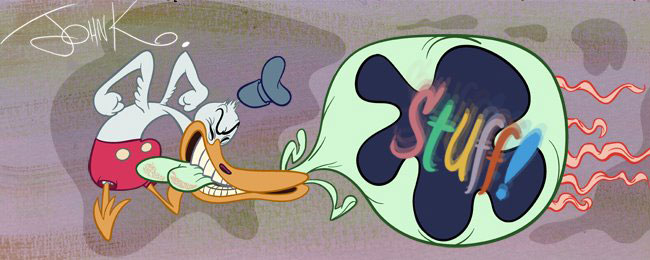
Here's some treats from Rex:


Here's an especially weird and interesting artist. Klaus Nordling.
He has a few posts about Johnny Hart, creator of B.C. and Wizard of Id.


Johnny also had a funny way of drawing pain. You really felt the charactor's agony from the gnashed teeth and hideous grimaces he (they) drew. I'll try to find some good pain faces in my own collection...
What beautiful layout and composition!
The inker changed the head shape and position from my pencil layout for some reason.
George's eyebrow is too short in the above and missing the eyebrow wrinkle that should accompany it. I think it's supposed to be the same eyebrow as the rest of the head that is being re-used from scene 3.

I'm sure that the reason these are so good is that Ryan is a big UFC fan and pretty solid himself.
This is impressive...Mitch is critiquing himself and improving his work with each critique. This is a good way to learn any skill - to be self critical. Some young artists love everything they do and don't take to constructive criticism well, which will inhibit their progress.![[sody01b.jpg]](http://4.bp.blogspot.com/_ONiNgqolO94/SIybw_yiS2I/AAAAAAAAATM/4yyvBrgGO6w/s1600/sody01b.jpg)
![[05c.jpg]](http://3.bp.blogspot.com/_1cXCkmrxxfY/SJATkd9jEjI/AAAAAAAAAO4/aZb-63pPjWk/s1600/05c.jpg)
![[ink_05.jpg]](http://2.bp.blogspot.com/_EpyQb9Rnmzg/SJAPn8b8naI/AAAAAAAAAnM/pneVMKu6jZg/s1600/ink_05.jpg)
KEEPING IT FUNNY AND APPEALING


I use crappy cheap lined writing pads and BIC medium ballpoint pens, so I don't worry about wasting good paper. I want to draw fast, not worry about construction too much and not worry about clean lines at all.


Ryan G
Here are some layouts of Slab N Ernie for those of you who are practicing clean ups and inking and are sick of the same George drawings.

Here's Amir Avni. Pretty damn good. I gave him a couple corrections.


Brian Romero stayed up all night designing these boxes. He's on his way to the Con now and I'm sure most of you are, so maybe you won't even see these.


Here she colored each layer so you could easily see how it works. Each individual part has to be inked all around, even where you won't see it in an individual frame.


****Note- see where I made the pencil lines thicker in the indentations of the smile line? That makes the cheeks and smile feel fleshy and full. Follow that through in the inking. It helps the expressions read.
If you are applying for inking or cleanup, these are stellar examples of what we need.

Her stylistic influences are obviously a different assortment than mine (with some overlap) but they are held together by the same exact principles that my artists aspire too.


Her designs are real designs, not just collections of unrelated abstract flat shapes. They have hierarchy - an overall statement that is then broken down into levels of sub forms and details that obey the planes of the larger forms.
Her drawings have form; she can draw from difficult angles and in many styles.
She almost makes me like Anime!
Beautiful shapes, contrasts, large negative areas, clear silhouettes, line of action, construction....the whole shebang of good drawing skills, and to top it off, a lot of individuality and fun!


Or try hiding them in your pant suit!

These toys are not only sculpted beautifully, but we've taken extra time and effort to color them slightly off register, just like old fashioned 60s toys!


And here's some more nifty toys to rock your ass off! Sculpted by Chris Peterson and company and colored by Beth Colla at Wheaty Wheat.
We are recreating this historic scene in toy form! Tell me you will run to the toy store and buy 'em!


This one by Aaron isn't bad either, though a tad o the wonky side:
Jim is doing some dynamite design and layouts on the George Show and I want to give him some help. I don't want to waste his time cleaning up his own roughs when he could be doing more drawings. The more Jim drawings in the cartoons, the more fun they will be!
He has a very specific elusive style and I need an assistant who has a natural eye for solid manly drawings and good perspective.
There are a lot of subtleties in Jim's style and I want to capture those.
You have to be really careful when putting a clean line down on his drawings that it doesn't flatten them out. No mechanical straight lines or even curves. Solid and organic at the same time.
The best way for a young cartoonist to break into the business is to be able to clean up the work of a star. You absorb a lot of information by osmosis. ( although we wouldn't turn down someone with experience either.)
these 2 frames will barely register; they are just there to connect George's pose from the last scene into his main pose in the new scene. It's a hook up that by today's regulations doesn't hook up. But in motion and cuts it works.
Here's the key pose that's based on the storyboard pose. Below are some breakdowns of main mouth positions created in layout. They all work within the emotion of the key pose but accent and color the dialogue.
In most cartoons the same few mouth shapes are used over and over again. This looks robotic to me-even in fully animated features there is an obvious formula for lip synch.
This is not your normal "O" mouth, obviously. I just thought I would do something related to the key mouth shape.
"OO" mouths work best when preceded by an "O" mouth. The O provides a quick accent that helps you notice the "OO".
"I" mouths are long and tall, just like the letter itself.
"T" 's can be used for "N", "G" and some other letters.

Google is getting some serious press, support, and power from Hollywood today. According to the New York Times, Google will be bringing on Seth MacFarlane, creator of the hilarious TV series "Family Guy", to work on a secret animated series called "Seth MacFarlane's Cavalcade of Cartoon Comedy." While that's nothing short of exciting, Google's distribution plan for the project is causing heads to turn.
"Google will syndicate the program using its AdSense advertising system to thousands of Web sites that are predetermined to be gathering spots for Mr. MacFarlane's target audience, typically young men. Instead of placing a static ad on a Web page, Google will place a "Cavalcade" video clip. "


Look how cool his early "Mutt 'N' Jeff" style was! Totally different than his own personal style that came a bit later.

Marc told me he bought a bunch of Gross strips from 1930 and 31 and that they were among his best.
Here's 3 of them and they are beautiful all right.
What I'm calling the layout "keys" are the drawings that match the storyboard expressions. These drawings, as I explained in my last post, are tricky to do and are just translations of the previous artists' storyboard poses.

these are connecting links between the main expressions and poses. This scene only had a couple of breakdown poses. I'm showing you a simple scene to get the idea across.
Next post, I'll show you breakdowns using dialogue mouths and expressions that really help act and color the scenes.

A layout artist have to be able to capture the essence of the attitudes, poses and expressions in storyboard but add:
What I'm really after are skilled artists that can do all this...WITHOUT TONING DOWN THE STORYBOARDS.
It's not an easy task. You have to be careful to not let the details get in the way of the line of action and overall clean silhouette.

The flesh and clothes wrinkles - if they stick out too much from the silhouette of the pose, will eat away at the pose and distract from the overall message.
Some artists have submitted samples of their layout interpretations of these same poses and had some of the problems I mentioned: adding too much sticky-outy flesh and clothes wrinkles that ate away from the pose.


Color style and paint technique are 2 different skills and talents. All these paintings by Scott Wills have very clever color styling and expert technique.
I've worked with a lot of talented painters. Scott stands out as someone who has a really high level of skill in technique.
Scott may possibly be the neatest painter I have every known. His work is super clean and precise.
Here is a potentially busy BG that is rendered completely readable and fun by Scott's skill in creative decision making. It's very colorful and fun without being stock cartoon colors.
In this mountain range, the values are kept close; not a lot of contrast. The contrasts are supplied by the washy greenish foliage against the pink sky.
The contrasts in the above picture are higher, suggesting that we are supposed to notice the tree branches. The details behind them are much lower in value contrasts, yet have enough detail to make the image atmospheric rather than completely cold and flat.
There aren't a lot of different paint techniques employed in this particular modern cartoon style-mostly drybrush and sponge - harkening back to early Hanna Barbera BGs (and Ren and Stimpy's version of that style).
But Scott's control of these minimal techniques and the clever color choices makes the BGs feel rich and much more colorful than what we normally think of as cartoon backgrounds. In the minds of many studios, cartoon colors mean garish colors. Garish equals colorful. Garish to me means ugly and formulaic.
Painters like Scott have an extra daunting task, having to take super flat and cold layout drawings like these and somehow warm them up and wring some fun and mood out of them.
Painters like Scott are rare. This is not the only style he does, unlike many artists who copy this style.


Garish color, amazing technique.
Beautiful color, garish yet expert technique.
This title card has a masterful use of hierarchical organization. From the overall framing of the trees around the title lettering, all the way down to the smallest level of individual leaves that radiate froM the branches and fill the washy clumps behind them. Each of those clumps flows naturally next to the other clumps and al fit together into an overall shape of foliage.
Each bush fits within an organized group of bushes and is also divided into sub forms and on down into the suggestion of leaves that flow around the forms.
Big heavy tree next to a skinny frail tree. Lots of space between them to make it easy for us to see the contrast.
The plank is basically a man made geometric shape. This contrasts against the wheat grass which is organized into its own overall flowing form with obedient subdivisions of grass and wheat, but is more organic than the board. The cans are also man made geometric shapes-but round stubby ones to contrast against the long flat rectangular board.
Drawing a thick forest can easily add up to hard-to-read anarchy, but with organizational skills and hierarchies and patterns you can create quite pleasing and functional scenes that help support the characters with a rich environment and atmosphere.
This 50s WB style is what many studios misinterpret today as "wonkiness" - no rules. Some modern layout artists see a license for anarchy in these stylized images. I see very slightly distorted perspectives and stylistic interpretations of reality, but with still great planning and organization of all the graphic elements into a quickly readable statement that has a purpose in the scene and story.


Then what I expect from the storyboard artist is to sketch the continuity. The drawings don't have to be cleaned up, but you do need to be able to draw the characters well -understand their basic shapes and their proportions.
You also need to understand the story and the personalities of the characters, so you can draw the acting. I will help by giving you some of my sketches and acting out the whole scene, either in person or over the phone.
The drawings have to have life, be specific and put the point of each gag and story point across without ambiguity.
Your storyboard should provide a strong framework for the pose/layout artist who will do tighter versions of the storyboard roughs and add some breakdown poses.

So if you have experience doing either storyboards or layouts and can draw both cartoony and fairly solid, and are going nuts from working on formula stuff, and are funny, then I need you.


Hierarchy:


Because he doesn't use a lot of detail in his scenes. It's all about the overall statement and clarity.
He uses plenty of empty space in between more filled areas.
He doesn't compose anything directly in the middle.
Nothing is evenly spaced.
He uses a combination of controlled framing devices and intersection. Nothing is placed in the scenes by accident.


He uses lots of contrasts, tall and thin, short and wide, characters posed on angles to contrast against perpendicular furniture and buildings. Organic VS geometric shapes.
His scenes have an overall clear statement. The whole frame reads as a design.
You know how you can tell if you have a good composition? An overall pleasing design statement and a clear image? Not just a bunch of clutter?
Look at the image small. If you can still easily read what is happening and the overall shapes add up to a clear design, then you are probably there.

Frank Frazetta has beautiful intricate details in his work, but his images also are stunning simple compositions. The whole image is a design.


In my opinion, a good clean handsome layout beats a ton of evenly spaced cluttered detail any day. Especially in anmated cartoons where you keep cutting from scene to scene.

He's great at girls too.


He seems to be heavily influenced by Owen Fitzgerald. The way he composes his characters together in a scene, the opposing poses, the groups of characters as blocks of people, the use of negative shapes...
He draws really cartoony cars that still are solid, and he can draw anything from any angle.
His clean compositions, full of pleasing negative shapes to draw your attention to the filled shapes.
Hierarchy of forms within forms.


I'm gonna break down some of his skills in further posts.