 Best lummox cartoon ever...


Thursday, April 29, 2010
Wednesday, April 28, 2010
Japanese Off Model Is Fun


 Here's Craig's version of off-model George that reminds me of the Japanese toys.


All Mediums Have Arbitrary Rules

2 major rules of the modern comic strip medium seem to be:
1) Design the characters so that they don't have faces-make it hard to figure out where the eyes, nose and mouth are.
2) Use the same drawing and poses in every successive panel.
 I don't know who makes these rules and wonder if someone broke them, would they get fired? If I were to submit a comic strip to a newspaper editor and you could tell where the faces were and something happened in each panel, would it automatically get rejected just because it didn't follow the rules?
Does the editor actually tell the artists up front: "Make sure you repeat the same drawing in every panel. Don't make anything up." Or, do the artists who grow up reading these kinds of comics just sub-consciously absorb the rules and have never thought about it? Will they read this and have a revelation?:" Wow! Of course! I could do a new drawing in every panel!"
I'm not picking on this strip; I don't even know what it is; I just found it at Ger's great blog. But it looks just like so many other strips that it makes me think that there must be an actual strict rule book.
I think media has always had some sort of arbitrary rules, but they seem more narrow and strict than ever today. I had a pitch meeting once and the executive asked me if my stories followed the acceptable plot formula of all the sitcom cartoons. I didn't even know there was a formula, but they explained it to me with much sincerity. Supposedly, you have to have an "a" plot that takes 8 minutes to establish-then you drop it altogether and purposely frustrate the audience. There also has to be a "b" plot that sneaks in at some pre-ordained moment and who knows, maybe some "c" plot that doesn't go anywhere as well. Do they really think the audience cares about any of this? Or thinks about it?
I may be nuts, but it seems to me that if you have to have everything tailored to an equation, you aren't really going to be very creative. I always thought the idea of being creative was to have the ability to make things up. - and to have great skills that wow the audience. All these formulae and rules tell me that anybody can now do these jobs. You just plug in the assets to the equation. Homer asset, Homer-like character asset, assertive female asset, sarcastic baby asset etc.
As far as the comic strip rule that makes it ok to have characters with no faces, I think that may have started in the 60s with this strip:
 The rubber stamp poses might also have started with Tumbleweeds.
I remember thinking how strange this was when I first saw it. Were these mistakes or just laziness? I never would have imagined that one guy's quirks would eventually become a mass religion that would take over the whole art form. Before this strip, there was a wide variety of techniques and everybody had faces, and each panel had different poses. That was expected. Now it isn't.
I'm noticing this mass-trend style thinking more and more today in everything I look at. All movie and TV posters look the same. "Reality" shows all have the same format (or maybe there are 2 or 3 variations). All networks have "bugs" and ads that crawl all over the screen while you are trying to watch your show. These are all things that almost nobody likes. People like variety and interest-yet someone who is in control imitates all the other mistakes that other people in control make.
I wonder if the idea of "creator driven" custom ideas and content will ever become the norm again.
 Who came up with the idea that regular everyday dumpy people should try to look tough when they pose for their reality show posters? And did congress sign it into law?


Tuesday, April 27, 2010
Wisdom Of Coker


 This sounds like he's talking about the animation industry:
http://comicrazys.com/2010/04/25/humorous-illustration-the-decorative-approach-paul-coker/
Sunday, April 25, 2010
Specific Acting - Sven Hoek
A specific expression can't be described in one or 2 words. It also hasn't been used a million times -and only in the cartoon medium. "Happy" is not specific; it is general. Even "very happy" is not specific. A specific expression is one you make up just for one scene.
 Retarded, yet alert and obedient to responsibility.
 Retarded in automatic response mode.
 Dreamy version of automatic response retard.
 Eager to share a secret idiotic thrill.
 Slow realization of a new and wondrous sensation; not sure whether it is good or bad yet.
 Nervous and guilty but having an uncontrollable urge to admit a dirty secret.
 Admitting the sheer joy of a shameful pleasure.
 The face of ecstasy you make only when snugly immersed in wet litter.
Specific expressions can't be described as clearly and distinctly as they can be drawn. "A picture is worth a thousand words" - unless the picture is generic.
These kinds of expressions would not be created at the model sheet stage by a designer. The designer can't anticipate every scene of a cartoon and all the emotions a character will experience. Specific expressions have to be created by either the storyboard artist, the layout man, director or animator. They are customized to the character and each specific moment within the story.
If you are working on a production where everyone has to stick to the model sheets, then your cartoon will not have specific expressions. It will have pre-designed generic expressions.
This makes most cartoons less interesting on an acting level than live action. Real people do not have a mere handful of pre-determined expressions created by someone else. They have their own unique myriad of expressions and can make them spontaneously with little effort. We cartoonists don't have it so easy. We have to imagine each expression and then figure out how to draw it - a very unnatural procedure. This might explain why it hardly ever happens.
 Retarded, yet alert and obedient to responsibility.
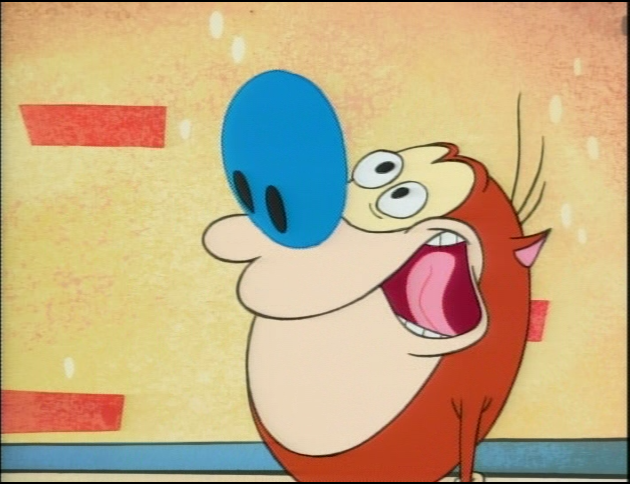 Retarded in automatic response mode.
 Dreamy version of automatic response retard.
 Eager to share a secret idiotic thrill.
 Slow realization of a new and wondrous sensation; not sure whether it is good or bad yet.
 Nervous and guilty but having an uncontrollable urge to admit a dirty secret.
 Admitting the sheer joy of a shameful pleasure.
 The face of ecstasy you make only when snugly immersed in wet litter.
Specific expressions can't be described as clearly and distinctly as they can be drawn. "A picture is worth a thousand words" - unless the picture is generic.
These kinds of expressions would not be created at the model sheet stage by a designer. The designer can't anticipate every scene of a cartoon and all the emotions a character will experience. Specific expressions have to be created by either the storyboard artist, the layout man, director or animator. They are customized to the character and each specific moment within the story.
If you are working on a production where everyone has to stick to the model sheets, then your cartoon will not have specific expressions. It will have pre-designed generic expressions.
This makes most cartoons less interesting on an acting level than live action. Real people do not have a mere handful of pre-determined expressions created by someone else. They have their own unique myriad of expressions and can make them spontaneously with little effort. We cartoonists don't have it so easy. We have to imagine each expression and then figure out how to draw it - a very unnatural procedure. This might explain why it hardly ever happens.
Saturday, April 24, 2010
Book Revue - Wolf With Axe

 I think it's pretty obvious that Clampett was the most influential 40s animation director. His "looney" energy, character driven comedy and wild invention dragged Chuck and Friz along practically against their will for years. The whole attitude of Looney Tunes is based on Bob's personality (and some of Tex's). Everyone was influenced by and imitated Clampett superficially, but there are some things he did so well that almost nobody followed up on them. His style of custom movement for example. He directed the motion in his cartoons like nobody else. By the mid 40s, it was never enough to just tell the joke or get the character from this pose to that pose. The motion itself is mesmerizing. It's not merely "cartoony" as in early 30s cartoons. It's cartoony and unrealistic, but unlike early cartoons it has weight power, emphasis and control. It feels more real than reality. Clampett found a way to combine the magic and invention of early cartoons with the skills and principles of Disney animation.
Book Revue, like Tokyo Woes is a practical encyclopedia of amazing animation techniques that he just dumped on the whole business to let everyone pick up on them - and no one did. I don't get it.
 Here's a scene that has a ton of energy and power, and it's totally cartoony.


Antic, Bounce, swing and antic
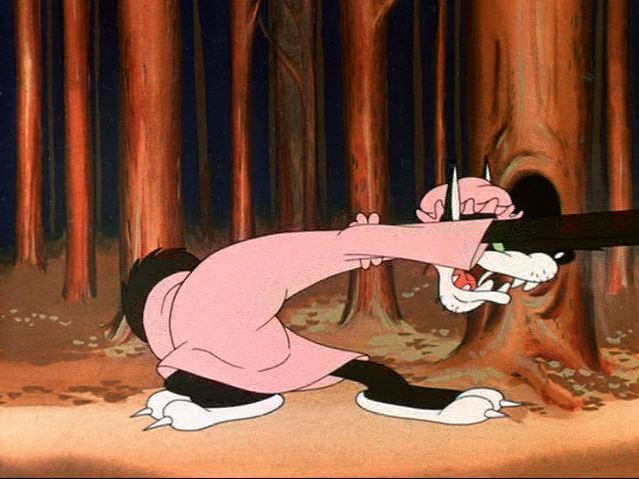 This would merely be an antic in anyone else's cartoon, but here it's like an animation tour de force. The wolf actually antics a couple times as the axe bounces from its heavy weight.


 ..then instead of just going from the antic directly to the tree, the wolf swings the whole axe all the way around first. This builds up way more energy than a direct antic and hit. - he uses this same technique to get the characters into the scene. They don't just run directly to the tree - they go all the way around first, but it's animated so fast that you don't really see it. You feel all that extra speed and energy though.
 Clampett packs more action into a scene than anyone, yet he does it with such perfect timing that you don't miss anything important. All the actions take place within a structured hierarchy.

Axe Hits and Recoils
 When he finally hits the tree with the axe, he generates more power with this crazy long vibrating recoil...


CUT: Wolf wobbles and hat pops off
 This scene always baffled me. I never quite understood what was happening, but it's animated so powerfully and with such great timing and fun that it just stands out like a piece of pure animation candy. The animation is the reason for it's existence. It's not exactly needed for story or even for the completion of the point of the scene. It's just really Goddamned cool.


http://www.cartoonthrills.org/blog/Clampett/46BookRevue/WolfRevueAxe-desktop.mov
The only person smart enough (that I can think of) that ever took advantage of Clampett's great animation techniques was Brad Caslor - almost 40 years later in his NFB cartoon "Get A Job". After Clampett left Warner Bros. in 1946 his style of movement was replaced (or abandoned) quickly with pose to pose animation and formula. Even his own animators never did this kind of thing again-probably because no one would let them.
To me, this is the whole reason to even do animation. -To make things move with such inventiveness and vigor that no other medium can compete with it. It should be fun to watch even with the sound off. Story, characters, design, backgrounds and the other arts we use to supplement our medium are all extra gravy, but without the basic ingredient of customized magic movement we are not taking advantage of what it's all about.
You can find better stories in books and movies. Better illustrations in magazines and on book covers, richer characters in Dickens and in classic sitcoms. Where else can you get get magic moving eye candy but in animated cartoons when they are in top form? - and why do so few places and people want to give it to you?

Subscribe to:
Posts (Atom)