

 Here's a really funny Chuck Jones cartoon. It's not totally typical of his style. It's a lot wilder and makes me think he was trying to do his version of Clampett.
 Has anyone noticed that the copyright dates on the Looney Tunes DVDs don't match the dates in the filmographies?

 Who's the animator that gives Daffy a pointy lower beak?

When I was watching "You Were Never Duckier" it reminded me of some animation in "Pest in The House". The way Daffy swayed his head back and forth and paused his head in profiles before hitting an accent in the dialogue.
The animator here employs some of the same general punctuation techniques that I posted in "You Were Never Duckier".


 When Daffy starts walking, the animator works up a rhythm, making Daffy sway left and right.
 The walk doesn't seem to be hitting a consistent beat though, which strikes me as odd.
 By the time Daffy's feet are out of frame, the walk gets really erratic. It looks like the animator is just animating totally to the dialogue and putting steps wherever they fit in the rhythm of Mel's acting.
 Daffy antics during a pause in the dialogue by turning his head to the side and then...
 "Blow!" Hits the accent
 A bunch of quick little steps at the end.
Straight Ahead Acting To The Voice Track
http://cartoonthrills.org/blog/Jones/47Pest/Daffyact2.mov This scene had to be influenced by Scribner's animation in "The Great Piggy Bank Robbery".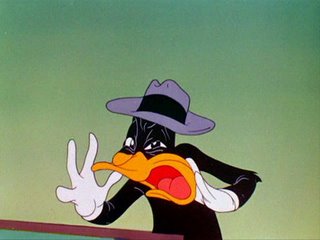
http://johnkstuff.blogspot.com/2006/03/specific-acting-in-looney-tunes-duck.html
 The animator here goes into a more straight-ahead approach (although there are some inbetweens) and just draws wacky poses and expressions to match the voice track.
 He still uses the antic with a profile and swaying back and forth.
 When I watch the scene closely I start to think maybe the two approaches are fighting each other. It would be hard to control and continual rhythm of swaying back and forth, while at the same time being inspired to draw something custom for each inflection in Mel's great acting.
 I think it works great though.
 He hits some of the accents by moving the head down in between the swaying left and right.

 It's a loose swaying pattern, but made organic by not following a perfect mechanical timing and posing.

Same Idea, More Pose to Pose

If you follow his cartoons chronologically, it seems that way.
 His early to mid forties have the loosest animation of his career. Some of his animators drew a lot of their own poses and fitted them between Chuck's layout keys. By 1948, when Jones hit his entertainment stride and was doing his funniest cartoons, the animation was still good but much more tightly controlled to hit Jones' poses.
PHIL MONROE
http://johnkstuff.blogspot.com/2007/12/acting-head-motion-to-punctuate.htmlBy the way, Greg Duffel solved the mystery for me of who animated the scenes I posted in "Duckier".
Hi John: Sorry I'm so late in getting back to you. I haven't checked this email address in a long time. The animator of that scene (and I'm sure someone has already told you) was Phil Monroe.
I believe that Monroe was first with Tashlin, then Freleng and then with Jones until the early '50's when he took a job with Leo Burnett ad agency and developed the more cartoony Kellogg's animated characters like Tony the Tiger and Snap, Crackle, Pop etc. etc for tv commercials.
He hired lots of Warner Brothers animators and studios to make the commercials.
He came back to Warners in the latter days to direct some of the last Warner cartoons in the 1964 period after they fired Chuck. He did the final Sheepdog and Wolf cartoon as well as a Bugs and Daffy opus set in the far north.


Chuck brought Phil in to direct the Chipmunks TV special in the late '70's after Chuck had redesigned the Chipmunks for Bagdasarian.
Phil served as an animator for Chuck on the "Return of the 24th and a half century" debacle as well as some new Roadrunner material released with it.
I've even seen some footage of Phil talking about animation in a Chuck Jones documentary filmed in the 1979 or so.


