


 Animation is an imaginative medium, capable of anything you can dream up.




 Percy has a condition. He tends to swell and fill with viscous fluids.
 But then comes release.
 THE 80S WAS A BIZARRE TIME
 These were from a presentation for a cartoon show based on "The Garbage Pail Kids". I knew from the beginning that even after somewhat toning down all the gross stuff that the show would never sell, but CBS really wanted to develop it - because the bubble gum cards were a huge hit with kids.
 These look so mild to me now, but were considered really radical in the 80s.


 Some people think that bad drawing is just another "style", among many. People like to say "Not everything needs to be cartoony" - which is usually the straw man argument used to endorse stiff bad drawings like you get in most TV cartoons from the 70s on.
 Even when good artists who worked on those bad stiff TV cartoons tell you these cartoons are bad and that we are ashamed to have contributed to them, there are still holdouts who won't believe it.
 Well there's nothing anyone can do about that.

 I sometimes wonder why some folks who so strongly disagree with the whole point of this blog keep coming back every day just to get mad.
 I agree that not everything needs to be cartoony. Everything isn't. Far from it. But in the cartoon business there ought to be at least a few homes for cartoonists to do what cartoonists invented and have had stolen from them.
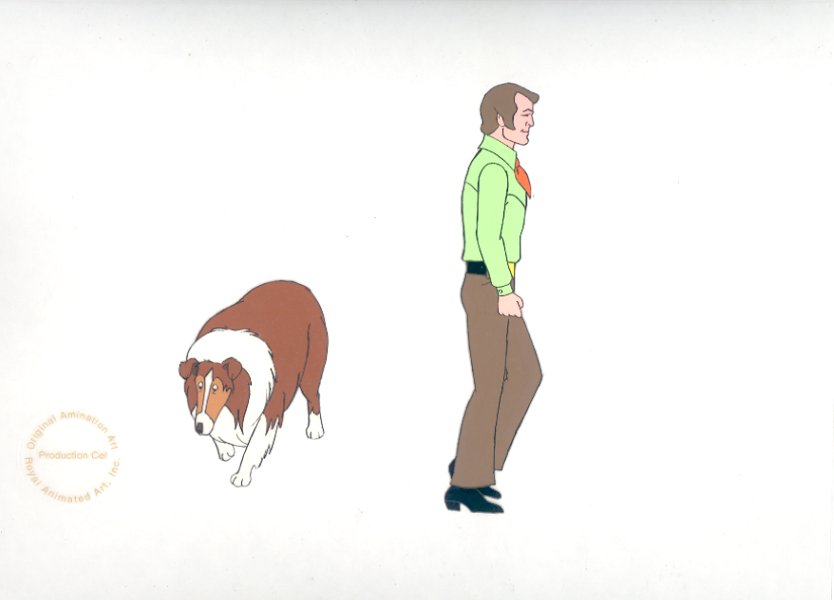
 Eye contact was a seemingly impossible skill at Filmation, no matter how much they begged for it.


 Will Finn said...
 i gotta add one more memorable moment that's relevant to "on model" dogma:
my first week on HE-MAN, the cleanup crew were given model sheets of "Ram Man" where the designer had drawn his thumbs on the wrong side of his hands.
In his "full front" pose and side pose, the thumbs were right, but in the rear pose, they were drawn incorrectly, it was an obvious mistake.
When we pointed this out to the clean up supervisor, she went ashen and told us we had to follow it anyway, until the proper protocol had been addressed to look into the problem. Whenever he turned his back, we had to have "Ram Man's" thumbs inbetween around to the wrong side of his hand to be perfectly "on model."
I swear to God I am not making this up.
It took a couple of weeks, but we were eventually given new "corrected models" and the crew went into overtime to re-do all the incorrect clean up we had been doing in the interim.

If Kafka had ever written pure farce, even he could not have topped FILMATION.
P.S. the original FAT ALBERT characters were done by some very good artists for 2 TV specials that were not done at FILMATION. These are for some reason not available and have not been aired in nearly 30 years. When the subject was sold to TV FILMATION, bastardized the models and the results were...well, typical.


 That sounds like you'd have to go to art school in France for 10 years before you can get a job at Filmation.
 This instruction means: only use 2 poses for dialogue. A front or 3/4 view. That's it. That way you can keep the rest of the drawing completely still- and don't forget to trace it! But be creative like the manual says.
 Be creative, but make sure if you make a radical "extreme change" like evening out the arms above, that you get official permission from the foreman.
 Test: name each of their emotions.
 Do I even need to say anything?
 I will anyway. In terms of sheer ugliness, it would be hard to beat this stuff. DiC came out of nowhere in the 1980s and seemed to have no rules or standards as to what made cartoons work. So they just made it up.
 The combination of the worst character designs I'd ever seen, with sending all the creative work to the cheapest service studios around the world added up to a style that makes Filmation look like 40s Disney.
 When I went to work in-house for DiC, they had not even heard of what a layout was- let alone an animator. They had storyboard artists that had never animated, and believed that any camera angle and any number of characters in a scene was no problem to animate- because they didn't have to do it. They drew storyboards with downshots of characters they couldn't draw themselves even in a straight on pose and then sent the storyboards to some poor nation across the globe. 6 months later, finished cartoons would show up back in LA and everyone here would slap each other on the back for the magic they had achieved- not knowing what miracle made the stuff move- when it actually did once in a blue moon.