 My friend Jill sent me these frame grabs she made from Tex Avery's "Wild and Wolfy:.
 I wonder why there aren't more animated sexy girls?
 It seems like such a natural thing for cartoons.
 Of course it isn't easy to do.


 My friend Jill sent me these frame grabs she made from Tex Avery's "Wild and Wolfy:.I wonder why there aren't more animated sexy girls?It seems like such a natural thing for cartoons.Of course it isn't easy to do.


 Here you can see that the second step corresponds to the first step. The positioning of each position is not an exact mirror image of the corresponding position. If it was, the walk would look stiff and mechanical.
 These are drawings made up entirely of 40s animation principles. Starting with very strong construction. All the characters are made of simple sphere, pear and tube shapes. I say simple, but that doesn't mean it's easy to put them together so well.
 Note that every character is the same design as Tom and Jerry and only superficial details that define the characters' species are differentiated. The chicken has feather and a comb. The dog has jowls. The pig has a snout and pig ears, etc...but everything else about them is exactly the same, just like Tom and Jerry. It made sense as animators were learning all the difficulties and principles of movement that they kept the characters fairly simple to draw - and solid, so they could easily turn them around in all dimensions. Many early characters hadn't evolved individual character designs yet. But they had everything else important to animating and clarity.
 Clear Staging/composition
 Line Of Action
 Silhouettes
 Opposing Poses
 The one stylistic statement that is consistent in this comic is that all the perspective in the backgrounds is rounded. Round streets, round fences and houses etc. This was a standard early 30s cartoon style and you don't see it in many 40s cartoons.
 By the 1940s, most of the advanced studios had gone past this pure, rounded spheres and pears approach and were starting to vary their character designs, background designs and some directors' styles were becoming very individual.
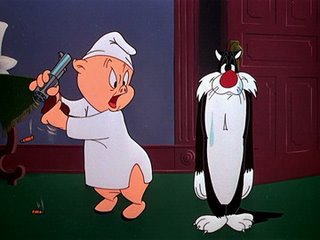 Bill and Joe hung on to this basic early 40s style longer than anybody.
  Joe himself was reluctant to change as long as his cartoons were popular and winning Academy Awards. He didn't start creating individual characters with their own unique designs until forced into television. Then he hired Ed Benedict who gave the Hanna Barbera studio a style and a cast of individual characters on the cheap.
 and he mixed it with Ed's later.
 That was goodbye to pure pears and spheres (Preston Blair) and hello to more complex shapes, curves and angles,
  but it was not goodbye to good solid drawing principles. Not yet.
 http://johnkstuff.blogspot.com/2009/05/eisenberg-subtleties-studies.html


 USE NEGATIVE SPACES WITHIN THE FORM!
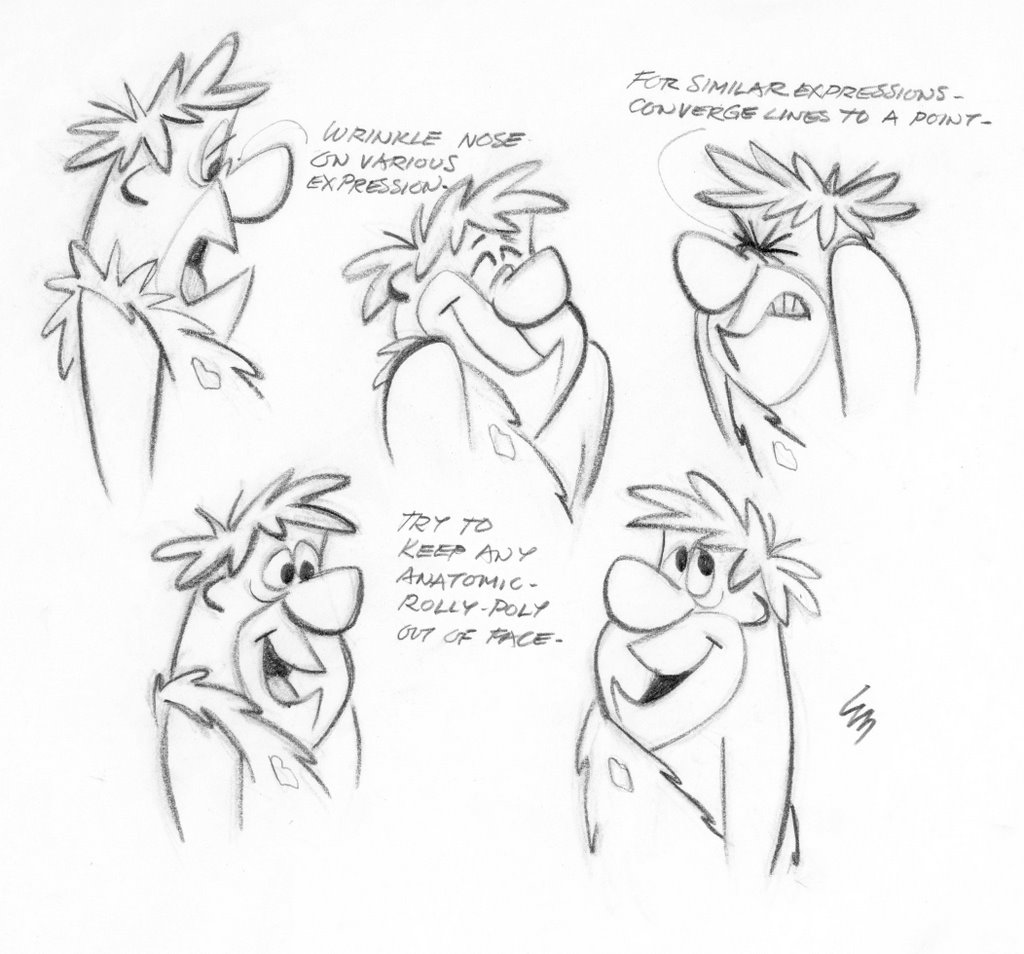
 Face is kept well to the front, with lots of negative space behind it. Top of face (eye area) is smaller than bottom of face (mouth area) for design contrast, Nose isn't in the middle. It's not symmetrical or evenly proportioned. If it was it would look mechanical.
 Dino's whole face is squashed together at the top of his head. Same with the top of his body where his arms are cramped together with no negative space. These are easy corrections if you are thinking about it.
 A vertical line running down the top of the face. Horizontal lines under and at top of eyes. These construction lines follow the form of that part of the head. This is where today a lot of people get it wrong.
  They have the plane of the eyes contradict the plane of the face they are sitting on. (It came from a mistake in a Ren and Stimpy cartoon, and everyone thought it was on purpose.)
 Disney eyes are very specific to them and their followers. You can always tell a Cal Arts animator by certain things they can't break out of - like Disney eyes. Sometimes the eyes have 4 corners. 2 subtle ones at top. But they always are thinner at the top, wider at bottom.
 Disney eyes and same head construction on all these characters.


 From Mark Mayerson's site:
 By the time of 101 Dalmations, the handful of stock Disney designs were all morphing into one. Every character in Dalmations has the same construction and eyes. Maybe Cruella has a very slight variation in head proportions, but the exact same eyes and eye expressions. This is the Don Bluth bible, and later in degraded form, the Cal Arts bible. Same character designs, same eyes over and over again.

 Slightly different jaw. Same eyes, only bigger. New nose! The Goth cartoonist's template.
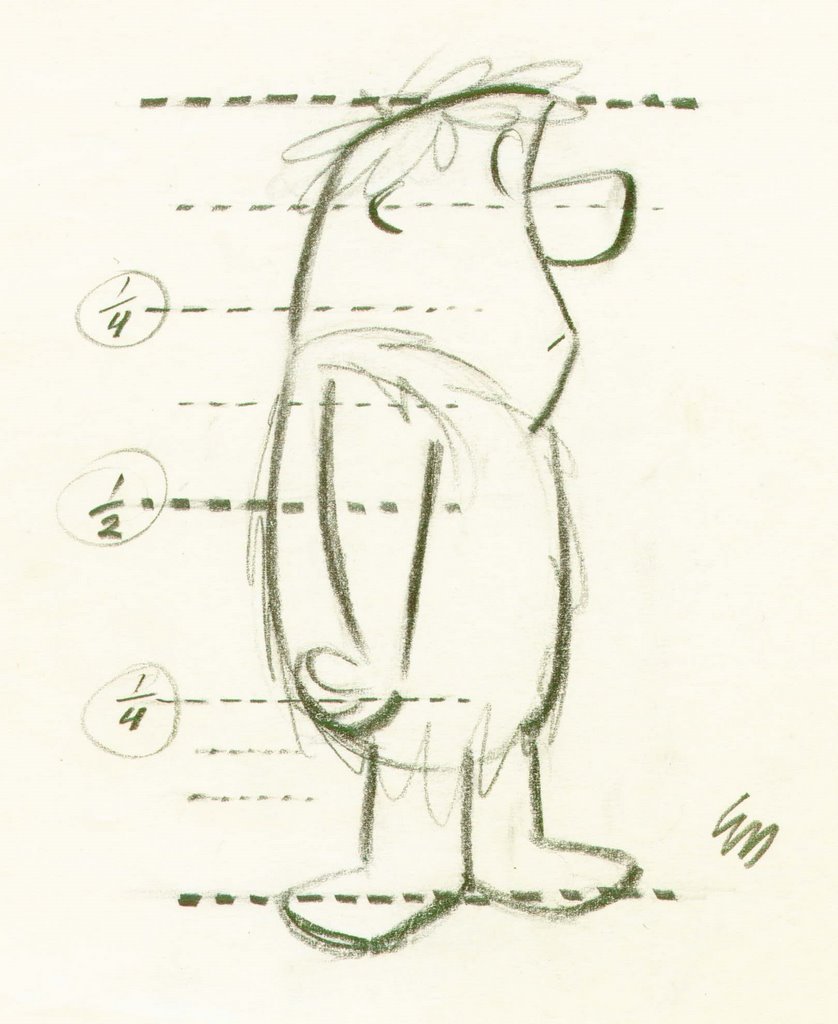

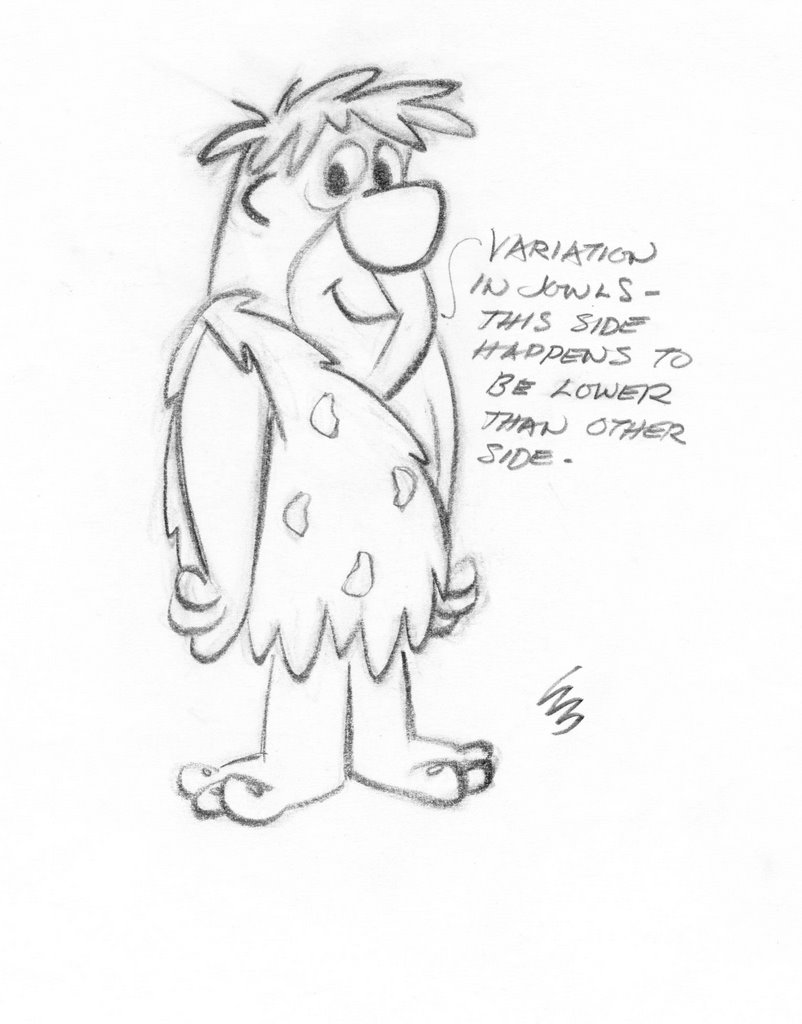
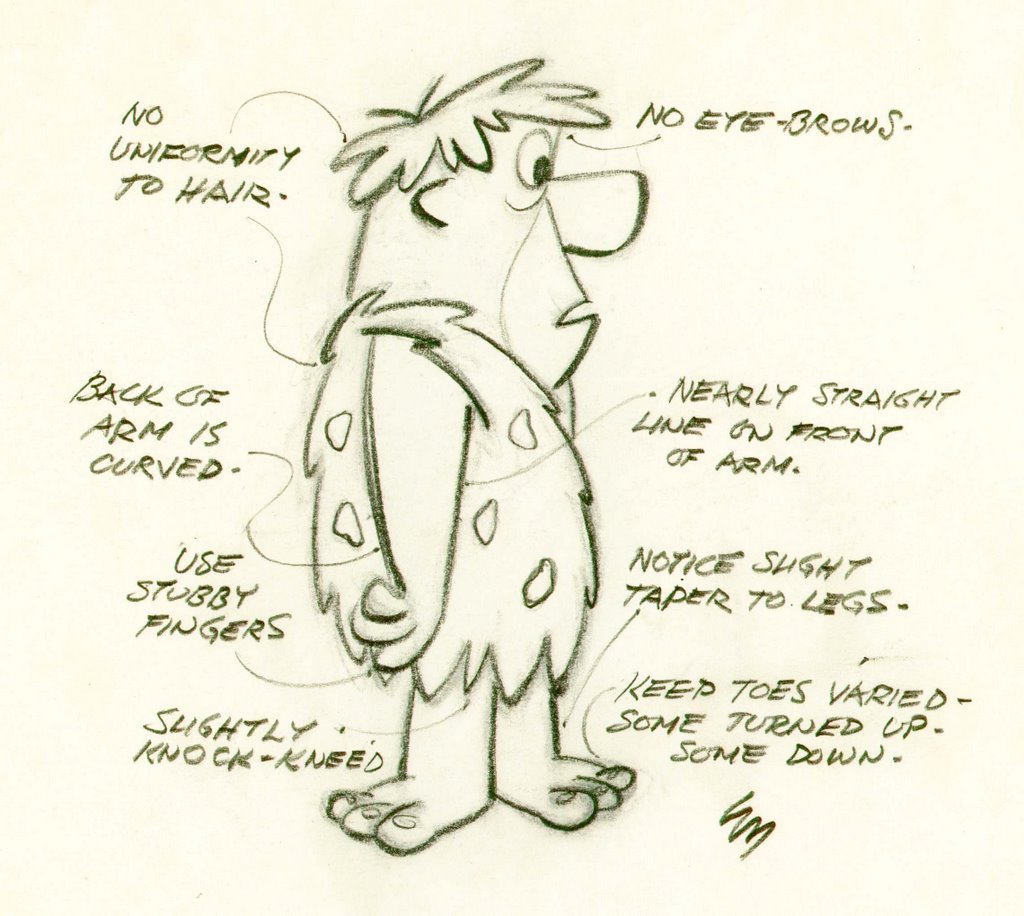
 Animation is infamous for recycling designs. (And even more for recycling stories-but I'll save that for a rant)
 Here's a much funnier variation on the head shape-and with original specific eye shapes. Try to catch all the subtleties. It's hard!