It happened in the late 40s.
ANIMATION GREW FASTER THAN ANY ART FORM IN HISTORYFrom the 20s and through the 30s animation exploded as an art form. From simple stick figures to a whole new discipline that took advantage of a visual element that was never possible before - movement.
A few animation "principles" were developed and refined within less than a decade!
IT WAS THE MOST APPEALING OF ALL VISUAL ARTSAnimation, born of the also recent invention of cartoon art and comics was a whole new way of looking at the world.
ITS WHOLE POINT WAS TO DISTILL THE FUN - LEAVE OUT THE BORING PARTSIt took all the boring parts out of life and just left the fun parts. It was fun to look at and fun to watch move. It told funny, ridiculous stories. It was the ice cream of the arts and because of it became the most popular of all the visual arts. Most people like fun - except executives who prefer market research.
To me the first half of the 20
th century could be known as "The Cartoon Age" just as well as "The Jazz Age" or "The Age Of Progress".
IT WAS NOT CONSIDERED ART- IT WAS MERE "ENTERTAINMENT"Astoundingly, this unbelievable new creative medium didn't get much respect - surely because it was so inventive and obviously directly enjoyable by so many people.
Some comic strips artists were respected (and made tons of money) but animators - who were doing a much more sophisticated form of cartoon got paid less and no respect. Most animators, excluding Walt Disney, were practically anonymous - unlike their comic strip counterparts who were rich and famous.
ANIMATION ARTISTS CAN'T DRAW AS WELL AS ILLUSTRATORS AND GET LESS RESPECTEven the best draftsmen of animation's Golden Age couldn't draw as well as the average illustrators from the same period and I think many suffered an inferiority complex because of it.
This was probably mostly Walt Disney's fault. His own inferiority complex was contagious and poisoned much of the rest of the business.
He diverted almost everyone away from their natural cartooning instincts and made them all want to create "quality" rather than fun. Quality meant animating things that other mediums could do better and much more easily, like:
More detailHuman proportionsElaborate special effectsSpectacleCryingTribes of Naked BabiesNone of these things lend themselves naturally to animation. They just make the work harder and eat away precious time that could be better spent being imaginative and doing what only cartoons and animation can do.
But creative cartoons and impossible magical animation don't get respect, remember. They just generate tons of money for the studios that release them - who in turn crap on the artists who made all the money for them.
ANIMATION ARTISTS TOOK MOVEMENT FOR GRANTED BECAUSE THEY WERE SO GOOD AT ITAnimators too busy comparing themselves unfavorably to illustrators, comic strip artists, live action movies and other related forms of art didn't realize how wonderful and unique their own skills were. The things you could only do in cartoons and the crazy amount of skill the animators developed in performing them came so natural to them that they didn't think much of them.
ANIMATION FIGURED OUT ITS BASICS BY 1940 - then stoppedWhat we think of today as "animation principles" were pretty much figured out by 1940 and nobody invented any new ones after that. For a few more years, they developed and refined this handful of techniques and produced the best animation in history.
ANIMATION LEADERS AIMED MORE AT THE DRAWINGS THAN THE MOVEMENT BY THE MID 40SWhile most animation leaders stopped developing new techniques in movement itself, they instead started thinking about "improvement" coming only from the drawings themselves. Different studios and leaders approached this in different ways, but all of them slowed down or reversed the tools that made animation its own unique art form.
DISNEY - MORE COMPLICATED DESIGNS - SAME MOTION PRINCIPLES AND FORMULASDisney kept designing more and more complicated or "realistic" characters. They didn't change the way they moved them so much, just made it harder to move them.
Taller proportions-long legs. Much harder to move convincingly.
More detail - the more details on a character, the slower and more difficult it becomes to animate the character. More effort is expended on just not making jerky mistakes than on making the characters fun and entertaining. For 25 years, Disney's characters became harder and harder to draw, but the animation hardly varied at all. The characters moved the same way the simpler characters did - according to old Disney formulae.
Other animators see how technically well animated these elaborate Disney features are and know the incredible effort that went into them and are impressed. This doesn't automatically impress laymen or the audience though.
CHUCK JONES - LESS ANIMATION, MORE CLEVER AND STYLISH POSESChuck Jones developed his own unique drawing style and humor and year by year, toned down the animators' input or directed it to point to Chuck's poses and expressions. By 1948 he was making his funniest cartoons, but the animation was less inventive and fun for its own sake than just a couple years earlier.
By the late 50s the animation had become completely stiff and Jones' drawing style tastelessly out of control.
UPA - MORE LIKE RESPECTABLE MAGAZINE CARTOONS - STYLIZED - LESS ANIMATIONMagazine cartoonists drawing for Punch or The New Yorker got a lot more intellectual respect that cartoons from the "funny papers" or animation. Don't ask me why. The
UPA artists drifted towards these graphic styles and abandoned creative movement - and definitely funny drawing almost altogether.
IN GENERAL - MORE TALK, LESS WALKBy the late 50s most non-Disney cartoons were left without clever and fun motion. Instead they traced back layout poses to make evenly timed
inbetweens. The characters talked a lot more than they moved.
Disney continued doing elaborate movement because they could afford to and they believed still that that was what animation should do - it should move. At least!
But it was mostly movements you had already seen before in previous features.
The exception would be the imitation
UPA cartoons they did - the ones you see imitated in all the "Art of
Pixar" books.
These flattened Disney cartoons look to me like a misunderstanding of the
UPA philosophy. Disney made harsh looking cold designs, but animated them very fluidly as if they were still animating Mickey and Donald. It's definitely clever (the first time!) but not very entertaining - except to Cal Arts alumni.
CLAMPETT LEFT WARNER BROS. IN 1946All growing art forms need bold charismatic talented leaders.
Clampett was the biggest most influential leader in funny cartoons for the first half of the 40s and everyone imitated him - even Disney was obviously influenced.
His cartoons were constantly inventive and he wasn't a total slave to the "Disney principles". He more than anyone, kept expanding the medium of impossible movement (animation) and dragged the rest of the business along with him while constantly creating and developing characters.
Then at the peak of his inventiveness and the peak of the Golden Age - he up and left!
Some say he was fired, he says he quit. But I think this single event in animation history was the most catastrophic thing we've ever endured. His momentum carried Warner Bros. for a few more years even as they gradually slowed down, but it created a hole in the art form that has never been filled.
TEX AVERY LAST LEADER TO KEEP UP CARTOONY ANIMATIONTex Avery was the last leader to continue doing
cartoony inventive animation, but he had less influence than
Clampett because he didn't create characters. He made gag cartoons based on funny ideas rather than stories about funny personalities.
History has decided to award him the creation of Bugs Bunny, somewhat arbitrarily in my opinion - but how could it be that someone who created the greatest animated cartoon character in history could never again create even 1 character that the public really wanted to follow?
TEX DIDN'T CREATE CHARACTERS AND THE PUBLIC WOULD RATHER STICK WITH LESS FUNNY CHARACTERS THAN MORE FUNNY CONCEPT CARTOONSTex still made some of the funniest cartoons ever, but we remember Chuck Jones, Hanna
Barbera and Disney more. - because we associate them with casts of characters. Most humans would rather watch continuing adventures with characters they are familiar with than a series of brilliant one-shot cartoons. Of course we love star characters the best, but we'll even take less charismatic continuing characters if there aren't any stars around.
It's a natural impulse for us to bond with friends. We bowl with our neighbors and party with them - even if they are not the most interesting folks in the city. Today's networks have come to realize this. They will leave a boring series on the air long past the period where they aren't getting ratings - because the audience will soon get used to the characters and accept them and even believe they are entertaining. Especially since there is no competition.
THE ENDTex was the last guy to uphold cartoon animation's roots, but he wasn't enough of an influence by the 50s to halt the ever more decadent trends that the rest of his colleagues were following.
Progress died and even worse - cartoons as a unique form of entertainment and art died.


 I have always been fascinated by "animation hair". (meaning hair styles in animated cartoons from 1980 and likely into the next couple centuries) You probably have too. If you ever met anyone in real life who had animation hair, your first instinct would be to beat the crap out of him.
 Characters in these modern animations do not have natural instincts though. They just magically accept the galling hairstyles - and sideways nipples.
 For a few years in the 1980s teenage suburban boys who hung out at the Galleria actually had a form of animation hair - hair that was half shaved and half long. I used to call it the "2 Barber Style" - as if 2 barbers had fought over what kind of hair style would look best on you and ended up compromising.
 The style didn't last long in the real world (probably because of the instinct mentioned above) but it has been reverently preserved in animated features (animated features are a veritable museum of archaic and mummified atrocities). Someone in charge of how to raise your kids believes that regular folks would want to hang out with people who have this hair.


 Girls have their own forms of animation hair too. This one above has "Furry Hair" - which is actually not hair at all, but a character from Disney's Robin Hood curled up asleep on top of her head.
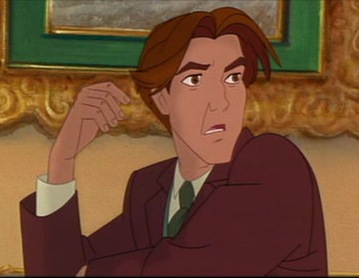 Here's a fine example of animation hair below. It's so wacky I can't even find words to describe it.
 What if your Dad came home one night with this hair style?
 ANIMATION EXECUTIVES REVERE SHEMP
 As everyone knows, Shemp was the pillar of hipness and animation executives have always liked his hair sense. A lot of them even wore the Shemp cut themselves. Shemp lives on to this day in animated features.
 To offset the Shemp hair style, some animation executives have devised the "Too far away nose".
 I had dinner one night with a Disney TV executive to discuss some show ideas. I had trouble concentrating because he had Shemp hair, and it was flopping around in front of his face and flinging his soup at me. One thing he said did sink in though. We were talking about how we got into animation. He said: "You're lucky John. You've always known what you wanted to do and you have the talent for it. Me, I have no talent and I wandered around aimlessly from job to job for years until, by accident I just sort of fell into a job as assistant to a rich guy who had just bought Harvey Comics. He made a deal later to make some cartoons and lo and behold, we were in the cartoon business! So I just fell into it and here we are! But I don't really know anything about cartoons, myself."
 Paper fold out hair was big for a while too.
 This animation hair style is the natural habitat of the Cardboard crunching Bug.
 Under those luscious blonde flaps lives a horde of these dung rolling creatures.


 Here's another indescribable animation hair style. Even Shemp wouldn't try this.
 The low forehead goes well with animation hair and too far away noses.
 Animation hair is so hard to keep in order that even the tiniest movement could get it out of place, so animation characters are careful to keep their facial muscles under strict control; any sudden expression might mess up their flaps or even worse - reveal their emotions.


 Feel free to print this blog post out and bring it to the barber the next time you want to look as hip as the boys in animated features. - or if you want regular Joes like Moe to tear your tonsils out.
 "I refuse to go out of style!" - Shemp Howard, 1952


