There are many ways to portray emotion - with body language, gestures and movements, (in animation we cheat a lot by using music and staging) but the most obvious tool we have to convey our feelings is the face.

Animation is far behind live actors and real people when it comes to expressing emotions. We generally rely on the simplest expressions of very basic emotions. Now and then, someone will take an adventure off into more specific acting, but it's rare and difficult. Even if you are like me, and you want to do more specific acting than what is typical of animation, you have to start somewhere. You have to understand what elements make up an expression, and how they are connected to each other.
I actually feel kind of ridiculous explaining expressions that are so simple, so forgive me if some of this stuff is obvious. But it won't be to people who are just learning to draw cartoons.
Generic Expressions that apply to everyone

Pincocchio is obviously a fantastically animated movie; a real classic in every sense, but you can see how simple his facial anatomy and expressions are from this model sheet. Almost every character in the movie has the same construction and makes the same simple expressions.
Sad
Sad is made by the eyebrows pulling up in the middle of the face, and drooping down on the sides.
The eyebrows pull the eyes with them into similar shapes.
The mouth droops down at the sides.

Scared

Scared is similar to sad but with eyes and mouth wider.
Mad

"Mad" is mostly defined visually by the eyebrows. They point down in the middle of the face.

The mouth is in a frown position; the sides of it pointing down - the opposite of the eyebrows.


"Take" or Surprise
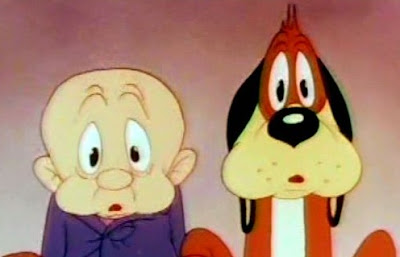
A "take" is what you do when you are surprised. It's an instant reaction of shock. Your eyes open wide, and you tend to open your mouth too. This can be subtle or taken to extremes.


 ___________________________
The Basic Elements Of Expressions
Expressions are made up of basically 4 elements.
2 Eyebrows
Betty's expression here is almost neutral. Her mouth isn't doing anything and her eyes are barely doing anything. The eyebrows, more than the other elements are causing her expression. They are telling us she is worried, because they are high in the centre of her face and low at the sides. This is the same position of a sad face-but without the sad mouth.
 4 Cheeks
Your cheeks don't cause expressions, but they react to them. The mouth is the instigator. If the mouth smiles and moves up at the sides, it pushes the cheeks up with them and squeezes them together and puffs them out.


If the mouth frowns, it pulls the cheeks down with it.

__________________________________________________

I don't think it's enough to know just what the individual elements of an expression are. You need to know how they relate to each other. When one moves, it pushes or pulls everything else around it. All your expression elements are attached to each other. Your eyebrows are on your skin, your eyes are in your skull, your mouth is a hole that is surrounded by lip muscles that connect to the cheek muscles. And all these elements not only connect to each other and affect each others' positions when they move; they also have to
wrap around the shape of the individual character's head. This is all so complicated that it explains why animated characters are generally simply constructed - like Mickey Mouse. The more complicated the shape of a head the more it magnifies the problems of wrapping an expression around it.

Beaky Buzzard here is a more difficult construction than Donald Duck, and Rod Scribner has drawn a lot of extra details to add to his expression, but he has used construction, facial mechanics and solid drawing to make it all make sense. He already understands the basics and has moved on from there.

This Chuck Jones Bugs Bunny expressions is very well constructed. Bugs is mad or stern.
His eyebrows point down in the middle of his face. The eyebrow wrinkles react to the main action of the eyebrows.
His mouth is pulled down at the sides-and in turn, pulls the cheeks down with it.

Compare that to this sloppy Woody Woodpecker drawing. The expressions of Woody and the Owl are clear. The individual elements of the expression are operating-but they aren't connected to each other.

Here is a scene of mine that is full of very specific custom-tailored expressions, none of them pure emotions or stock. Yet, they are all constructed. Them main elements of each expression tell the story, but all the flesh around them is pulled and pushed along with the eyebrows, mouth and eyes.

The Hanna Barbera drawing style is instantly recognizable by the "beard line" - like on Fred Flintstone or Ranger Smith. That beard line can be used as the upper cheek line, and will be pushed or pulled by the action of the mouth shapes. It is a slave to the expression. Always look at the space between the edge of the mouth and the outside cheek line. Does that shape make sense?

In the drawing above, Yogi's eyes are "cheated". They purposely are doing something that doesn't make sense. They are drawn above the hat. This is an ode to the original Ed Benedict design. Ed designed Yogi with one eye that sticks up over the hat. The rest of him makes sense. If nothing made sense, like many of today's TV cartoons, you lose control over your drawings and you lose control over the emotional efect you want to convey to the audience.

These are very difficult specific expressions and they are tailored to the voice track. They aren't useful again for other characters and other situations. You can study in general how they work, but I wouldn't use them for another cartoon.
 http://johnkstuff.blogspot.com/2009/01/head-mechanics-and-hierarchy.html
_____________________________________
Combining Two Layers Of Expressions
Wile E. Coyote is happy here- denoted by the mouth shape, but his eyebrows point down, like a mad expression. Together they make "evil-happy". Once you have mastered the most general "one-emotion" expressions, you can start mixing elements of different expressions to get slightly more complex attitudes.
The coyote drawing is even more impressive when you think of how complex his construction is. Don't try this at home.
_____________________________________
Specific Expressions:

Specific expressions are expressions that are more complex than the simple basic expressions. They are harder to describe in one word.
 Variations of General Expressions that are Specific To The Cartoonist (His style)
Some animators have expressions - or their own stylistic variations on the basic expressions.


_________________________________________________________
Physically Impossible Expressions

One thing that animation and cartoons can do that real people can't is make impossible expressions. These would be limitless. Here's a famous one specific to Chuck Jones.

Note that even though your eyes can't actually join in the center, these are still drawn with hierarchy and construction.
_________________________________________________
Overused "Animation Expressions"
Over many decades, we have accumulated a handful of expressions that are not general to real people, but that have become general to animation. You see them all the time.

They are stock animation expressions. The most common one today is probably 'TUDE. Stock animation expressions are fallbacks. They are automatically used when an animator is not actually thinking in terms of the characters having actual specific personalities. They are so ingrained in the animation world that most animators, even really good ones don't even realize they are relying on these instant formulas.
Animation formulaic acting (not the general emotions and expressions that are common to us all) is a poison in our art from. It's holding us back and I would love to see the next generation of animators be able to recognize it for what it is, and then bury it for good.
I think that if animation is to grow to the next level, this is a problem that finally has to be addressed - and gotten rid of. Animators, if we want to be thought of as "actors with a pencil" have to break out of simple formulas and start studying real people and good live actors who have an infinite amount of very specific expressions, tailored to the character, the situation and the instant.
_____________________________________________
If you wanna see some really sophisticated acting that would be impossible to draw, let alone animate with the meagre tools we avail ourselves of today, watch Edward G. Robinson in this clip from "Two Seconds":
http://uncleeddiestheorycorner.blogspot.com/2010/01/edward-g-robinson-in-two-seconds.htmlRobinson uses all the tools that make up acting: gestures, voice control, body language, expressions - and he uses them with amazing variation and structure. This kind of acting can give you chills.

 This is some really important shit. Stop drawing and study animation mimes instead.
 You'll want your cartoon characters to act like this if you want true believability.
 Ask Eddie what it all means.
 Clips:


 The reason to do layouts here (in America or your homeland) is so you can create custom acting.
 By "custom" I mean creating original poses and expressions that only fit the particular scene and story you are working on.
 If you are just gonna use stock prefab model sheet poses and expressions, then there really is no reason to do layouts in the country. You might as well just send the script directly overseas. It's a lot cheaper and all that matters is what the characters say anyway, right? Not how they say it or how they think?
 This is not exactly what layout was created for. It's really the animator's job to create the acting, but since animation is all done overseas (or in flash) this is the best solution I could come up with to at least have some directorial control over the performances in the stories.
 It's a bandaid created for TV production. However, TV practices and philosophy have largely been adopted by many full animators too. Meaning that most animators these days are expected to not really vary much from the model sheets or even the limited house styles that exist today. I see characters in every major studio making the same expressions and moving the same way they have moved for 25 years. Maybe some move smoother or have more overlap, but the acting seems to be out of the can.
 I've found that even really good animators have trouble adapting to different styles and especially breaking out of stock expressions, actions and poses. Too many artists do things the way "it's supposed to be done".
 So layout is also a way for me aid the animators in getting the customized acting I like.
 Chuck Jones used to do a lot of his own poses even back when he had great full animators at WB. I think he said not all them could draw well and needed detailed poses from the director.
 The ideal to me would be to have animators who not only can move things smoothly, but who also have their own individual styles - and an ability to break from formula - to be able to think on their feet. To be able to feel the emotions of scene and have the chops to translate those feelings into distinct and confident drawings and animation.
 FORMULA THINKING VS FEELING
 Here are a handful of storyboard panels from "Wilderness Adventure", one of the firs Ren and Stimpy stories written. The cartoon was rejected 3 times in a row by hippie ladies who hate Republican men.

 people ask me sometimes what the difference is between storyboards and layouts. These few storyboard panels turned into 34 layout poses.
 Here are the first few.
 Layouts are where I tighten up the poses and break down all the acting.
 You can't do this with the current system of drawing tight tiny storyboards and sending them overseas to animate without layouts.


 Pincocchio is obviously a fantastically animated movie; a real classic in every sense, but you can see how simple his facial anatomy and expressions are from this model sheet. Almost every character in the movie has the same construction and makes the same simple expressions.
 Here is about as generic happy as you can get: The mouth goes up at the sides of the face and pushes the cheeks up with it. The eyes are wide open.


 Here Mickey is squashing and stretching the sides of his face and head alternately to "keep him alive". It varies his generic happy expression slightly.


 Some characters, who have odd constructions not built for human expressions still are able to mold their anatomy into the general expressions in the same way.


 Scared is similar to sad but with eyes and mouth wider.
 "Mad" is mostly defined visually by the eyebrows. They point down in the middle of the face.
 The mouth is in a frown position; the sides of it pointing down - the opposite of the eyebrows.


 ___________________________
 Expressions are made up of basically 4 elements.


 If the mouth frowns, it pulls the cheeks down with it.
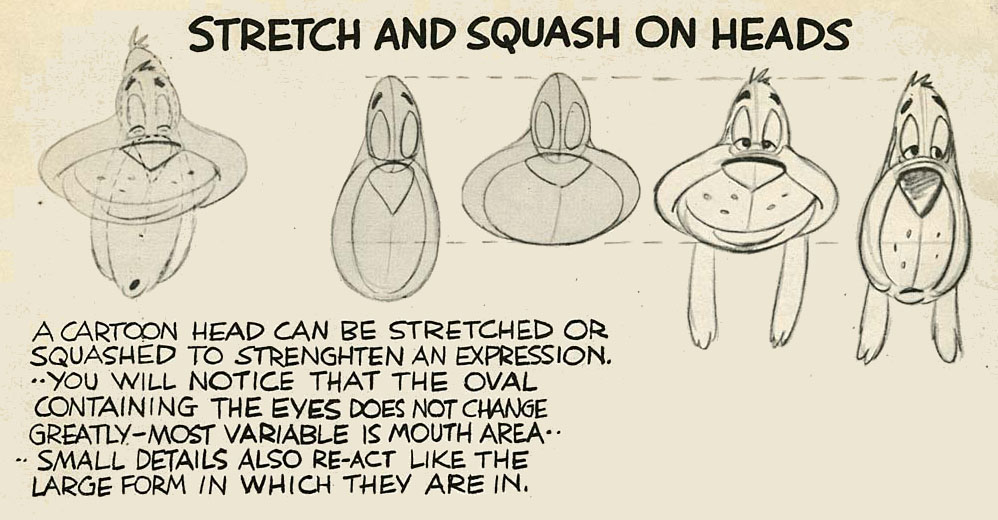 __________________________________________________
 I don't think it's enough to know just what the individual elements of an expression are. You need to know how they relate to each other. When one moves, it pushes or pulls everything else around it. All your expression elements are attached to each other. Your eyebrows are on your skin, your eyes are in your skull, your mouth is a hole that is surrounded by lip muscles that connect to the cheek muscles. And all these elements not only connect to each other and affect each others' positions when they move; they also have to wrap around the shape of the individual character's head. This is all so complicated that it explains why animated characters are generally simply constructed - like Mickey Mouse. The more complicated the shape of a head the more it magnifies the problems of wrapping an expression around it.
 Beaky Buzzard here is a more difficult construction than Donald Duck, and Rod Scribner has drawn a lot of extra details to add to his expression, but he has used construction, facial mechanics and solid drawing to make it all make sense. He already understands the basics and has moved on from there.
 Compare that to this sloppy Woody Woodpecker drawing. The expressions of Woody and the Owl are clear. The individual elements of the expression are operating-but they aren't connected to each other.


 These are very difficult specific expressions and they are tailored to the voice track. They aren't useful again for other characters and other situations. You can study in general how they work, but I wouldn't use them for another cartoon.


 Some animators have expressions - or their own stylistic variations on the basic expressions.

 One thing that animation and cartoons can do that real people can't is make impossible expressions. These would be limitless. Here's a famous one specific to Chuck Jones.
 Note that even though your eyes can't actually join in the center, these are still drawn with hierarchy and construction.
 They are stock animation expressions. The most common one today is probably 'TUDE. Stock animation expressions are fallbacks. They are automatically used when an animator is not actually thinking in terms of the characters having actual specific personalities. They are so ingrained in the animation world that most animators, even really good ones don't even realize they are relying on these instant formulas.


